Home
Class 11
PHYSICS
A rope thrown over a pulley has a on one...

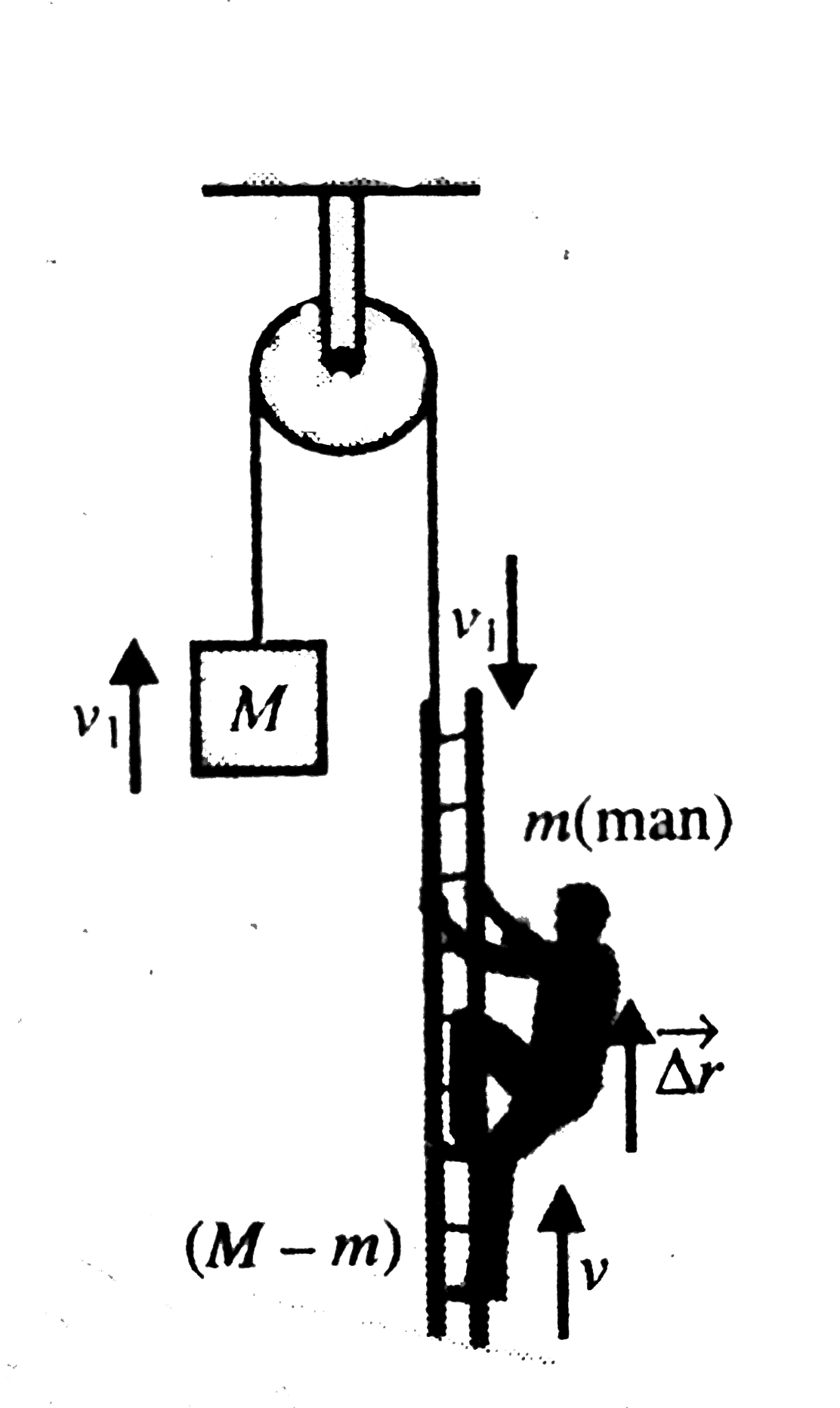
A rope thrown over a pulley has a on one of its ends and a counterbalancing mass `M` on its other end. The man whose mass is `m`, climbs upwards by `vec/_\r` relative to the ladder and then stops. Ignoring masses of the pulley and the rope, as well as the friction the pulley axis, find the displacement of the centre of mass of this system.

Text Solution

Verified by Experts
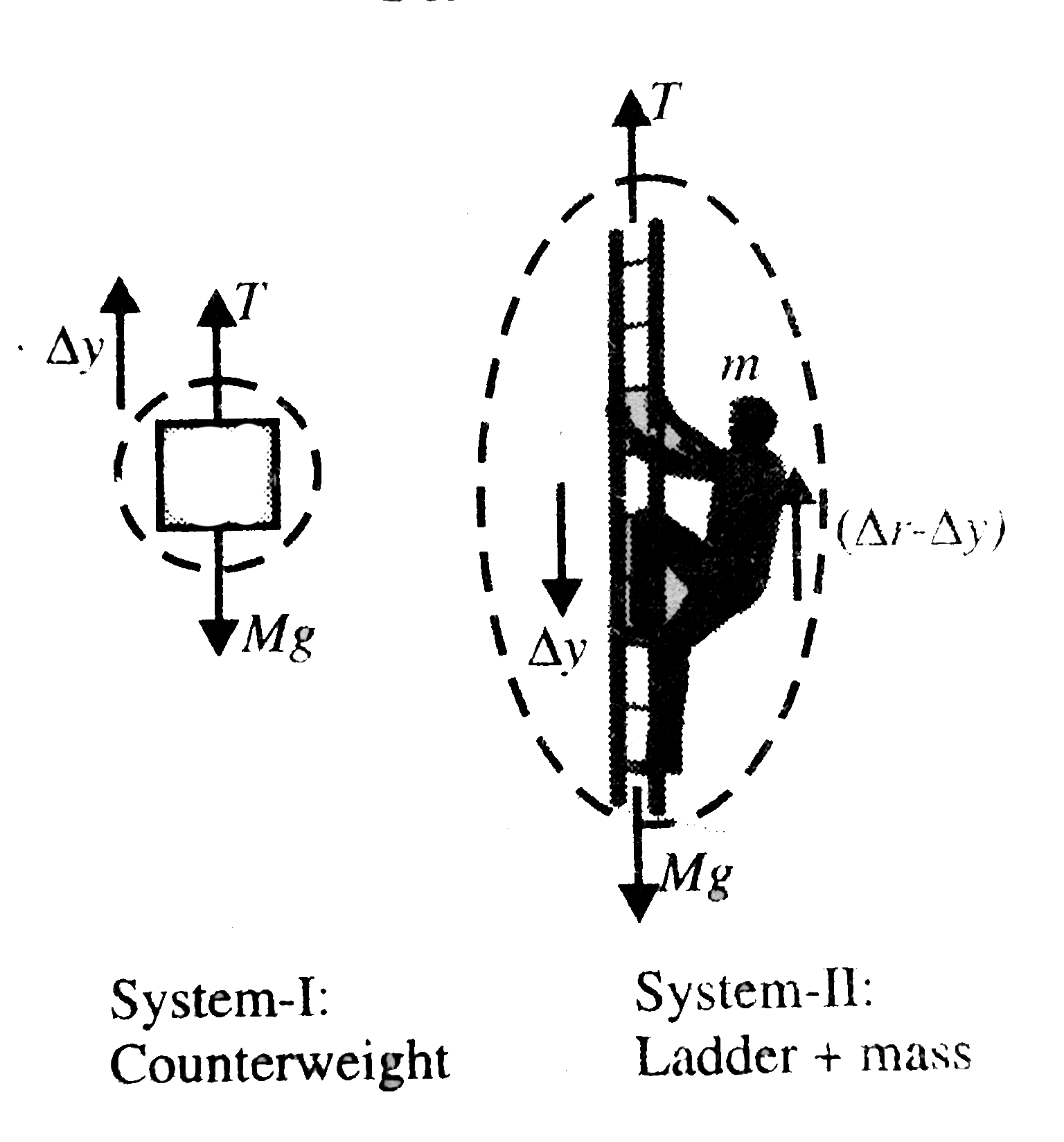
Let displacement of counterweight be `/_\y` therefore the dispacement of ladder will be `(-/_\y)`.
Displacement of man `/_\_(y_m)=/_\_(y_(m,l))+/_\_(y_l)`
`Y_(mj)=` displancement of man w.r.t of ladder `=/_\vecr`
`y_m=(/_\r-/_\y)`
Hence displacement of centre of mass of the system
`/_\vecr_c=(M_("mass")/_\vecr_("mass")M_("ladder")+/_\vecr_("ladder")+M_("mean")/_\vecr_("man"))/(M_("mass")+M_("ladder")+M_("man"))`
`/_\r_(c)=(M/_\y+(M-m)-(/_\y)+m(/_\r-/_\y))/(M+(M-m)+m)`
`implies /_\r_(c)=(m/_\r)/(2m)("upward")`
Method 2: All the bodies of the system are initially at rest. The rope tension is the same both as on the left and the right hand side, at every instant and consequently the momenta of the counterbalancing mass `(vecp_(1))` and the ladder with the Man `(vecp_(2))` are equal at any moment of time. i.e.,

`vecp_(1)=vecp_(2)`
or `Mvecv_(1)=mvecv+(M-M)vecv_(1)`............i
Here `vecv_(1)` and `vecv` are the velocities of the mass and the man respectively.
Velocity of man `vecv_("man") vecv_("man, ladder")+vecv_("ladder")=v'-v_(1)`...........ii
Where `vecv'` is the man's velocity relative of the ladder.
From eqn i and ii we obtain `vecv_(1)=(m/(2M))vecv'`
on the other hand the momentum of the centre of mass is
`vecp=vecp_(1)+vecp_(2)=2vecp_(1)`
or `2Mvecv_(C)=2M.vecv_(1)` or `vecv_(C)=vecv_(1)=(m/(2m))vecv'`
are finally the desired displacement is
`/_\vecr_(C)=intvecv_(C).dt=m/(2m)intvecv'dt=m/(2M)/_\vecr`
or displacement of centre of mass of system is
`/_\vecr_(C)=m/(2M)/_\vecr` As system I and system II both are having same mass and experiene equal force. Both starts from rest. hence displacement of centre of masses fo systems should be equal. As the system I has only one object, the diaplacement of the object will be same as the displascement of its centre of mass which is `/_\y` upward. hence the displacement of centre of mass of system II will so be `/_\y` upward
`(/_\vecy_(cm))_("systemI")=(/_\vecy_(cm))_("systemII")=/_\y("upward") `
`implies /_\y=(m(/_\r-/_\y)+(M-m)(-/_\y))/(m(M-m))`
`implies /_\y=(m/_\r)/(2M)("upward")`
Promotional Banner

Topper's Solved these Questions

  • CENTRE OF MASS

    CENGAGE PHYSICS|Exercise Exercise 1.1|20 Videos
  • CENTRE OF MASS

    CENGAGE PHYSICS|Exercise Exercise 1.2|23 Videos
  • CENTRE OF MASS

    CENGAGE PHYSICS|Exercise INTEGER_TYPE|1 Videos
  • CALORIMETRY

    CENGAGE PHYSICS|Exercise Solved Example|13 Videos
  • DIMENSIONS & MEASUREMENT

    CENGAGE PHYSICS|Exercise Integer|2 Videos

Similar Questions

Explore conceptually related problems

A rope thrown over a pulley has a ladder with a man of mass m on one of its ends and a counter balancing mass M on its other end. The man climbs with a velocity v_r relative to ladder. Ignoring the masses of the pulley and the rope as well as the friction on the pulley axis, the velocity of the centre of mass of this system is:

A stationary pulley carries a rope whose one end supports a ladder with a man and the other end the counterweight of mass M. The man of mass m climbs up a distance I^' with respect to the ladder and then stops. Neglecting the mass of the rope and the friction in the pulley axle, find the displacement I of the centre of inertia of this system.

A pulley fixed to the ceiling carries a thread with bodies of masses m_(1) and m_(2) attached at its ends. The masses of the pulley and thread are negligible, friction is absent. Find the acceleration of the centre of mass (a_("cm")) of this system.

A pulley fixed to the ceiling carries a thread with bodies of masses m_1 and m_2 attached to its ends. The masses of the pulley and the thread are negligible, friction is absent. Find the acceleration w_C of the centre of inertia of this system.

Find the acceleration of the block of mass m in the arrangement shown in the following figures. The masses of the pulleys and the threads, as well as the friction are assumed to be negligible.

A pulley fixed to the ceiling of an elevator car carries a thread whose ends are attached to the loads of masses 3m and m . The car starts gong up with acceleration g//s . Assuming the masses of the pulley and the thread, as well as friction, to be negligible, find the force exerted by the pulley on the ceiling of car.