Home
Class 11
PHYSICS
A small ball of mass m is projected with...

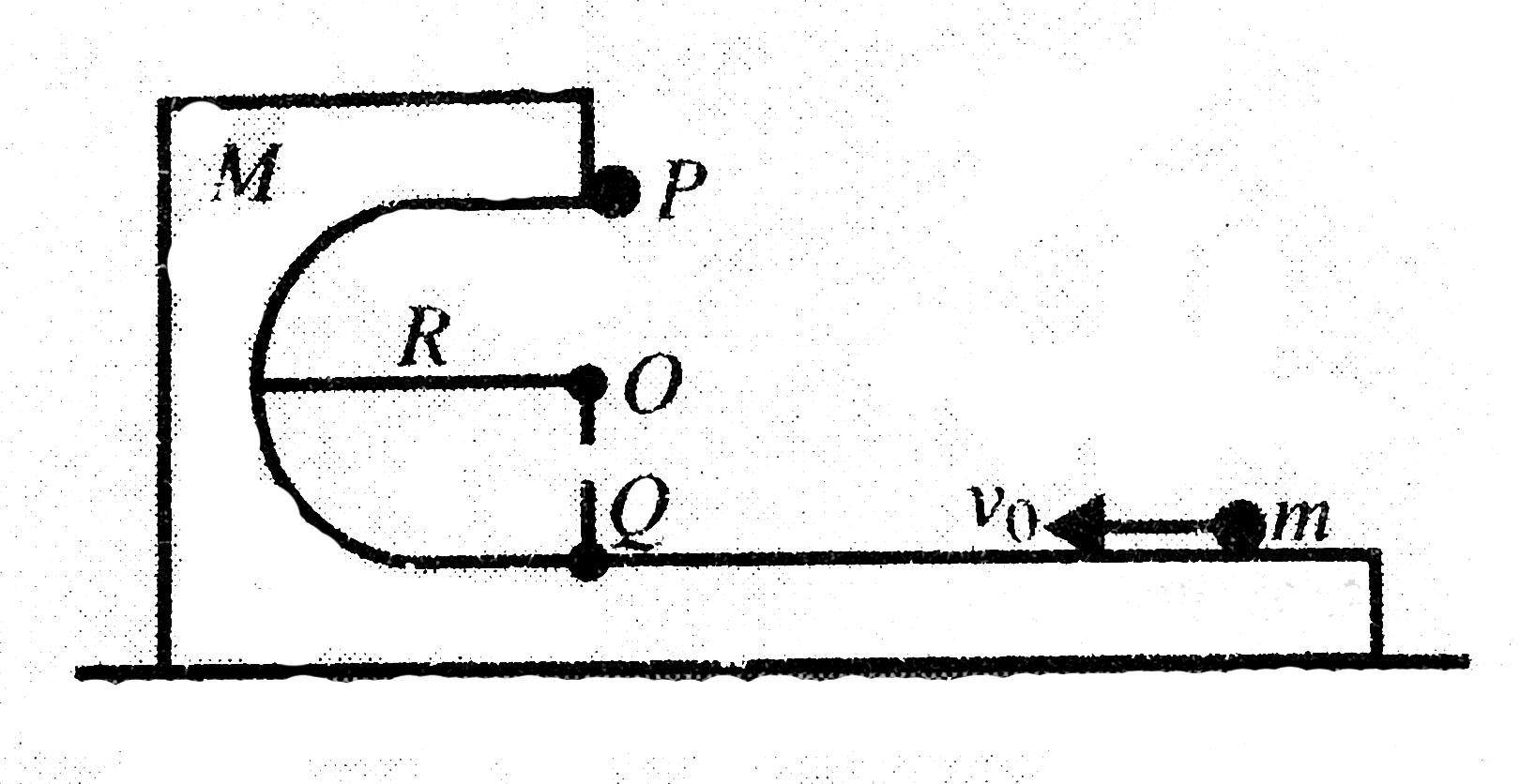
A small ball of mass `m` is projected with a minimum horizontal velocity `v_(0)` on a smooth wedge of mass `M` so that it will reach the highest point of the wedge. Find the value of `v_(0)`

Text Solution

Verified by Experts
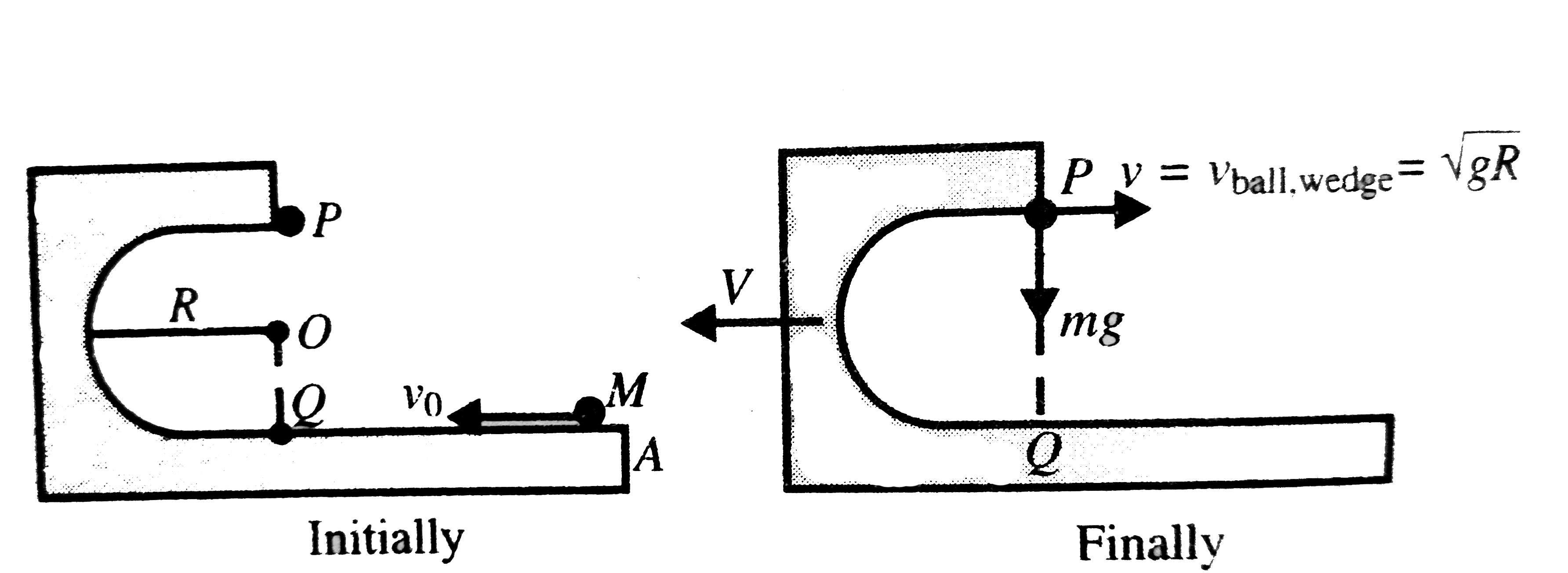

if the ball reaches at point `P`, the velocity of the ball with respect to wedge should be `sqrt(gR)`
using work energy theorem from centre of mass frame at `A` and the highest point `P` ltbr `W_(ext)+W_(int)+0=(/_\K)-(cm)`
`W_("gravity")=(/_\K)_(CM)`
`-mg(2R)=[1/2muv_(rel)^(2)]_("final")-[1/2muv_(rel)^(2)]_("initial")`
`-mg2R=1/2mu(V+v)^(2)-1/2muv_(0)^(2)`..............i
`mu=((mM)/(m+M))` and `v=sqrt(gR)`
As there is no external forces acting on the system in horizontal direction. the linear momentum of the system should be conserved.
i.e. `mv_(0)=m(V-v)+MV`
`V=(m(v_(0)+v))/((m+M))` ............ii
from eqn i and ii we get
`implies v_(0)=sqrt((5+(4m)/M))gR`
Promotional Banner

Topper's Solved these Questions

  • CENTRE OF MASS

    CENGAGE PHYSICS|Exercise Exercise 1.1|20 Videos
  • CENTRE OF MASS

    CENGAGE PHYSICS|Exercise Exercise 1.2|23 Videos
  • CENTRE OF MASS

    CENGAGE PHYSICS|Exercise INTEGER_TYPE|1 Videos
  • CALORIMETRY

    CENGAGE PHYSICS|Exercise Solved Example|13 Videos
  • DIMENSIONS & MEASUREMENT

    CENGAGE PHYSICS|Exercise Integer|2 Videos

Similar Questions

Explore conceptually related problems

A ball of mass m is projected with a velocity 'u' at angle theta with the horizontal. It collides with a smooth box of mass 'M' at its highest position. If the co-efficient of restitution is 'e' . Find the horizontal distance travelled by the ball before collision.

A ball of mass m is projected with a velocity 'u' at angle theta with the horizontal. It collides with a smooth box of mass 'M' at its highest position. If the co-efficient of restitution is 'e' . FInd the velocity of the ball after collision

A particle of mass m moving horizontal with v_(0) strikes a smooth wedge of mass M, as shown in figure. After collision, the ball starts moving up the inclined face of the wedge and rises to a height h. The final velocity of the wedge v_(2) is

A particle of mass m moving horizontal with v_(0) strikes a smooth wedge of mass M, as shown in figure. After collision, the ball starts moving up the inclined face of the wedge and rises to a height h. Choose the correct statement related to the wedge M

A particle of mass m moving horizontal with v_(0) strikes a smooth wedge of mass M, as shown in figure. After collision, the ball starts moving up the inclined face of the wedge and rises to a height h. When the particle has risen to a height h on the wedge, then choose the correct alternative(s)

A particle of mass m moving horizontal with v_(0) strikes a smooth wedge of mass M, as shown in figure. After collision, the ball starts moving up the inclined face of the wedge and rises to a height h. Suppose the particle when reaches the horizontal surfaces, its velocity with respect to ground is v_(1) and that of wedge is v2. Choose the correct statement (s)

A particle of mass m moving horizontal with v_(0) strikes a smooth wedge of mass M, as shown in figure. After collision, the ball starts moving up the inclined face of the wedge and rises to a height h. Choose the correct statement(s) related to particle m

A particle of mass m moving horizontal with v_(0) strikes a smooth wedge of mass M, as shown in figure. After collision, the ball starts moving up the inclined face of the wedge and rises to a height h. The maximum height h attained by the particle is

A particle of mass m moving horizontal with v_(0) strikes a smooth wedge of mass M, as shown in figure. After collision, the ball starts moving up the inclined face of the wedge and rises to a height h. Identify the correct statement(s) related to the situation when the particle starts moving downward

A shell of mass m is moving horizontally with velocity v_(0) and collides with the wedge of mass M just above points A, as shown in the figure. As a consequences, wedge starts to move towards left and the shell returns with a velocity in xy-plance. The principle of conservation of momentum can be applied for

