Home
Class 11
PHYSICS
A ball of mass m is pushed with a horizo...

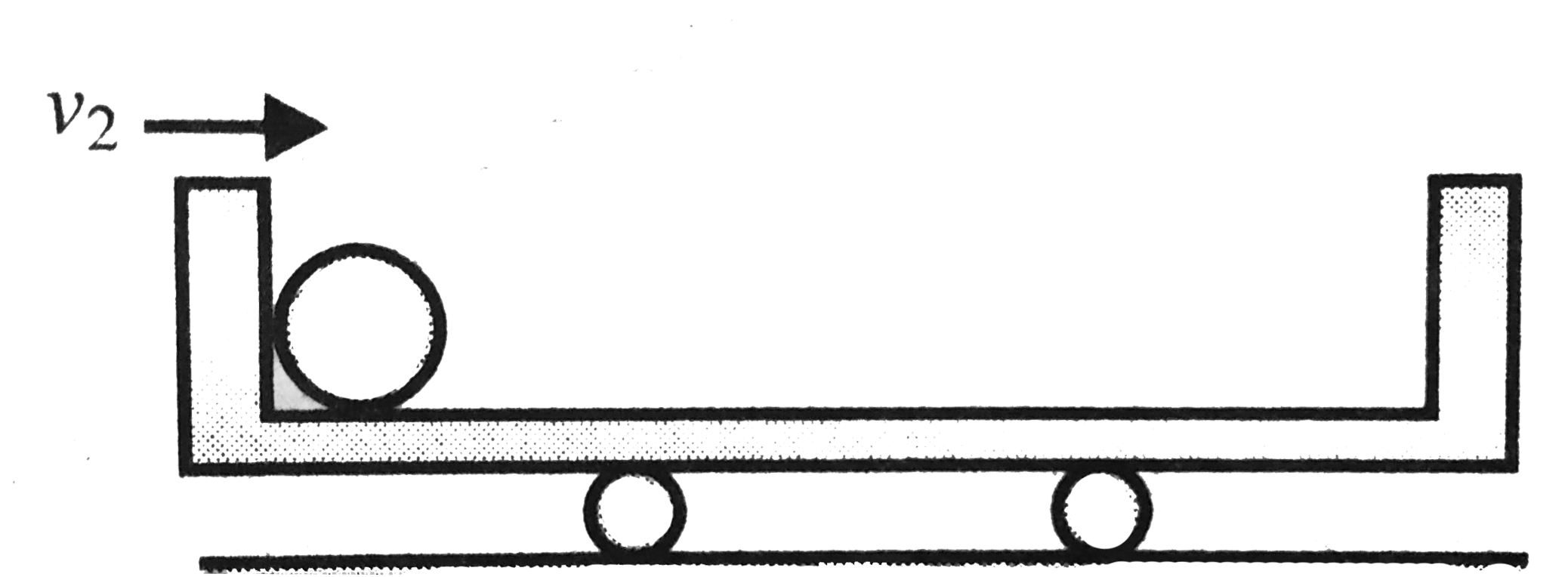
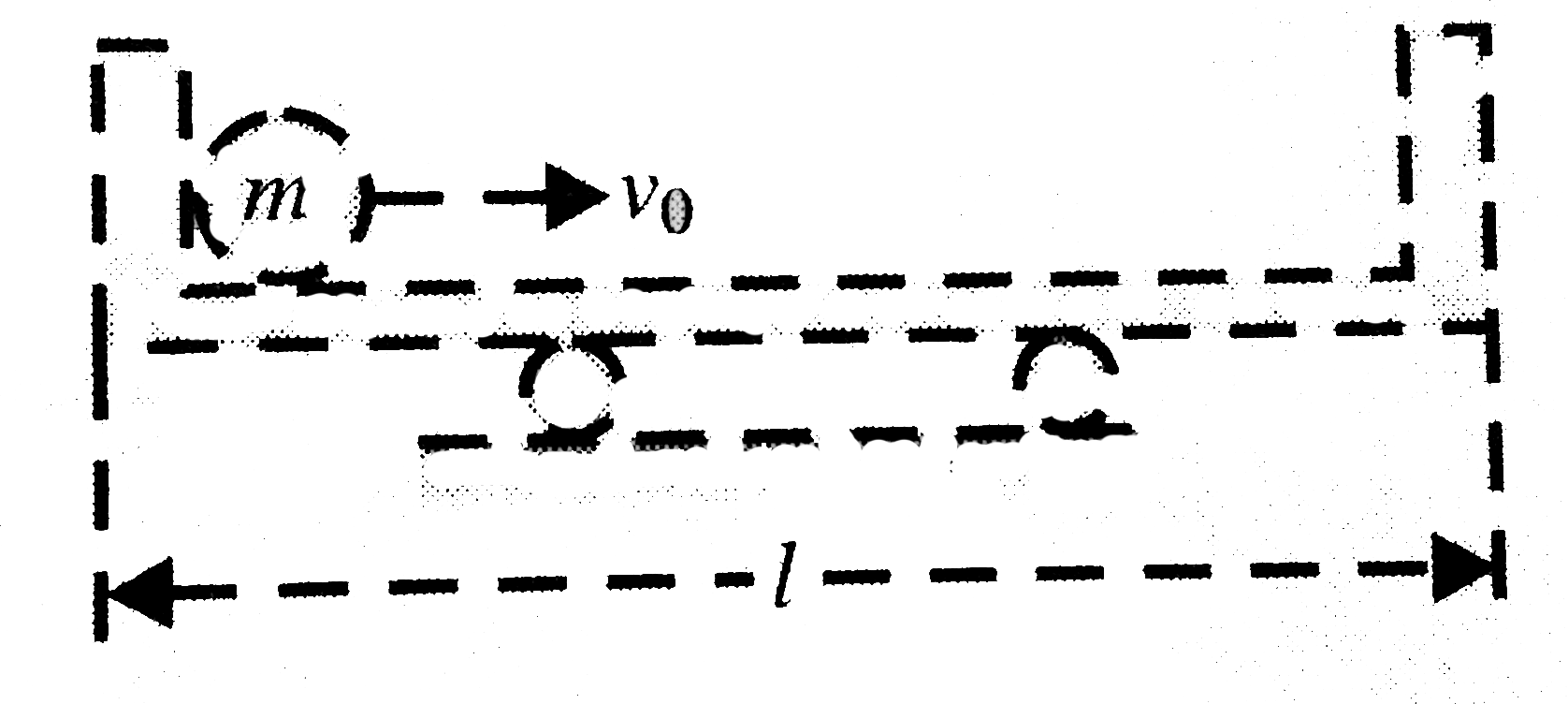
A ball of mass `m` is pushed with a horizontal velocity `v_(0)` from one end of a sledge of mass `M` and length `l`. if the ball stops after is first collision with the sledge, find the speeds of the ball ad sledge after the second collision of the ball with the sledge.

Text Solution

Verified by Experts
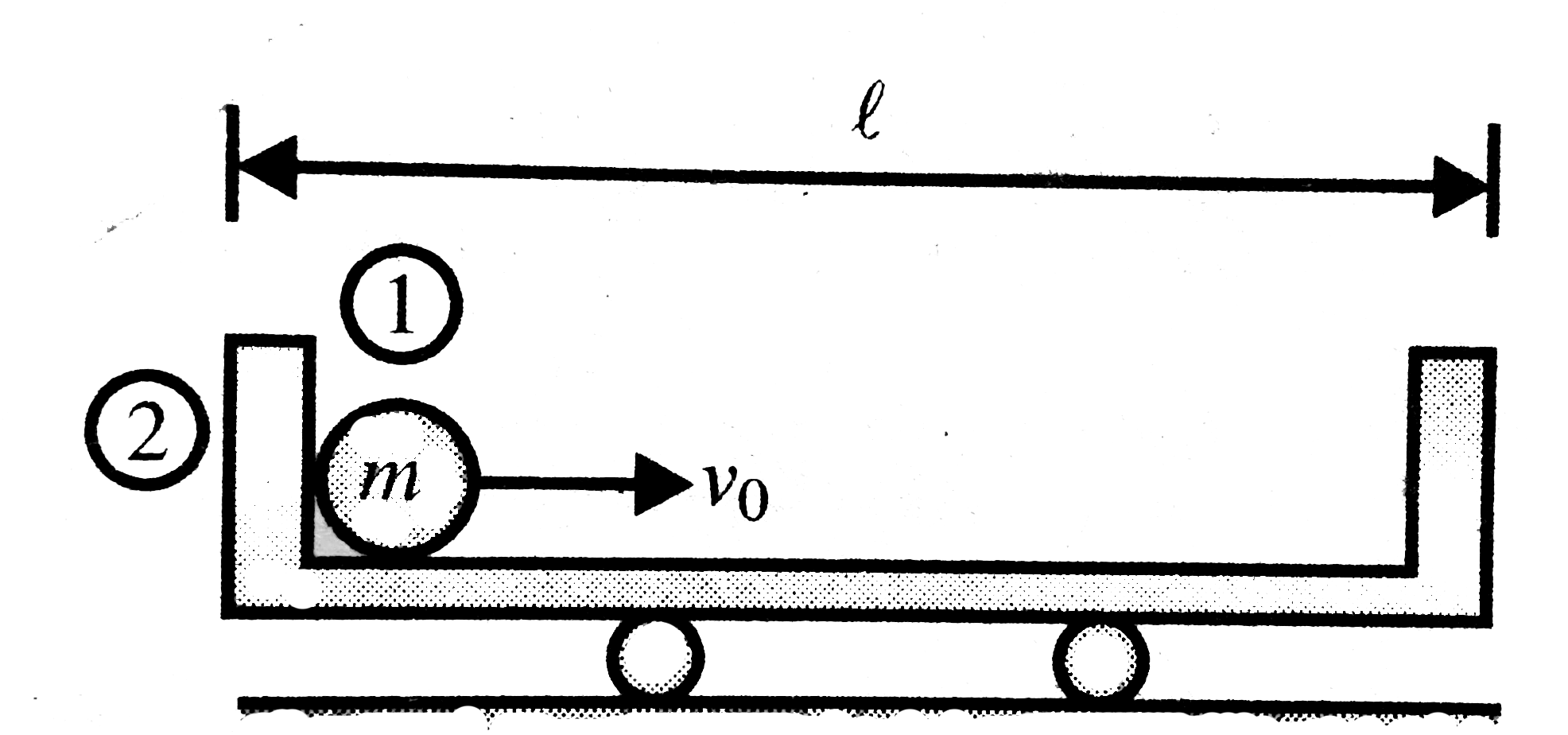
a. Using C.O.L.M, `Mv_(2)=mv_(0)` ………..i
Using Newton's restitution equation

`v_(2)-0=ev_(0)`
Here `m/Mv_(0)=ev_(0)`
which gives `e=m/M` ……….ii
Now the 2nd collisiion left wall the sledge and ball C.O.L.M.
`0+Mv_(2)=mv_(1)+MV_(2)^(')`
`M(m/Mv_(0))=mv_(1)+Mv_(2)^(')`
`implies mv_(1)+Mv_(2)^(')=mv_(0)`

Again using Newton's restitution law
`v_(2)^(')-v_(1)=e(0-m/Mv_(0))`
`v_(2)^(')-v_(1)=m/M(-m/Mv_(0))`
`v_(1)-v_(2)^(')=(m/M)v_(0)`..........iv
From eqn iii and iv we get
`v_(1)=(2v_(0))/((M+m))` and `v_(2)^(')=(mv_(0))/M((M-m)/(M+m))`
Promotional Banner

Topper's Solved these Questions

  • CENTRE OF MASS

    CENGAGE PHYSICS|Exercise Exercise 1.1|20 Videos
  • CENTRE OF MASS

    CENGAGE PHYSICS|Exercise Exercise 1.2|23 Videos
  • CENTRE OF MASS

    CENGAGE PHYSICS|Exercise INTEGER_TYPE|1 Videos
  • CALORIMETRY

    CENGAGE PHYSICS|Exercise Solved Example|13 Videos
  • DIMENSIONS & MEASUREMENT

    CENGAGE PHYSICS|Exercise Integer|2 Videos

Similar Questions

Explore conceptually related problems

Two small balls A and B each of mass m, are joined rigidly to the ends of a light rod of length L figure. The system translates on a frictionless horizontal surface with a velocity v_0 in a direction perpendicular to the rod. A particle P of mass kept at rest on the surface sticks to the ball A as the ball collides with it . Find a. the linear speeds of the balls A and B after the collision, b. the velocity of the centre of mass C of the system A+B+P and c. the angular speed of the system about C after the collision.

The first ball of mass m moving with the velocity upsilon collides head on with the second ball of mass m at rest. If the coefficient of restitution is e , then the ratio of the velocities of the first and the second ball after the collision is

A ball of mass m moving with a velocity v undergoes an oblique elastic collision with another ball of the same mass m but at rest. After the collision if the two balls move with the same speeds , the angle between their directions of motion will be:

Rod can rotate about hinge point 'P'. A ball of mass 'm' is projected with a velocity 5v_(0) in a gravity free space as shown in figure. Collision between the rod and the ball is perfectly elastic. Then find the magnitude of velocity of ball after the collision ( neglect the friction between the ball and the rod during the collision ).

A ball of mass m is projected with a velocity 'u' at angle theta with the horizontal. It collides with a smooth box of mass 'M' at its highest position. If the co-efficient of restitution is 'e' . FInd the velocity of the ball after collision

A ball of mass m moving with a constant velocity strikes against a ball of same mass at rest. If e= coefficient of restitution, then what will the the ratio of the velocities of the two balls after collision?

A ball is moving with velocity 2m//s towards a heavy wall moving towards the ball with speed 1m//s as shown in figure. Assuming collision to be elastic, find the velocity of ball immediately after the collision.

A ball of mass 'm' moving with a horizontal velocity 'v' strikes the bob of mass 'm' of a pendulum at rest. During this collision, the ball sticks with the bob of the pendulum. The height to which the combined mass raises is (g = acceleration due to gravity).