Home
Class 11
PHYSICS
Let there are three equal masses situate...

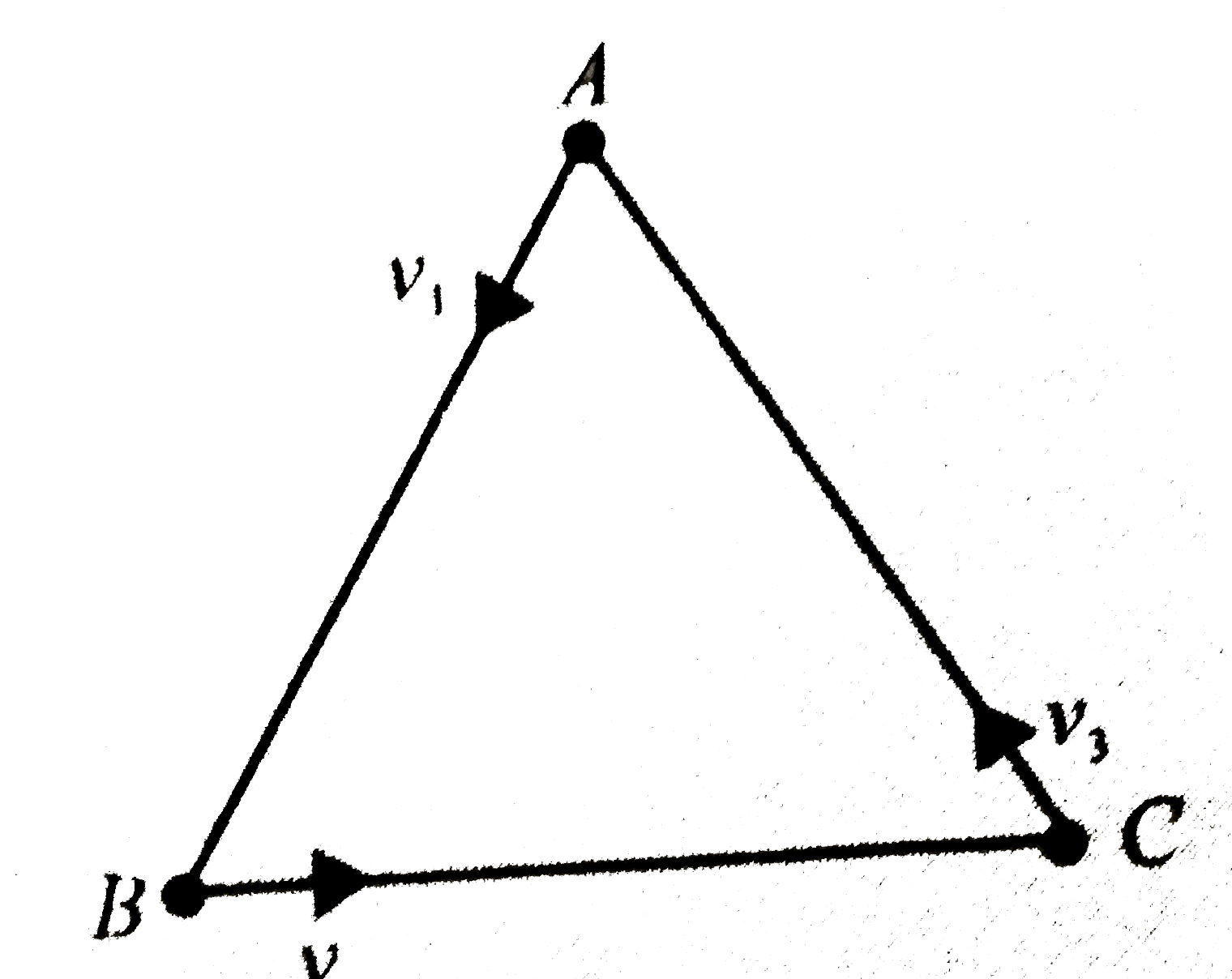
Let there are three equal masses situated at the vertices of an equilateral triangle, as shown in Fig. Now particle `A` starts with a velocity `v_(1)` towards line `AB`, particle `B` starts with the velocity `v_(2)`, towards line `BC` and particle `C` starts with velocity `v_(3)` towards line `CA`. Find the displacement of the centre of mass of the three particles `A, B` and `C` after time `t`. What would it be if `v_(1)=v_(2)=v_(3)`?

Text Solution

Verified by Experts

First we write the three velocities in vectorial form, taking right direction as positive `x`-axis and upwards as positive `y`-axis.
`vec_(1)=-1/2v_(1)hati-sqrt3/2v_(1)hatj`
`vecv_(2)=v_(2)hati, vecv_(3)=1/2v_(3)hati+sqrt3/2v_(3)hatj`
Thus the velocity of centre of mass of the system is
`vecv_(CM)=(vecv_(1)+vecv_(2)+vecv_(3))/3`
`=(v_(2)-1/2v_(1)-1/2v_(3))hati+sqrt3/2(v_(3)-v_(1))hatj` which can be written as `vecv_(CM)=v_(x)hati+v_(y)hatj`
Thus displacement of the centre of mass in time `t` is `/_\vecr=v_(x)thati+v_(y)thatj`
If `v_(1)=v_(2)=v_(3)=v` we have
`vecv_(CM)=0`
Therefore there is no displacement of centre of mass of the system.
Promotional Banner

Topper's Solved these Questions

  • CENTRE OF MASS

    CENGAGE PHYSICS|Exercise Exercise 1.2|23 Videos
  • CENTRE OF MASS

    CENGAGE PHYSICS|Exercise Exercise 1.3|24 Videos
  • CENTRE OF MASS

    CENGAGE PHYSICS|Exercise Solved Examples|13 Videos
  • CALORIMETRY

    CENGAGE PHYSICS|Exercise Solved Example|13 Videos
  • DIMENSIONS & MEASUREMENT

    CENGAGE PHYSICS|Exercise Integer|2 Videos

Similar Questions

Explore conceptually related problems

Three particles of equal masses are placed at the corners of an equilateral triangle as shown in the figure. Now particle A starts with a velocity v_(1) towards line AB , particle B starts with a velocity v_(2) towards line BC and particle C starts with velocity v_(3) towards line CA . The displacement of CM of three particle A, B and C after time t will be (given if v_(1)=v_(2)=v_(3))

Three particles A, B, Care located at the comers of an equilateral triangle as shown in figure. Each of the particle is moving with velocity v. Then at the instant shown, the relative angular velocity of

A particle moves with a velocity v(t)= (1/2)kt^(2) along a straight line . Find the average speed of the particle in a time t.

Two identical particles move towards each other with velocity 2v and v respectively. The velocity of centre of mass is

A particle of mass m has a velocity -v_(0) i , while a second particle of same mass has a velocity v_(0) j . After the particles collide, first particle is found to have a velocity (-1)/(2) v_(0) overline i then the velocity of othe particle is

Three particles A,B and C and situated at the vertices of an equilateral triangle ABC of side of length l at time t=0 ,Each of the particles move with constant speed u . A always has its velocity along AB, B along BC and C along CA .

Three particles A, B and C are situated at the vertices of an equilateral triangle ABC of side d at time t=0. Each of the particles moves with constant speed v. A always has its velocity along AB, B along BC and C along CA. At what time will the particles meet each other?

The acceleration of a particle varies with time t as a=t^(2)+t+2 where t is in seconds. The particle starts with an initial velocity v-3m/s at t=0. find the velocity of the particle at the end of 5s.

CENGAGE PHYSICS-CENTRE OF MASS-Exercise 1.1
  1. Two children A and B of same mass (including their caps) M are sitting...

    Text Solution

    |

  2. Figure shows a fixed wedge on which two blocks of masses 2 kg and 3 k...

    Text Solution

    |

  3. Consider a rectangular plate of dimensions axxb. If this plate is cons...

    Text Solution

    |

  4. There are two masses m(1) and m(2), placed at a distance l apart, let ...

    Text Solution

    |

  5. Let there are three equal masses situated at the vertices of an equila...

    Text Solution

    |

  6. Figure shows a flat car of mass M on a frictionless road. A small mass...

    Text Solution

    |

  7. Figure shows two blocks of masses 5 kg and 2 kg placed on a frictionle...

    Text Solution

    |

  8. Two blocks of masses m(1) and m(2), connected by a weightless spring o...

    Text Solution

    |

  9. Mr. Verma (50kg) and Mr. Mathur (60kg) are sitting at the two extremes...

    Text Solution

    |

  10. A cart of mass M is at rest on a frictionless horizontal surface and a...

    Text Solution

    |

  11. Find the displacement of the wedge when m comes out of the wedge. Ther...

    Text Solution

    |

  12. A block of mass m is initially lying on a wedge of mass M with an angl...

    Text Solution

    |

  13. Calculate the displacement of the wedge when the hall reaches at the b...

    Text Solution

    |

  14. A block is released on the convex surface of a hemispherical wedge as ...

    Text Solution

    |

  15. Two masses, m(1) and m(2) , are moving with velocities v(1) and v(2). ...

    Text Solution

    |

  16. Figure shows the system is at rest initially with x = 0, A man and a ...

    Text Solution

    |

  17. A 30 kg projectile moving horizontally with a velocity vecv(0)=(120m//...

    Text Solution

    |

  18. Two 20 kg cannon balls are chained together and fired horizontally wit...

    Text Solution

    |

  19. A juggler juggles three balls in a continuous cycle. Any one ball is i...

    Text Solution

    |

  20. A cannon and a supply of cannon balls are inside a sealed rail road ca...

    Text Solution

    |
