Home
Class 11
PHYSICS
A cannon and a supply of cannon balls ar...

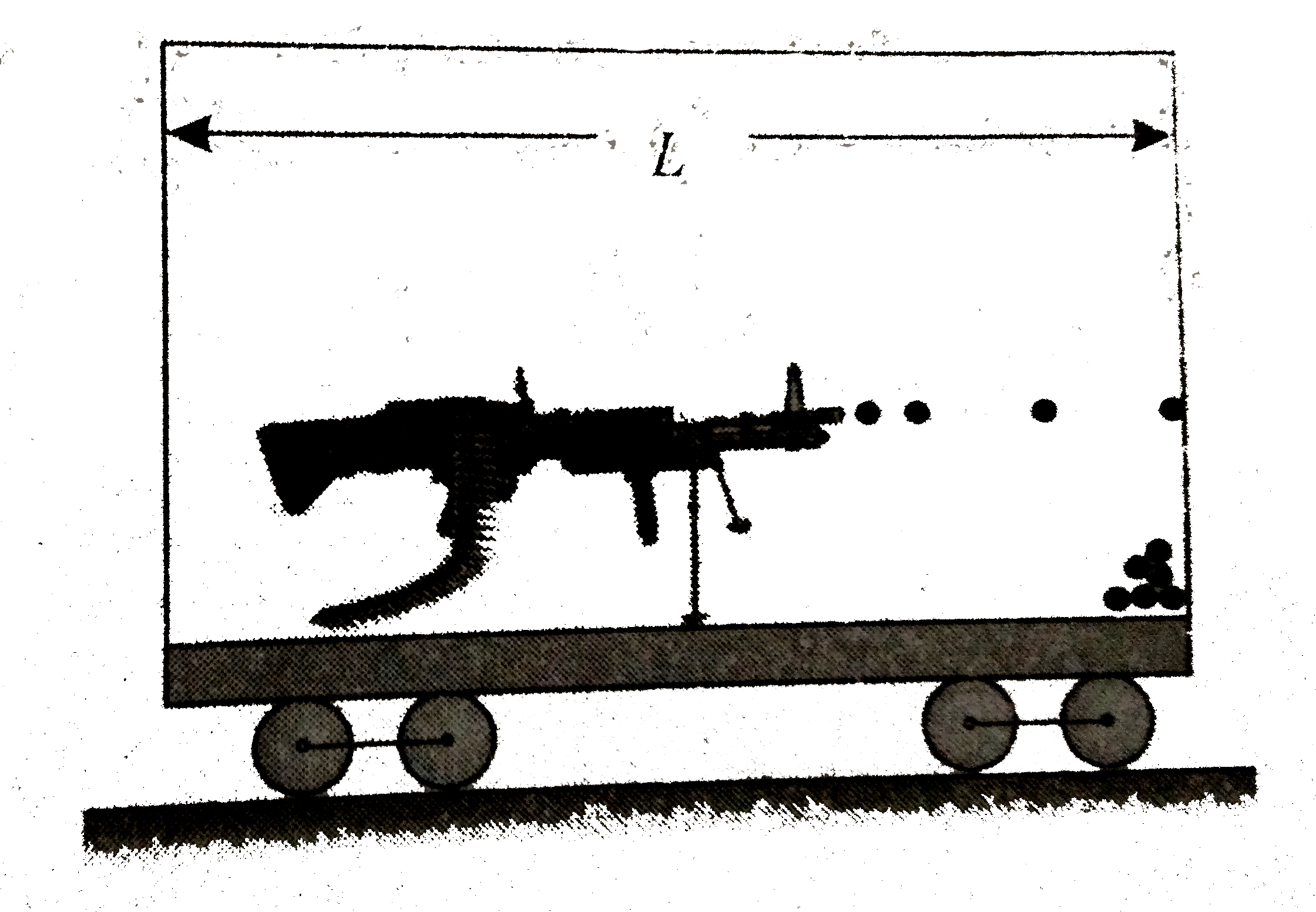
A cannon and a supply of cannon balls are inside a sealed rail road car. The cannon fires to the right, the car recoils to the left. The canon balls remain in the car after hitting the far wall. Show that no matter how the cannon balls are fired, the rail road car cannot travel more than `L`. assuming it starts from rest.

Text Solution

Verified by Experts

Initially, the whole system is at rest, so `v_(CM)=0`. As there is no external force acting on the system`vecv_(CM)=`constant `= 0`. So position of centre of mass of system remains fixed.
`x_(CM)=(mx_(1)+Mx_(2))/(m+M)`…………i
where in is mass of the cannon balls and `M` that of the (car `+` cannon) system.
`As /_\x_(CM)=0` therefore
`m/_\x_(1)+m/_\x_(2)=0`.....ii
As cannon balls cannot leave the car, so maximum displacement of the balls relative to the car is `L` and in doing so the car will shift a distance `/_\x_(2)=D`(say) relative to the ground, opposite to the displacement of the balls, then the displacement of balls relative to ground will be
`/_\x_(1)=L-D`.........iii
Substituting the value of `/_\x_(1)` from eqn iii in eqn ii we get
`m(L-D)-MD=0`
`impliesD=(mL)/(M+m)=L/(1+M/m)`
`implies DltL`
i.e. rail road car cannot travel more than `L`,
Promotional Banner

Topper's Solved these Questions

  • CENTRE OF MASS

    CENGAGE PHYSICS|Exercise Exercise 1.2|23 Videos
  • CENTRE OF MASS

    CENGAGE PHYSICS|Exercise Exercise 1.3|24 Videos
  • CENTRE OF MASS

    CENGAGE PHYSICS|Exercise Solved Examples|13 Videos
  • CALORIMETRY

    CENGAGE PHYSICS|Exercise Solved Example|13 Videos
  • DIMENSIONS & MEASUREMENT

    CENGAGE PHYSICS|Exercise Integer|2 Videos

Similar Questions

Explore conceptually related problems

A cannon-ball is fired with a speed 50 m//sec with respect to ground from one end of a stationary railroad car which rests on a smooth track. The ball collides with opposite wall and stops. How much distance did the railroad car cover just before the collision? Given that the ratio of the mass of the ball to that of the railroad car is 1//99 and the length of the car is 50m

A car starts from rest on a half kilometer long bridge. The coefficiet of friction between the tyre and the road is 1.0. Show that one cannot drive thrugh the bridge in less than 10 s.

A car P is moving with a uniform speed 5sqrt3 m//s towards a carriage of mass 9 kg at rest kept on the rails at a point B as shown in figure. The height AC is 120 m. Cannon balls of 1 kg are fired from the car with an initial velocity 100m//s at an angle 30^@ with the horizontal. The first cannon hall hits the stationary carriage after a time t_0 and sticks to it. Determine t_0 . At t_0 , the second cannon ball is fired. Assume that the resistive force between the rails and the carriage is constant and ignore the vertical motion of the carriage throughout. If the second ball also hits and sticks to the carriage, what will be the horizontal velocity of the carriage just after the second impact?

In a car race, car A takes a time t less than car B at the finish and passes the finishing point with speed v more than that of the car B. Assuming that both the cars start from rest and travel with constant acceleration a_1 and a_2 respectively. Show that v=sqrt (a_1 a_2) t.

A physical quantity is a phyical property of a phenomenon , body, or substance , that can be quantified by measurement. The magnitude of the components of a vector are to be considered dimensionally distinct. For example , rather than an undifferentiated length unit L, we may represent length in the x direction as L_(x) , and so forth. This requirement status ultimately from the requirement that each component of a physically meaningful equation (scaler or vector) must be dimensionally consistent . As as example , suppose we wish to calculate the drift S of a swimmer crossing a river flowing with velocity V_(x) and of widht D and he is swimming in direction perpendicular to the river flow with velocity V_(y) relation to river, assuming no use of directed lengths, the quantities of interest are then V_(x),V_(y) both dimensioned as (L)/(T) , S the drift and D width of river both having dimension L. with these four quantities, we may conclude tha the equation for the drift S may be written : S prop V_(x)^(a)V_(y)^(b)D^(c) Or dimensionally L=((L)/(T))^(a+b)xx(L)^(c) from which we may deduce that a+b+c=1 and a+b=0, which leaves one of these exponents undetermined. If, however, we use directed length dimensions, then V_(x) will be dimensioned as (L_(x))/(T), V_(y) as (L_(y))/(T), S as L_(x)" and " D as L_(y) . The dimensional equation becomes : L_(x)=((L_(x))/(T))^(a) ((L_(y))/(T))^(b)(L_(y))^(c) and we may solve completely as a=1,b=-1 and c=1. The increase in deductive power gained by the use of directed length dimensions is apparent. From the concept of directed dimension what is the formula for a range (R) of a cannon ball when it is fired with vertical velocity component V_(y) and a horizontal velocity component V_(x) , assuming it is fired on a flat surface. [Range also depends upon acceleration due to gravity , g and k is numerical constant]

A man standing on a long rail road car throws a ball vertically upward with speed 20 m//s . The car starts from rest and moves with acceleration 2 m//s^(2) . How far behind the man will the ball fall on the car ?

CENGAGE PHYSICS-CENTRE OF MASS-Exercise 1.1
  1. Two children A and B of same mass (including their caps) M are sitting...

    Text Solution

    |

  2. Figure shows a fixed wedge on which two blocks of masses 2 kg and 3 k...

    Text Solution

    |

  3. Consider a rectangular plate of dimensions axxb. If this plate is cons...

    Text Solution

    |

  4. There are two masses m(1) and m(2), placed at a distance l apart, let ...

    Text Solution

    |

  5. Let there are three equal masses situated at the vertices of an equila...

    Text Solution

    |

  6. Figure shows a flat car of mass M on a frictionless road. A small mass...

    Text Solution

    |

  7. Figure shows two blocks of masses 5 kg and 2 kg placed on a frictionle...

    Text Solution

    |

  8. Two blocks of masses m(1) and m(2), connected by a weightless spring o...

    Text Solution

    |

  9. Mr. Verma (50kg) and Mr. Mathur (60kg) are sitting at the two extremes...

    Text Solution

    |

  10. A cart of mass M is at rest on a frictionless horizontal surface and a...

    Text Solution

    |

  11. Find the displacement of the wedge when m comes out of the wedge. Ther...

    Text Solution

    |

  12. A block of mass m is initially lying on a wedge of mass M with an angl...

    Text Solution

    |

  13. Calculate the displacement of the wedge when the hall reaches at the b...

    Text Solution

    |

  14. A block is released on the convex surface of a hemispherical wedge as ...

    Text Solution

    |

  15. Two masses, m(1) and m(2) , are moving with velocities v(1) and v(2). ...

    Text Solution

    |

  16. Figure shows the system is at rest initially with x = 0, A man and a ...

    Text Solution

    |

  17. A 30 kg projectile moving horizontally with a velocity vecv(0)=(120m//...

    Text Solution

    |

  18. Two 20 kg cannon balls are chained together and fired horizontally wit...

    Text Solution

    |

  19. A juggler juggles three balls in a continuous cycle. Any one ball is i...

    Text Solution

    |

  20. A cannon and a supply of cannon balls are inside a sealed rail road ca...

    Text Solution

    |
