Home
Class 11
PHYSICS
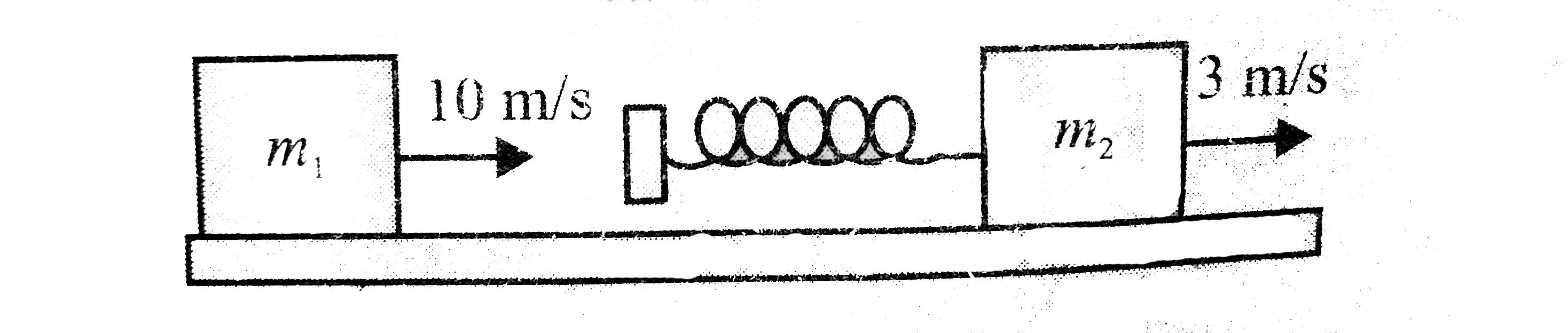
Two blocks of masses m(1) = 2 kg and m(2...

Two blocks of masses `m_(1) = 2 kg` and `m_(2) = 5` kg are moving in the same direction along a frictionless surface with speeds `10 m//s` and `3 m//s`, respectively, `m_(2)` being ahead of `m_(1)`. An ideal spring with `k = 1120 N//m` is attached to the back side of `m_(2)`. Find the maximum compression of the spring when the blocks collide. What are the final velocities of the blocks when they separate?

Text Solution

Verified by Experts

Form conservation of momentum
`v=(m_(1)v_(1)+m_(2)v_(2))/(m_(1)+m_(2))=5m//s`
conservationof energy
`1/2m_(1)v_(1)^(2)+1/2m_(2)v_(2)^(2)=1/2(m_(1)+m_(2))v^(2)+1/2kx^(2)`
`implies kx^(2)=(m_(1)v_(1)^(2)+m_(2)v_(2)^(2)-(m_(1)-m_(2))v^(2))/k`
`implies x=sqrt(40/1120)=0.25m`
when the blocks have equa speeds, spring has maximum commpression. after his instasnt,the spring againexpands, and after sometimes `m_(1)` loses contact with the spring.
Let `v_(1)` and `v_(2)` be the velocities of the blocks after they lose contact.
`m_(1)u_(1)+m_(2)u_(2)=m_(1)v_(1)+m_(2)u_(2)`
and `v_(1)-v_(2)=-1(u_(1)-u_(2))`
`[e=1,` because there is no loss in `KE`]
Solving for `v_(1)` and `v_(2)` we get
`v_(1)=0m//s` and `v_(2)=7m//s`
Promotional Banner

Topper's Solved these Questions

  • CENTRE OF MASS

    CENGAGE PHYSICS|Exercise Exercise 1.3|24 Videos
  • CENTRE OF MASS

    CENGAGE PHYSICS|Exercise Subjective|23 Videos
  • CENTRE OF MASS

    CENGAGE PHYSICS|Exercise Exercise 1.1|20 Videos
  • CALORIMETRY

    CENGAGE PHYSICS|Exercise Solved Example|13 Videos
  • DIMENSIONS & MEASUREMENT

    CENGAGE PHYSICS|Exercise Integer|2 Videos

Similar Questions

Explore conceptually related problems

Two blocks of masses m_(1)= 2 kg and m_(2) = 4 kg are moving in the same direction with speeds v_(1) = 6 m//s and v_(2) = 3 m//s , respectively on a frictionless surface as shown in the figure. An ideal spring with spring constant k = 30000 N//m is attached to the back side of m_(2) . Then the maximum compression of the spring after collision will be

Two blocks of mass m_(1) and m_(2) , resting on a frictionless table, are connected by a stretched spring and then released -

A block of mass m_(1) =2 kg slides along a firictionless table with a speed of 10m // s. Directly infront of it,and moving in the same direction is a block of mass m_(2) 5 kg moving at 3 m // s. A mass less spring with a spring constant 11.2 N // cm is attached to as shown in figure-5.146. When the block collide,what is the maximum compression of the spring ? Assume that the spring does not bend.

A block of mass 2kg slides on a frictionless table with with a speed of 10 ms^(-1) . Directly in front of it and moving in the same direction is a block of mass 5 kg moving at 3 ms^(-1) . A massless spring with force constant k = 1120 Nm^(-1) is attached to its back (the side facing 2 kg mass) When the blocks collide, what is the maximum compression of the spring ? [Hint : Apply 'work energy' theorem to the system of block and principle of conservation of momentum]

Two blocks of masses 1 kg and 3 kg are moving with velocities 2 m//s and 1 m//s , respectively , as shown. If the spring constant is 75 N//m , the maximum compression of the spring is

Two blocks of masses m_(1) =1kg and m_(2) = 2kg are connected by a spring of spring constant k = 24 N/m and placed on a frictionless horizontal surface. The block m_(1) is imparted an initial velocity v_(0) = 12cm/s to the right. The amplitude of osciallation is

Each of the blocks shown in figure has mass 1 kg. The rear block moves with a speed of 2 m/s towards the front block kept at rest. The spring attached to the front block islight and has a spring constant 50 N/m. find the maximum compression of the spring.

A block of mass 2 kg is moving on a frictionless horizontal surface with a velocity of 1m//s towards another block of equal mass kept at rest. The spring constant of the spring fixed at one end is 100 N//m. Find the rnaximum compression of the spring

Two smooth blocks of mases m_(1) and m_(2) attached with an ideal spring of stiffness k and kept on hrozontal surface. If m_(1) is projected with a horizontal velocity v_(0) . Find the maximum compression of the spring.

Two blocks of mass 2kg and 5kg are given speed as shown in the figure. System is lying on a frictionless surface and the blocks are connected by a massless spring if spring constant 35 N/m . Find the maximum compression in the spring.

CENGAGE PHYSICS-CENTRE OF MASS-Exercise 1.2
  1. Discuss the possibility of conservation of linear momentum of a block ...

    Text Solution

    |

  2. A shell is fired from a cannon with a speed of 100 m//s at an angle 30...

    Text Solution

    |

  3. Figure shows a block A of mass 6 m having a smooth semicircular groove...

    Text Solution

    |

  4. Two friends A and B (each weighing 40 kg) are sitting on a frictionles...

    Text Solution

    |

  5. A smooth wedge of mass M rests on a smooth horizontal surface. A block...

    Text Solution

    |

  6. Two identical buggies 1 and 2 with one man in each move along parallel...

    Text Solution

    |

  7. In Fig. a man stands on a boat floating in still water. The mass of t...

    Text Solution

    |

  8. Two blocks of masses m(1) = 2 kg and m(2) = 5 kg are moving in the sam...

    Text Solution

    |

  9. An 80 kg boy and his 40 kg sister, both wearing roller blades, face ea...

    Text Solution

    |

  10. Two blocks of masses M and 3M are placed on a horizontal, frictionless...

    Text Solution

    |

  11. A pendulum bob of mass 10^-2kg is raised to a height 5xx10^-2m and the...

    Text Solution

    |

  12. A rifle man, who together with his rifle has a mass of 100 kg, stands ...

    Text Solution

    |

  13. A projectile of mass 50 kg is shot vertically upwards with an initial ...

    Text Solution

    |

  14. a. A rail road flat car of mass M can roll without friction along a st...

    Text Solution

    |

  15. a. A rail road car of mass M is moving without friction on a straight ...

    Text Solution

    |

  16. A shell of mass 2 kg moving at a rate of 4 m//s suddenly explodes into...

    Text Solution

    |

  17. A mud ball at rest explodes into three fragmennts of masses in the rag...

    Text Solution

    |

  18. A hemisphere of radius R and of mass 4m is free to Slide with its base...

    Text Solution

    |

  19. A gun (mass = M) fires a bullet (mass = m) with speed v(r) relative to...

    Text Solution

    |

  20. Two trolleys A and B are free to move on a level frictionless track, a...

    Text Solution

    |
