Home
Class 11
PHYSICS
A ball of mass 'm' moving with speed 'u'...

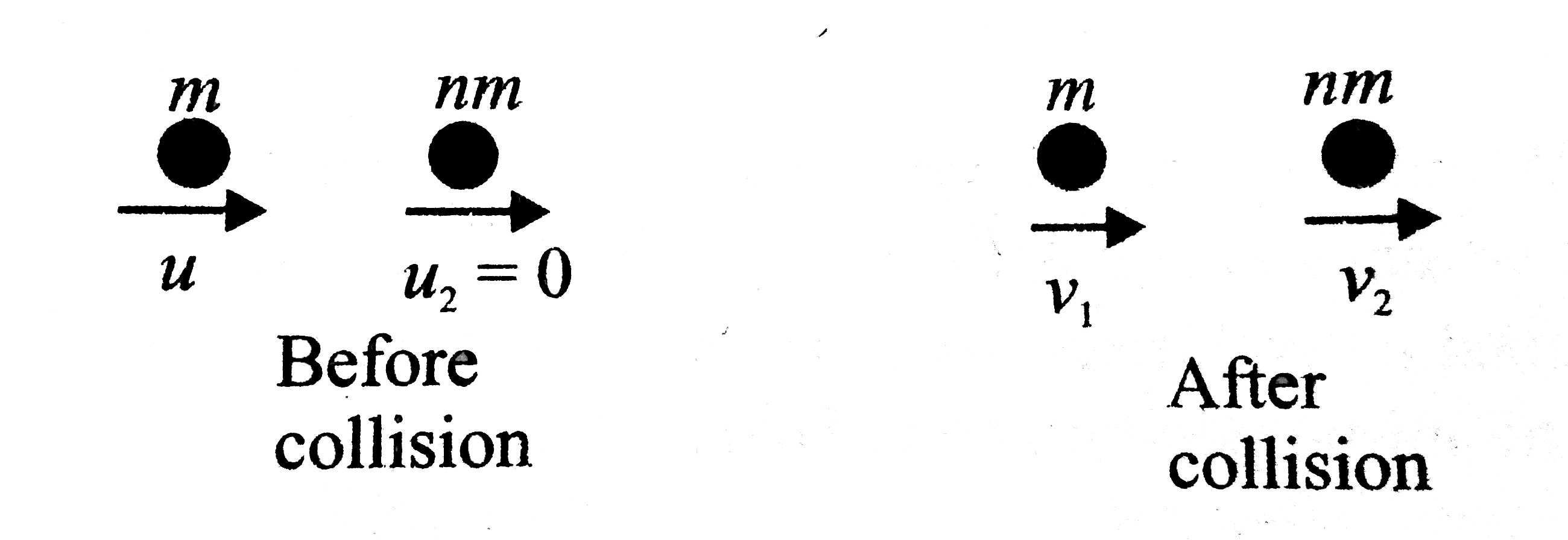
A ball of mass 'm' moving with speed 'u' undergoes a head-on elastic collision with a ball of mass 'nm' initially at rest. Find the fraction of the incident energy transferred to the second ball.

A

`n/(1+n)`

B

`n/((1+n)^(2))`

C

`(2n)/((1+n)^(2))`

D

`(4n)/((1+n)^(2))`

Text Solution

Verified by Experts

The correct Answer is:
D

As the collision in elastic we can find
`v_(1)=(1-n)/(1+n)u, v_(2)=(2u)/(1+n)`

Hence the required fraction i
`(1/2nmv_(2)^(2))/(1/2"mu"^(2))=n(v_(2)/u)^(2)=(4n)/((1+n)^(2))`
Promotional Banner

Topper's Solved these Questions

  • CENTRE OF MASS

    CENGAGE PHYSICS|Exercise Multiple Correct|25 Videos
  • CENTRE OF MASS

    CENGAGE PHYSICS|Exercise Assertion - Reasoning|2 Videos
  • CENTRE OF MASS

    CENGAGE PHYSICS|Exercise Subjective|23 Videos
  • CALORIMETRY

    CENGAGE PHYSICS|Exercise Solved Example|13 Videos
  • DIMENSIONS & MEASUREMENT

    CENGAGE PHYSICS|Exercise Integer|2 Videos

Similar Questions

Explore conceptually related problems

A body of mass m_(1) moving at a constant speed undergoes an elastic head on collision with a body of mass m_(2) initially at rest. The ratio of the kinetic energy of mass m_(1) after the collision to that before the collision is -

A neutron moving at a speed v undergoes a head-on elastic collision with a nucleus of mass number A at rest. The ratio of the kinetic energies of the neutron after and before collision is :

A moving body of mass m makes a head on elastic collision with another body of mass 2m which is initially at rest. Find the fraction of kinetic energy lost by the colliding particles after collision.

A ball of mass m moving with a velocity v undergoes an oblique elastic collision with another ball of the same mass m but at rest. After the collision if the two balls move with the same speeds , the angle between their directions of motion will be:

A body of mass M moving with a speed u has a ‘head on’, perfectly elastic collision with a body of mass m initially at rest. If M > > m , the speed of the body of mass m after collision, will be nearly :

A ball of 4 kg mass moving with a speed of 3ms^(-1) has a head on elastic collision with a 6 kg mass initially at rest. The speeds of both the bodies after collision are respectively

A ball of mass m makes head-on elastic collision with a ball of mass urn which is initially at rest. Show that the fractional transfer of energy by the first ball is 4n/(1 + n)^(2) . Deduce the value of n for which the transfer is maximum.

A ball of mass m moving at a speed v makes a head on inelastic collision with an identical ball at rest. The kinetic energy of the balls after the collision is 3/4th of the original. Find the coefficient of restitution.

A ball of mass m moving with velocity V , makes a head on elastic collision with a ball of the same moving with velocity 2 V towards it. Taking direction of V as positive velocities of the two balls after collision are.

A ball of mass 1kg moving with a velocity of 15m // s undergoes a head on elastic collision with another ball of unknown mass at rest, and rebound with a velocity of 10m//s . What is the mass of the other ball?

CENGAGE PHYSICS-CENTRE OF MASS-Single Correct
  1. In Fig., a hollow tube of mass M is free in horizontal direction. The ...

    Text Solution

    |

  2. A particle of mass m travelling with velocity v and kinetic energy E c...

    Text Solution

    |

  3. A ball of mass 'm' moving with speed 'u' undergoes a head-on elastic c...

    Text Solution

    |

  4. A trolley was moving horizontally on a smooth ground with velocity v w...

    Text Solution

    |

  5. In a figure shown mass of A and B is equal to M each. Friction between...

    Text Solution

    |

  6. Two blocks of masses in and 4m lie on a smooth horizontal surface conn...

    Text Solution

    |

  7. A vessel at rest explodes breaking it into three pieces. Two pieces ha...

    Text Solution

    |

  8. A stationary body of mass 3 kg explodes into three equal pieces. Two o...

    Text Solution

    |

  9. A ball of mass in collides horizontally with a stationary wedge on a r...

    Text Solution

    |

  10. A body is hanging from a rigid support. by an inextensible string of l...

    Text Solution

    |

  11. A ball is let fall from a height h(0). There are n collisions with the...

    Text Solution

    |

  12. A body X with a momentum p collides with another identical stationary ...

    Text Solution

    |

  13. A pendulum consists of a wooden bob of mass in and of length l. A bull...

    Text Solution

    |

  14. Two pendulums each of length l are initially situated as shown in Fig....

    Text Solution

    |

  15. A wooden block of mass 10 g is dropped from the top of a tower 100 m h...

    Text Solution

    |

  16. A machinist starts with three identical square plates but cuts one cor...

    Text Solution

    |

  17. A particle of mass 2m is projected at an angle of 45^@ with horizontal...

    Text Solution

    |

  18. A smooth sphere is moving on a horizontal surface with velocity vector...

    Text Solution

    |

  19. Two equal spheres A and B lie on a smooth horizontal circular groove a...

    Text Solution

    |

  20. A block 'A' of mass m1 hits horizontally the rear side of a spring (id...

    Text Solution

    |

