Home
Class 11
PHYSICS
Two pendulums each of length l are initi...

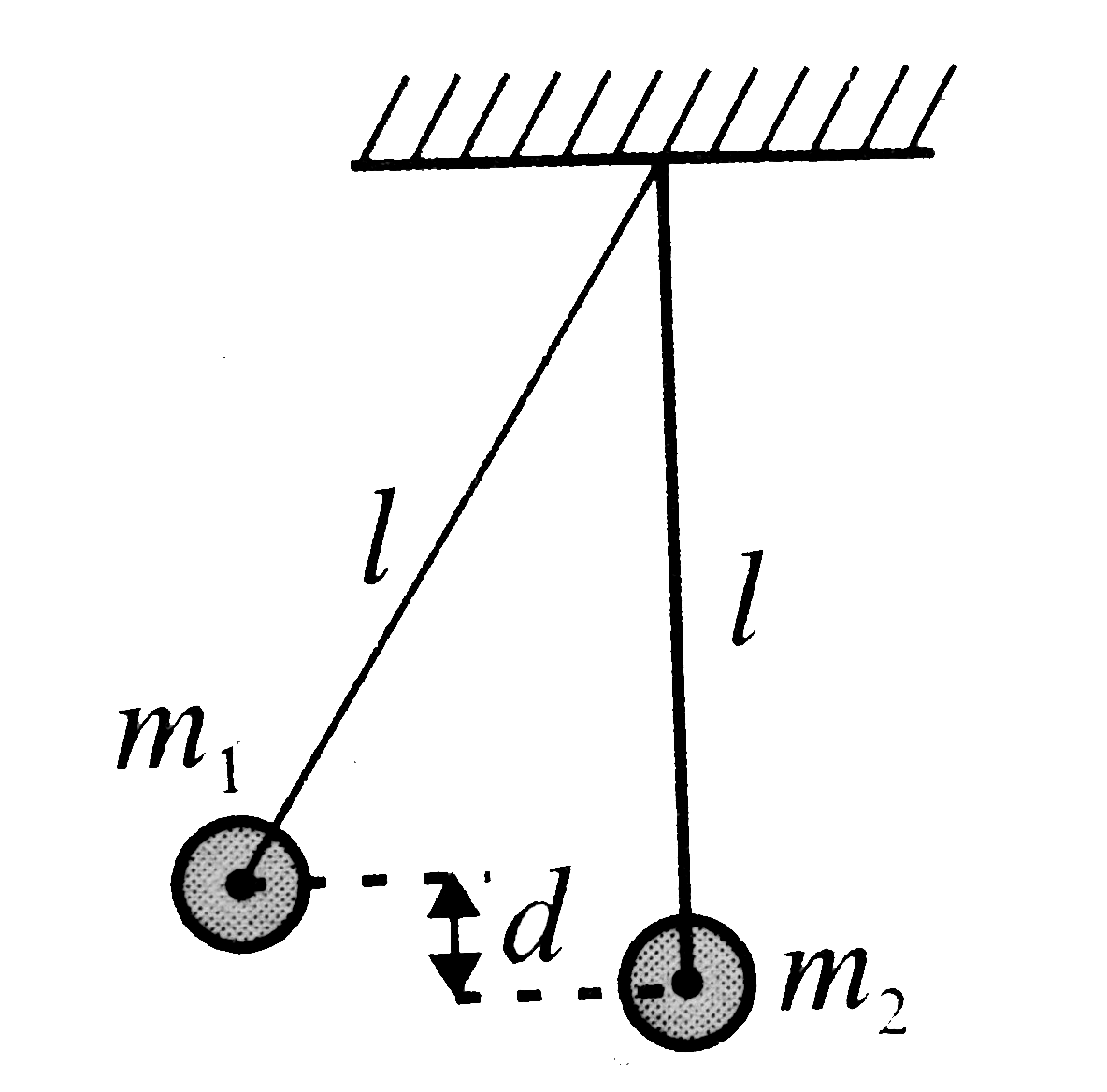
Two pendulums each of length `l` are initially situated as shown in Fig. The first pendulum is released and strikes the second. Assume that the collision is completely inelastic and neglect the mass of the string and any frictional effects. How high does the centre of mass rise after the collision?

A

`d[(m_(1))/((m_(1)+m_(2)))]^2`

B

`d[(m_(1))/((m_(1)+m_(2)))]`

C

`d[((m_(1)+m_(2)))/(m_(2))]^(2)`

D

`[(m_(2))/((m_(1)+m_(2)))]^(2)`

Text Solution

Verified by Experts

The correct Answer is:

A

Applying the law of conservatioin of momentum
`m_(1) v_(1)=(m_(1)+m_(2))V` …………i
where `v_(1)=sqrt(2gd)` is the velocity with which `m_(1)` collides with `m_(2)` therefore
`V=m_(1)/((m_(1)+m_(2)))sqrt(2gd)`
Now, let the centre of mass rise through a height `h` after collision. In this case, the kinetic enerty of `m_(1)+m_(2)` system is converted into potential energy at maximum height `h`
`implies 1/2(m_(1)+m_(2))V^(2)=(m_(1)+m_(2))gh`
`implies1/2(m_(1)+m_(2)){(m_(1))/(m_(1)+m_(2))}^(2) 2gh=(m_(1)+m_(2))gh`
`implies h=d{m_(1)/(m_(1)+m_(2))}^(2)`
Promotional Banner

Topper's Solved these Questions

  • CENTRE OF MASS

    CENGAGE PHYSICS|Exercise Multiple Correct|25 Videos
  • CENTRE OF MASS

    CENGAGE PHYSICS|Exercise Assertion - Reasoning|2 Videos
  • CENTRE OF MASS

    CENGAGE PHYSICS|Exercise Subjective|23 Videos
  • CALORIMETRY

    CENGAGE PHYSICS|Exercise Solved Example|13 Videos
  • DIMENSIONS & MEASUREMENT

    CENGAGE PHYSICS|Exercise Integer|2 Videos

Similar Questions

Explore conceptually related problems

Two pendulum each of length l are initial situated as shown in figure. The first pendulum is released and strikes the second . Assume that the collision is completely inelastic and neglect the mass of the string and any frictional effects. How high does the center of mass rise after the collision?

Two pendulums each of lengh l are initially situated as shown in figure. The first pendulum is released and strikes the second. Assume that the collision is completely inelastic and neglect the mass of the string and frictional effects. How high does the centre of mass rise after the collision ?

A ball of mass m moving horizontally at a speed v collides with the bob of a simple pendulum at rest. The mass of the bob is also m. If the collision is perfectly inelastic and both balls sticks, the height to which the two balls rise after the collision will be given by:

Two balls having masses m and 2m are fastened to two light strings of same length l figure. The other ends of the strings ar fixed at O. The strings are kept in the same horizontal line and the system is released from rest. The collision between the balls is elastic. a. Find velocities of the balls just after their collision. b. How high will the balls rise after the collision.

Two massless string of length 5 m hang from the ceiling very near to each other as shown in the figure. Two balls A and B of masses 0.25kg and 0.5kg are attached to the string. The ball A is released from rest at a height 0.45m as shown in the figure. The collision between two balls is completely elastic. Immediately after the collision, the kinetic energy of ball B is 1 J The velocity of ball A just after the collision is

A uniform rod of length L lies on a smooth horizontal table. The rod has a mass M . A particle of mass m moving with speed v strikes the rod perpendicularly at one of the ends of the rod sticks to it after collision. Find the velocity of the centre of mass C and the angular, velocity of the system about the centre of mass after the collision.

Three solid spheres each of mass m and radius R are released from the position shown in Fig. What is the speed of any one sphere at the time of collision?

A bar of mass 'm' length 'l' is in pure translatory motion with its centre velocity 'v' It collides with another identical bar which is in rest and sticks to it. Assume that after the collision it becomes one system, then the angular velocity of the system after the collision is. .

CENGAGE PHYSICS-CENTRE OF MASS-Single Correct
  1. A body X with a momentum p collides with another identical stationary ...

    Text Solution

    |

  2. A pendulum consists of a wooden bob of mass in and of length l. A bull...

    Text Solution

    |

  3. Two pendulums each of length l are initially situated as shown in Fig....

    Text Solution

    |

  4. A wooden block of mass 10 g is dropped from the top of a tower 100 m h...

    Text Solution

    |

  5. A machinist starts with three identical square plates but cuts one cor...

    Text Solution

    |

  6. A particle of mass 2m is projected at an angle of 45^@ with horizontal...

    Text Solution

    |

  7. A smooth sphere is moving on a horizontal surface with velocity vector...

    Text Solution

    |

  8. Two equal spheres A and B lie on a smooth horizontal circular groove a...

    Text Solution

    |

  9. A block 'A' of mass m1 hits horizontally the rear side of a spring (id...

    Text Solution

    |

  10. A particle of mass 4m is projected from the ground at some angle with ...

    Text Solution

    |

  11. A block of mass M is tied to one end of a massless rope. The other end...

    Text Solution

    |

  12. A particle of mass m1 moving with velocity v in a positive direction c...

    Text Solution

    |

  13. A strip of wood of mass M and length l is placed on a smooth horizonta...

    Text Solution

    |

  14. The system in Fig. is released from rest from the position shown. Afte...

    Text Solution

    |

  15. A car of mass m is initially at rest on the boat of mass M tied to the...

    Text Solution

    |

  16. A partical of mass m moving with velocity 1m//s collides perfectly ela...

    Text Solution

    |

  17. A canon shell moving along a straight line bursts into two parts. Just...

    Text Solution

    |

  18. Figure shows a hollow cube of side 'a' and volume 'V'. There is a smal...

    Text Solution

    |

  19. Two men 'A' and 'B' are standing on a plank. 'B' is at the middle of t...

    Text Solution

    |

  20. A gun which fires small balls of mass 20 g is firing 20 balls per seco...

    Text Solution

    |
