Home
Class 11
PHYSICS
A U-shaped wire has a semicircular bendi...

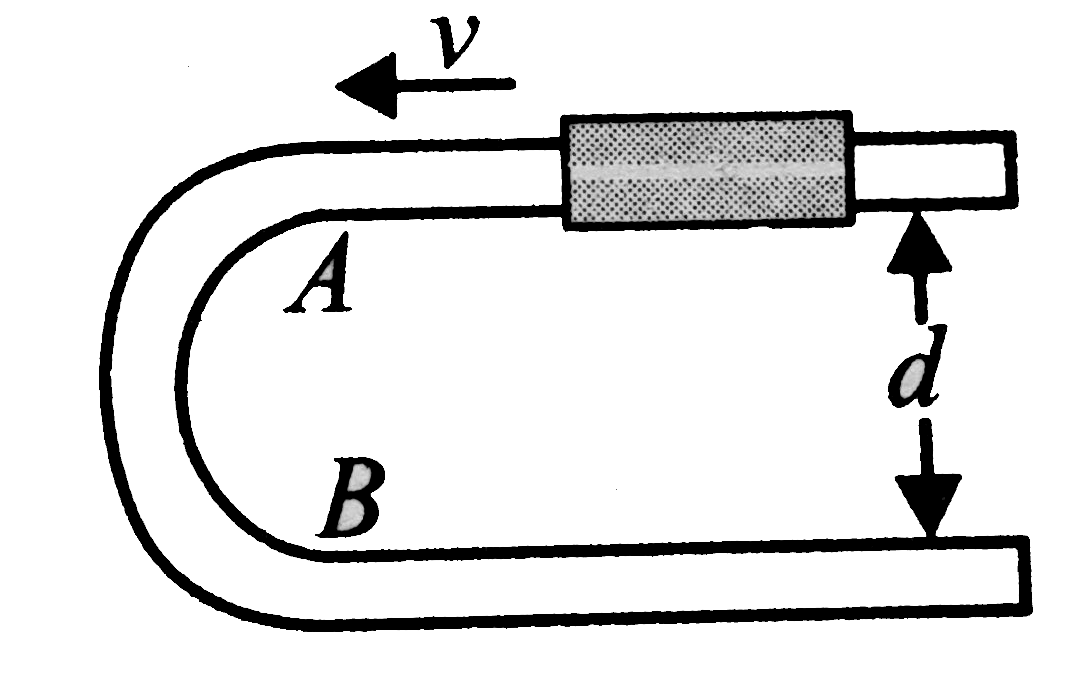
A `U`-shaped wire has a semicircular bending between `A` and `B` as shown in Fig. A bead of mass `m` moving with uniform speed `v` through a wire enters the semicircular bend at `A` and leaves at `B` with velocity `v//2` after time `T`. The average force exerted by the bead on the part `AB` of the wire is

A

`0`

B

`(3mv)/(2T)`

C

`(3mv)/T`

D

none of these

Text Solution

Verified by Experts

The correct Answer is:
B

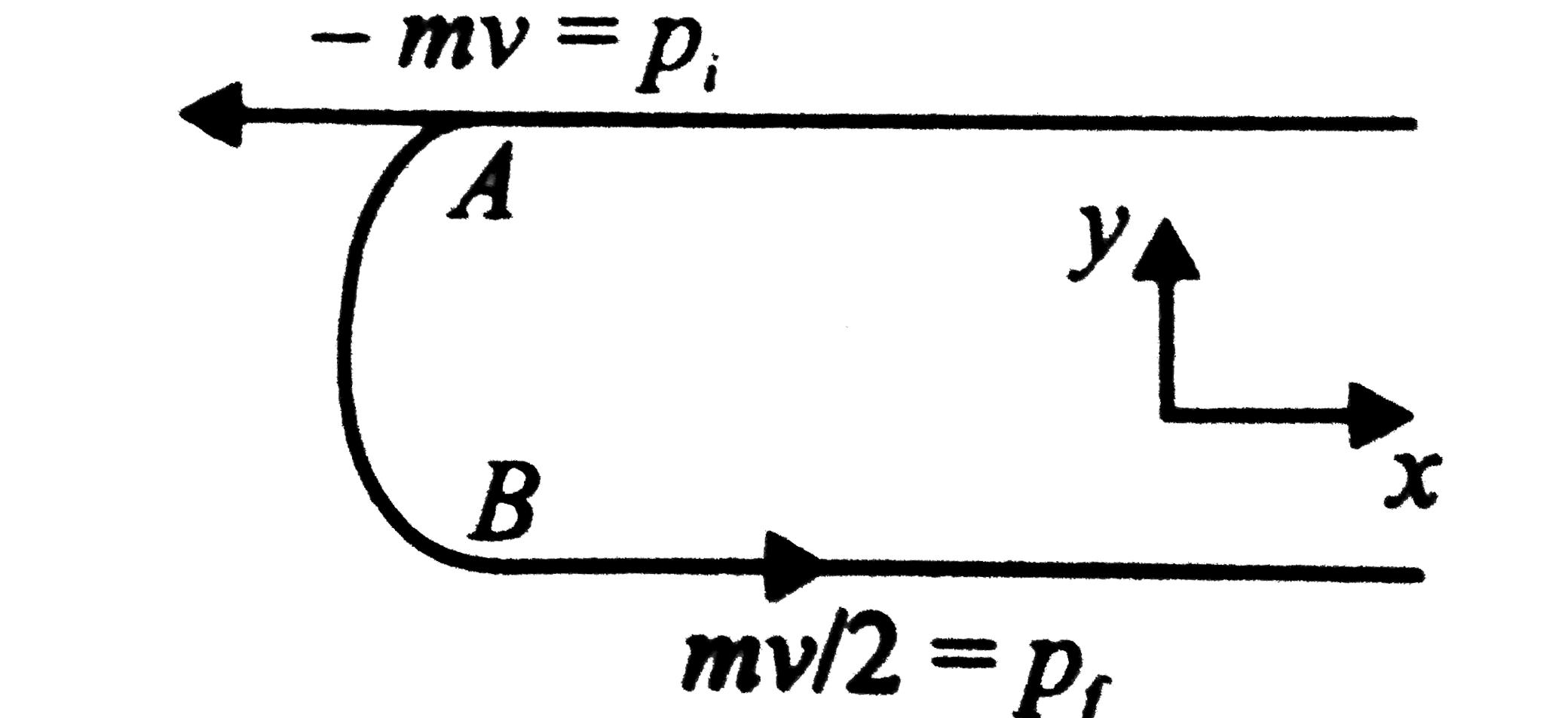
The momentum of the ead at `A` is `P_(i)-mvhati`

The momentum of the bead at `B` is `vecP_(f)=((mv)/2)hati`
Therefore, the magnitude of the change in momentum between `A` and `B` is
`/_\P=|vecP_(f)-vecP_(f)|=(3/2)mv`
Average force exerted by the bead on the wire is
`F_(av)=(/_\p)/(/_\t)=(3mv)/(2T)`
Promotional Banner

Topper's Solved these Questions

  • CENTRE OF MASS

    CENGAGE PHYSICS|Exercise Multiple Correct|25 Videos
  • CENTRE OF MASS

    CENGAGE PHYSICS|Exercise Assertion - Reasoning|2 Videos
  • CENTRE OF MASS

    CENGAGE PHYSICS|Exercise Subjective|23 Videos
  • CALORIMETRY

    CENGAGE PHYSICS|Exercise Solved Example|13 Videos
  • DIMENSIONS & MEASUREMENT

    CENGAGE PHYSICS|Exercise Integer|2 Videos

Similar Questions

Explore conceptually related problems

A fixed U -shaped smooth wire has a semi-circular bending between A and B as shown in the figure. A bead of mass 'm' moving with uniform speed v through the wire enters the semicircular bend at A and leaves at B . The magnitude of average force exerted by the bead on the part AB of the wire is

A U-shaped smooth wire has a semi-circular bending between A and B as shown in fig. A bead of mass m moving with uniform speed v through the wire enters the semiculcular bent at A and leaves at B. Find the average force exerted by the bead on the part AB of the wire.

A semicircular wire of radius R, carrying current I, is placed in a magnetic field as shown in Fig. On left side of X'X, magnetic field strangth 2B_0 . Both fields are directed inside the page. The magnetic force experienced by the wire would be

A particle of mass m moves with constant speed v on a circular path of radius r as shown in figure. The average force on it during its motion from A to B is

A semicircular wire frame of radius R is standing vertical on a horizontal table. It is pulled horizontally towards right with a constant acceleration. A bead of mass m remain in equilibrium (relative to the semicircular wire) at a position where radius makes an angle q with horizontal. There is no friction between the wire and the bead. The bead is displaced a little bit in upward direction and released. Calculate the speed of the bead relative to the wire at the instant it strikes the table. Assume that all throughout the semicircular wire keeps moving with constant acceleration.

A bead of mass m and diameter d is sliding back and forth with velocity v on a wire held between two right walls of length L. Assume that th ecollisions with the wall are perfectly elastic and ther is no friction. The average force that the bouncing bead exerts on the one of the walls is :_

The wires A and B shown in Fig. are made of the same material and have radii r_(A) and r_(B) , respectively. The block between them has a mass m . When the force F is mg//3 , one of the wires breaks. Then

Figure 10-82 is an overhead view of semicircular ring of mass m and radius R that lies on a frictionless surface. The ring is connected by elevated spokes (not shown) to a pivot at the center of the semicircle. The ring can rotate around that pivot but is initially stationary. A bead of mass m and speed v is shot into the ring, entering under the spokes and tangentially to the ring and then sliding along the ring. The ring and bead then rotate together around the pivot. Find their angular speed.

A bead of mass m stays at point P (a,b) on a wire bent in the shape of a parabola y =4 Cx^(2) and rotating with angular speed omega (see figure ) . The value of omega is (neglect friction),

CENGAGE PHYSICS-CENTRE OF MASS-Single Correct
  1. A heavy chain of length 1 m and weight 20 kg hangs vertically with one...

    Text Solution

    |

  2. A cannon of mass 1000 kg located at the base of an inclined plane fire...

    Text Solution

    |

  3. A U-shaped wire has a semicircular bending between A and B as shown in...

    Text Solution

    |

  4. A particle of mass 2 kg moving with a velocity of 3 m//s is acted upon...

    Text Solution

    |

  5. A body of mass 3 kg moving with a velocity of 4 m//s towards left coll...

    Text Solution

    |

  6. Two blocks of masses m(1)= 2 kg and m(2) = 4 kg are moving in the same...

    Text Solution

    |

  7. A cracker is thrown into air with a velocity of 10 m//s at an angle of...

    Text Solution

    |

  8. A force exerts an impulse Ion a particle changing its speed from initi...

    Text Solution

    |

  9. A ball falls vertically onto a floor with momentum p and then bounces ...

    Text Solution

    |

  10. A ball released from a height ho above a horizontal surface rebounds t...

    Text Solution

    |

  11. Two identical balls, of equal masses A and B, are lying on a smooth su...

    Text Solution

    |

  12. A particle of mass in is made to move with uniform speed v0 along the ...

    Text Solution

    |

  13. A continuous stream of particles, of mass m and velocity r, is emitted...

    Text Solution

    |

  14. A ball kept in a close box moves in the box making collisions with the...

    Text Solution

    |

  15. A particle of mass m moving with a velocity u makes an elastic one-dim...

    Text Solution

    |

  16. A stationary body explodes into two fragments of masses m(1) and m(2)....

    Text Solution

    |

  17. A ball of mass m is projected with a speed v into the barrel of a spri...

    Text Solution

    |

  18. A railway flat car has an artillery gun installed on it. The combined ...

    Text Solution

    |

  19. Two blocks of masses 6 kg and 4 kg are attached to the two ends of a m...

    Text Solution

    |

  20. The momentum of a moving particle is vectorially given a, vecp=p(0)(co...

    Text Solution

    |

