Home
Class 11
PHYSICS
Three balls A, B and C of masses 2 kg, 4...

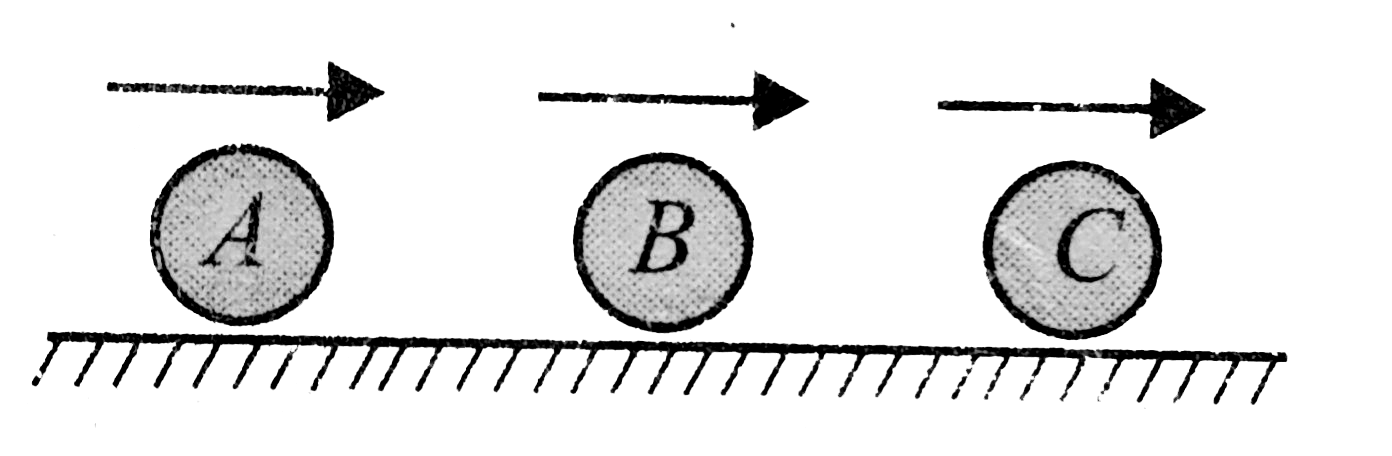
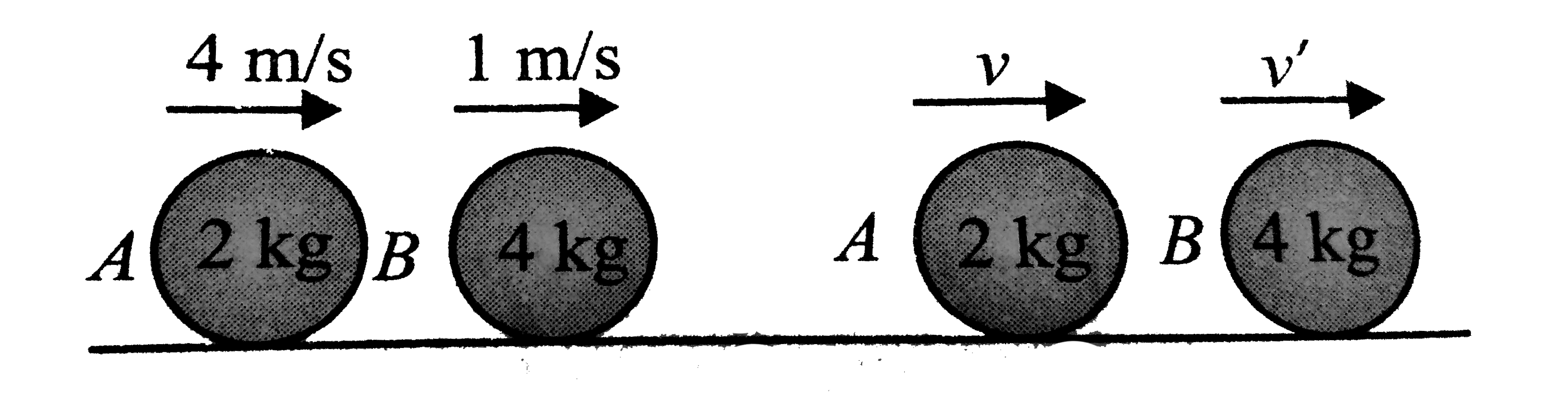
Three balls `A, B` and `C` of masses `2 kg, 4 kg` and `8 kg`, respectively, move along the same straight line and in the same direction, with velocities `4m//s,1m//s, 3/4m//s`. If `A` collides with `B` and subse-quently `B` collides with `C`, find the velocity of ball `A` and ball `B` after collision, taking the coefficient of restitution as unity.

A

`V_(A)=3,V_(B)=9//4`

B

`V_(A)=0, V_(B)=3`

C

`V_(A)=3, V_(B)=0`

D

`V_(A)=0, V_(B)=0`

Text Solution

Verified by Experts

The correct Answer is:
D

First consider the collision of balls `A` and `B`. let the velocities of these two balls after their collision be `v` and `v'`.
Momentum after impact `=` Momentum before impact

`:. 2v+4v'=2xx4+4xx1`
`:. 2v+4v'=12`
`implies v+2v'=6`..........i
relative velocity after impact `=-exx` relative velocity before impact
`v-v'=-(4-1)`
`v-v'=(-3)`............ii
substracting eqn ii from eqn i we get
`3v'=9`
`v'=3m//s` Substituting in eqn ii we get
`v_3=-3impliesv=0`

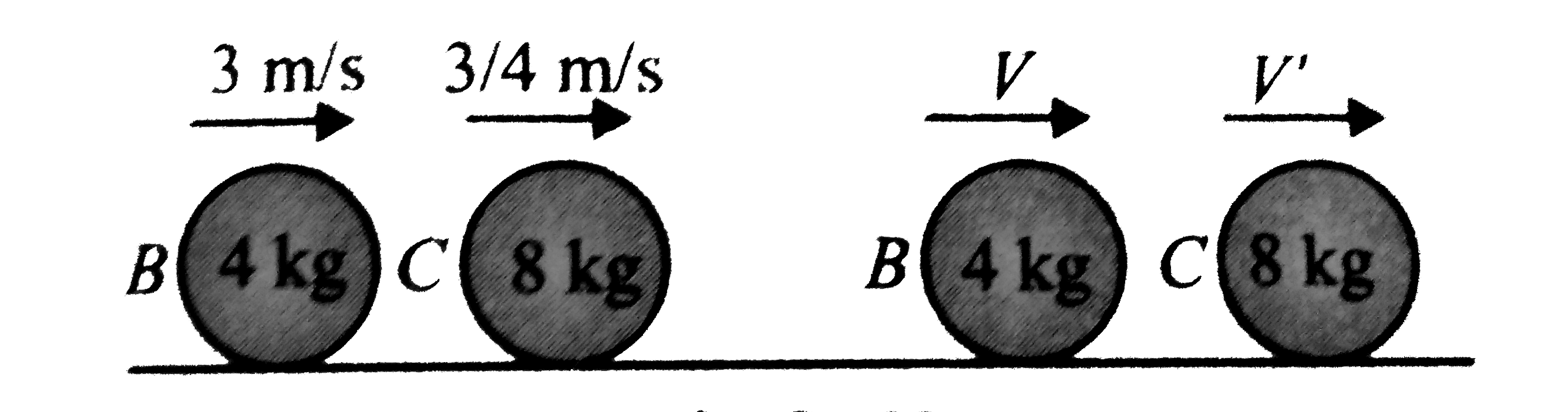
Hence, after the collision ball `A` is brought to rest, while ball `B` will move with a velocity of `3m//s`. now consider the collision of balls `B` and `C`.Let the velocities of these balls after collision be `V` and `V'` respectively.
Total momentum after impact = Total momentum before impact
`4V+8V'=4xx3+8xx3/4=18`
`V+2V'=9/2`............iii
Relative velocity after impact `=-exx` relative velocity before impact
`V-V'=(-1)(3-3/4)`
`V-V'=-9/4`.........iv
Subtracting eq iv from eqn iii we get
`3V'=27/4impliesV'=9/4m//s`
`V=0`
`V_(A)=0,V_(B)=0`
Promotional Banner

Topper's Solved these Questions

  • CENTRE OF MASS

    CENGAGE PHYSICS|Exercise Multiple Correct|25 Videos
  • CENTRE OF MASS

    CENGAGE PHYSICS|Exercise Assertion - Reasoning|2 Videos
  • CENTRE OF MASS

    CENGAGE PHYSICS|Exercise Subjective|23 Videos
  • CALORIMETRY

    CENGAGE PHYSICS|Exercise Solved Example|13 Videos
  • DIMENSIONS & MEASUREMENT

    CENGAGE PHYSICS|Exercise Integer|2 Videos

Similar Questions

Explore conceptually related problems

Two objects of masses 100g and 200g are moving along the same line in the same line in the same direction with velocities of 2m//s and 1m//s , respectively. They collide and after the collison, the first object moves at a velocity of 1.67 m//s in the same direction. Determine the velocity of the second object.

A railway carriage of mass 10g and 200g are moving along the same line in the same direction with velocities of 2m//s and 1m//s respectively. They collide and after the collison, the first object moves with a velocity of 1.67m//s in the same direction. Determine the velocity of the second object.

A 1 kg ball moving at 12 m//s collides head on with a 2g ball moving in the opposite direction at 24 m//s . The velocity of each ball after the impact, if the coefficient of restitution is 2//3 is

Two object A and B are moving along the same straight line in opposite directions with velocities 10m//s and 5m//s respectively. They collide during which they stick to each other. If mass of A is 1.5kg and mass of B is 1kg , what is the velocity of the combinations?

Two balls A and B of masses 0.3 kg and 0.2 kg respectively are moving along positive X-axis and negaive X-axis with velocities 2.0 m // s. They collide and thereafter move in the directions opposite to their original directions. Find the velocities of A and B after collision. Also, calculate total K.E. of the ball before and after collision.

2kg ball moving at 6ms^(-1) collides head on with a 3kg ball moving in the opposite direction at 12m/s .The velocity of each ball after the impact, if the coefficient of restitution is 1/2, is ?

Two smooth spheres A and B of masses 4kg and 8kg move with velocities 9m//s and 3m//s in opposite directions. If A rebounds on its path with velocity 1m//s , then

Two spheres of masses 1 kg and 2 kg are moving with velocities of 10 m/s and 5 m/s respectively in the same direction. After the collision the velocity of the lighter sphere decreases by 4 m/s. What is the coefficient of restitution?

A ball of mass 2kg moving with speed 5m/s collides directly with another ball of mass 3kg moving in the same direction with speed 4m/s. The coefficient os restitution is 2/3. Find the velocities of both ball after the collision.

CENGAGE PHYSICS-CENTRE OF MASS-Single Correct
  1. A particle at rest is constrained to move on a smooth horizontal surfa...

    Text Solution

    |

  2. A particle of mass m comes down on a smooth inclined plane from point ...

    Text Solution

    |

  3. Three balls A, B and C of masses 2 kg, 4 kg and 8 kg, respectively, mo...

    Text Solution

    |

  4. A ball of mass m moving with velocity v(0) collides with a wall as sho...

    Text Solution

    |

  5. Five balls are placed one after the other along a straight line as sho...

    Text Solution

    |

  6. Two objects are at rest on a level frictionless surface. The objects a...

    Text Solution

    |

  7. A highly elastic ball moving at a speed of 3 m//s approaches a wall mo...

    Text Solution

    |

  8. Two identical billiard balls undergo an oblique elastic collision. Ini...

    Text Solution

    |

  9. A ball of mass m is attached to a cord of length L, pivoted at point O...

    Text Solution

    |

  10. A ball of mass m is released from rest relative to elevator at a heigh...

    Text Solution

    |

  11. Two blocks A and B of masses in and 2m, respectively, are connected wi...

    Text Solution

    |

  12. A 3000 kg space probe is moving in a gravity free space at a constant ...

    Text Solution

    |

  13. After a totally inelastic collision, two objects of the same mass and ...

    Text Solution

    |

  14. An object of mass 10 kg is launched from the ground at t = 0, at an an...

    Text Solution

    |

  15. For the system shown in Fig. the string is light and pulley is frictio...

    Text Solution

    |

  16. A parallel beam of particles of mass m moving with velocity v impinges...

    Text Solution

    |

  17. A block of mass m starts from rest and slides down a frictionless semi...

    Text Solution

    |

  18. Three blocks are initially placed as shown in the figure. Block A has ...

    Text Solution

    |

  19. In the figure shown, the two identical balls of mass M and radius R ea...

    Text Solution

    |

  20. Three blocks are placed on smooth horizontal surface and lie on same h...

    Text Solution

    |