Home
Class 11
PHYSICS
A ball of mass m moving with velocity v(...

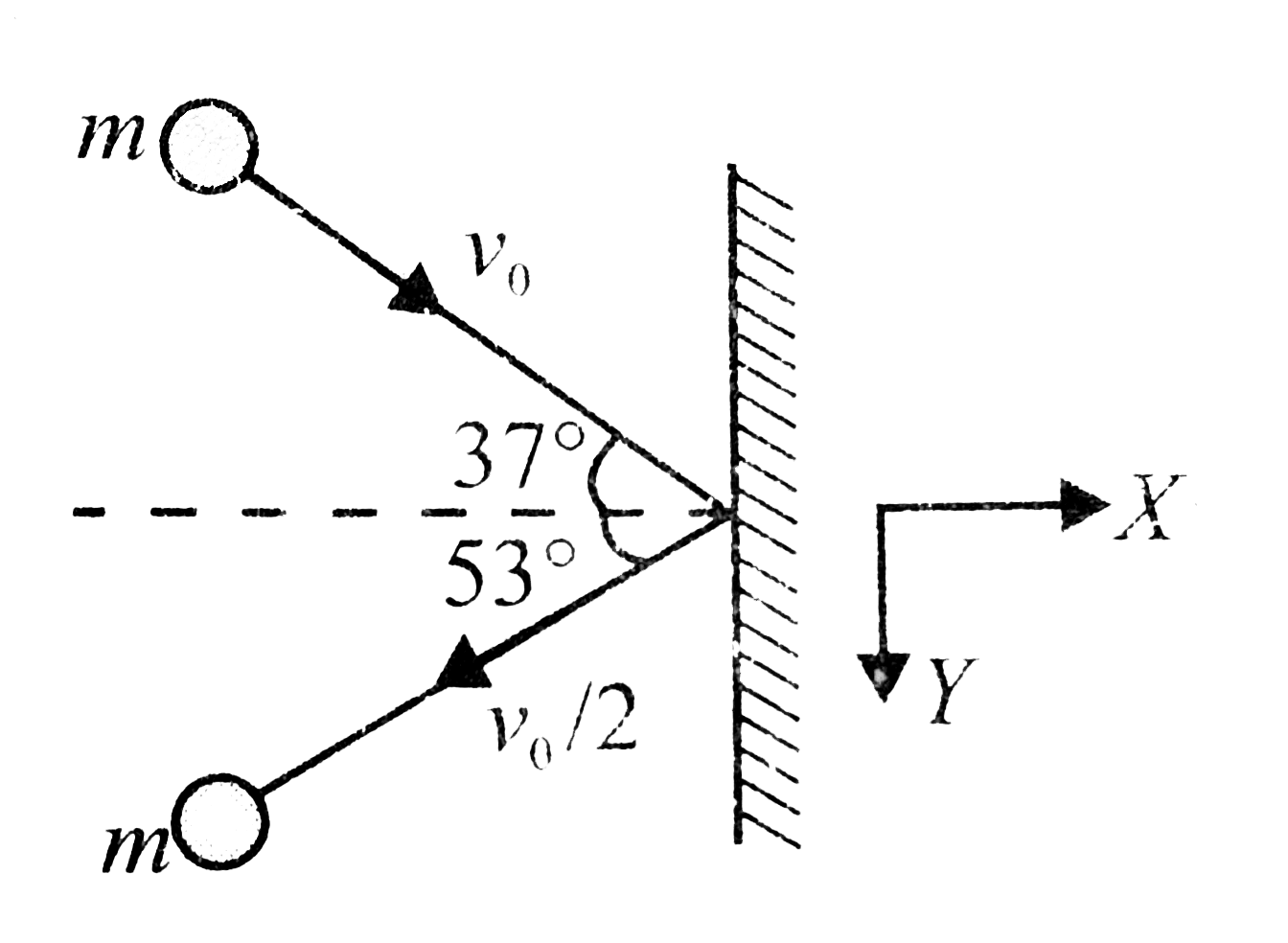
A ball of mass `m` moving with velocity `v_(0)` collides with a wall as shown in Fig. After impact it rebounds with a velocity' `(v_(0))//2`The component of impulse acting on the ball along the wall is

A

`(mv_(0))/2hatj`

B

`-(mv_(0))/2hatj`

C

`-(mv_(0))/5hatj`

D

none of these

Text Solution

Verified by Experts

The correct Answer is:

C

Component of initial momentum along the wall is
`P_(iy)=mv_(0)sin37^(@)hatj`
component of final momentum along the wall is
`P_(iy)=(mv_(0)) sin37^(@)hatj`
`P_(fy)=(mv_(0))/2sin53^(@)hatj`
So, component of impulse along the wall is `J_(y)=P_(fy)-P_(iy)`
`(mv_(0))/2xx4/5-(mv_(0))/1xx3/5hatj=-(mv_(0))/5hatj`
Promotional Banner

Topper's Solved these Questions

  • CENTRE OF MASS

    CENGAGE PHYSICS|Exercise Multiple Correct|25 Videos
  • CENTRE OF MASS

    CENGAGE PHYSICS|Exercise Assertion - Reasoning|2 Videos
  • CENTRE OF MASS

    CENGAGE PHYSICS|Exercise Subjective|23 Videos
  • CALORIMETRY

    CENGAGE PHYSICS|Exercise Solved Example|13 Videos
  • DIMENSIONS & MEASUREMENT

    CENGAGE PHYSICS|Exercise Integer|2 Videos

Similar Questions

Explore conceptually related problems

A ball of mass m moving with velocity v_0 collides a wall as shown in figure. After impact it rebounds with a velocity 3/4v_0 . The impulse acting on ball during impact is

A ball of mass m moving with velocity v , collide with the wall elastically as shown in the figure. After impact the change in angular momentum about P is : .

A ball of mass m moving with velocity v collides head on elastically with another identical ball moving with velocity - V. After collision

A ball of mass m moving with velocity v collides elastically with another ball of identical mass coming from the opposite direction with velocity 2v. Their velocities after collisions are-

A ball of mass M moving with a velocity v collides perfectly inelastically with another ball of same mass but moving with a velocity v in the opposite direction. After collision

A ball of mass m moving with velocity v collides head-on which the second ball of mass m at rest. I the coefficient of restitution is e and velocity of first ball after collision is v_(1) and velocity of second ball after collision is v_(2) then

A ball of mass '2m' moving with velocity u hat(i) collides with another ball of mass 'm' moving with velocity - 2 u hat(i) . After the collision, mass 2m moves with velocity (u)/(2) ( hat(i) - hat(j)) . Then the change in kinetic energy of the system ( both balls ) is

CENGAGE PHYSICS-CENTRE OF MASS-Single Correct
  1. A particle of mass m comes down on a smooth inclined plane from point ...

    Text Solution

    |

  2. Three balls A, B and C of masses 2 kg, 4 kg and 8 kg, respectively, mo...

    Text Solution

    |

  3. A ball of mass m moving with velocity v(0) collides with a wall as sho...

    Text Solution

    |

  4. Five balls are placed one after the other along a straight line as sho...

    Text Solution

    |

  5. Two objects are at rest on a level frictionless surface. The objects a...

    Text Solution

    |

  6. A highly elastic ball moving at a speed of 3 m//s approaches a wall mo...

    Text Solution

    |

  7. Two identical billiard balls undergo an oblique elastic collision. Ini...

    Text Solution

    |

  8. A ball of mass m is attached to a cord of length L, pivoted at point O...

    Text Solution

    |

  9. A ball of mass m is released from rest relative to elevator at a heigh...

    Text Solution

    |

  10. Two blocks A and B of masses in and 2m, respectively, are connected wi...

    Text Solution

    |

  11. A 3000 kg space probe is moving in a gravity free space at a constant ...

    Text Solution

    |

  12. After a totally inelastic collision, two objects of the same mass and ...

    Text Solution

    |

  13. An object of mass 10 kg is launched from the ground at t = 0, at an an...

    Text Solution

    |

  14. For the system shown in Fig. the string is light and pulley is frictio...

    Text Solution

    |

  15. A parallel beam of particles of mass m moving with velocity v impinges...

    Text Solution

    |

  16. A block of mass m starts from rest and slides down a frictionless semi...

    Text Solution

    |

  17. Three blocks are initially placed as shown in the figure. Block A has ...

    Text Solution

    |

  18. In the figure shown, the two identical balls of mass M and radius R ea...

    Text Solution

    |

  19. Three blocks are placed on smooth horizontal surface and lie on same h...

    Text Solution

    |

  20. A particle of mass m is moving along the x-axis with speed v when It c...

    Text Solution

    |
