Home
Class 11
PHYSICS
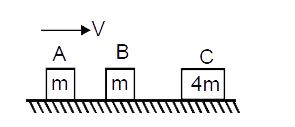
Three blocks are initially placed as sho...

Three blocks are initially placed as shown in the figure. Block A has mass m and initial velocity v to the right. Block B with mass m and block C with mass 4 m are both initially at rest. Neglect friction. All collisions are elastic. The final velocity of block A is

A

`0.6v` to the left

B

`1.4 v` to the left

C

`v` to the let

D

`0.4 v` to the right

Text Solution

Verified by Experts

The correct Answer is:

A

Since `A` and `B` have same mass. So, after elastic collision they interchange their velocity
`:. v_(B)=v`
After collision takes place between `A` and `B` so, velocity will be inter changed.
`:. v_(A)^(')=(v_(B)^('))=3/5v` in left ward direction.
Promotional Banner

Topper's Solved these Questions

  • CENTRE OF MASS

    CENGAGE PHYSICS|Exercise Multiple Correct|25 Videos
  • CENTRE OF MASS

    CENGAGE PHYSICS|Exercise Assertion - Reasoning|2 Videos
  • CENTRE OF MASS

    CENGAGE PHYSICS|Exercise Subjective|23 Videos
  • CALORIMETRY

    CENGAGE PHYSICS|Exercise Solved Example|13 Videos
  • DIMENSIONS & MEASUREMENT

    CENGAGE PHYSICS|Exercise Integer|2 Videos

Similar Questions

Explore conceptually related problems

Three blocks A, B and C each of mass m are placed on a surface as shown in the figure. Blocks B and C are initialyy at rest. Block A is moving to the right with speed v. It collides with block B and stricks to it. The A-B combination collides elastically with block C. Which of the following statement is (are) true about the velocity, of block B and C.

Three blocks are placed as shown in figure. Mass of A, B and C are m_(1), m_(2),"and "m_(3) respectively. The force exerted by block 'C' on 'B' is :-

Three blocks A,B and C are suspended as shown in the figure. Mass of each block A and C is m. if the system is in equilibrium and mass of B is M, then

Three blocks are placed on smooth horizontal surface and lie on same horizontal straight line. Block 1 and block 3 have mass m each and block 2 has mass M (M gt gt m) . Block 2 and block 3 are initially stationary, while block 1 is initially moving towards block 2 with speed v as shown. Assume that all collisions are head on and perfectly elastic. What value of M//m ensures that block 1 and block 3 have the same final speed?

Three blocks of masses m , m and M are kept on a frictionless floor as shown in the figure .The leftmost block is given velocity v towards the right . All the collision between the blocks are perfectly inelastic . The loss in kinetic energy after all the collision is 5//6th of initial kinetic energy. The ratio of M//m will be

Two identical blocks, each having mass M, are placed as shown in figure. These two blocks A and B are smoothly conjugated, so that when another block C of mass m passes from A to B there is no jerk. All the surfaces are frictionless, and all three blocks are free to move. Block C is released from rest, then

There are hundred indentical blocks equally spaced on a frictionless track as shown in the figure . Initially , all the blocks are separate . Each collision is perfectly inelastic . The final velocity will be

Block A has a mass 3kg and is sliding on a rough horizontal surface with a velocity u_A=2m//s when it makes a direct collision with block B, which has a mass of 2kg and is originally at rest. The collision is perfectly elastic. Determine the velocity of each block just after collision and the distance between the blocks when they stop sliding. The coefficient of kinetic friction between the blocks and the plane is mu_k=0.3 ( Take g=10m//s^2 )

Figure shows three identical blocks 1,2 & 3 each of mass m kept on frictionless surface. Block 1 is given initial velocity v_(0) in the direction shown. Block 1 hits block 2 and stops

Two block A and B of masses m and 2m respectively are connected by a spring of spring cosntant k. The masses are moving to the right with a uniform velocity v_(0) each, the heavier mass leading the lighter one. The spring is of natural length during this motion. Block B collides head on with a thrid block C of mass 2m . at rest, the collision being completely inelastic. The velocity of block B just after collision is -

CENGAGE PHYSICS-CENTRE OF MASS-Single Correct
  1. A parallel beam of particles of mass m moving with velocity v impinges...

    Text Solution

    |

  2. A block of mass m starts from rest and slides down a frictionless semi...

    Text Solution

    |

  3. Three blocks are initially placed as shown in the figure. Block A has ...

    Text Solution

    |

  4. In the figure shown, the two identical balls of mass M and radius R ea...

    Text Solution

    |

  5. Three blocks are placed on smooth horizontal surface and lie on same h...

    Text Solution

    |

  6. A particle of mass m is moving along the x-axis with speed v when It c...

    Text Solution

    |

  7. A particle of mass m is acted on by two forces of equal magnitude F ma...

    Text Solution

    |

  8. Three particles of equal masses are placed at the corners of an equila...

    Text Solution

    |

  9. A ball is projected in a direction inclined to the vertical and bounce...

    Text Solution

    |

  10. In the figure shown, the heavy ball of mass 2m, rests on the horizonta...

    Text Solution

    |

  11. In the figure shown, the cart of mass 6m is initially at rest. A parti...

    Text Solution

    |

  12. Two identical particles collide in air inelastically. One moves horizo...

    Text Solution

    |

  13. A particle at rest is constrained to move on a smooth horizontal surfa...

    Text Solution

    |

  14. A stationary body explodes in to four identical fragments such that th...

    Text Solution

    |

  15. Shown in the figure is a system of three particles of mass 1 kg, 2 kg ...

    Text Solution

    |

  16. A ping-pong ball of mass m is floating in air by a jet of water emergi...

    Text Solution

    |

  17. A body of mass 1 kg initially at rest, explodes and breaks into three ...

    Text Solution

    |

  18. A block m(1), strikes a stationary blocks m(3) inelastically. Another ...

    Text Solution

    |

  19. A ball collides with an inclined plane of inclination theta after fall...

    Text Solution

    |

  20. A particle loses 25% of its energy during collision with another ident...

    Text Solution

    |
