Home
Class 11
PHYSICS
In the figure, the block B of mass m sta...

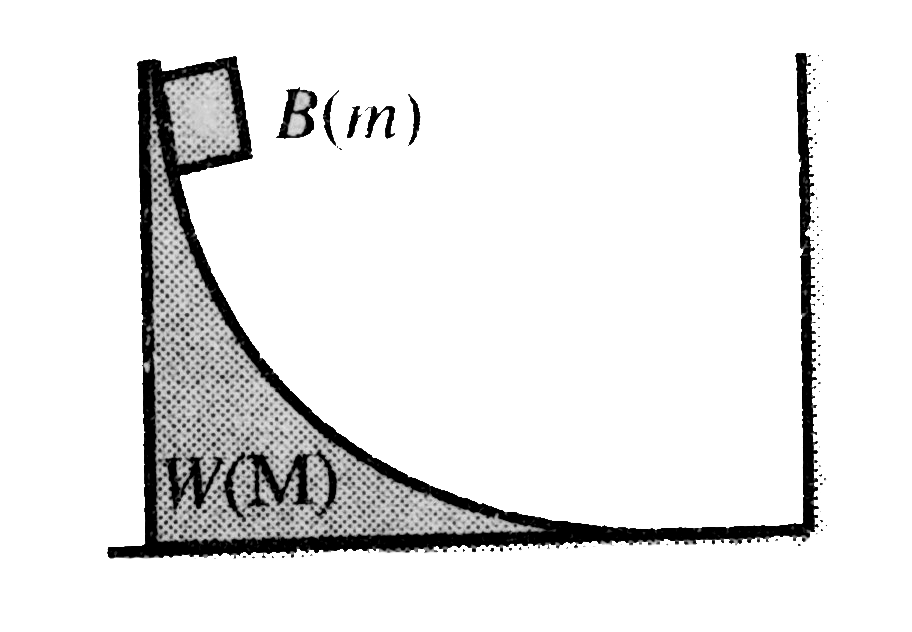
In the figure, the block `B` of mass `m` starts from rest at the top of a wedge `W` of mass `M`. All surfaces are without friction. `W` can slide on the ground. `B` slides down onto the ground, moves along it with a speed v, has an elastic collision with the wall, and climbs back on to `W`.

A

From the beginning, till the collision with the wall, the centre of mass of `'B` plus `W'` does not move horizontally.

B

After te collision, the centre of mass of `B` plus `W` moves with the velocity `(2mv)/(m+M)`

C

When `B` reaches its highest position of `W`, the speed of `W` is `(2mv)/(m+M)`

D

When `B` reaches its highest position of `W`, the speed of `W` is `(mv)/(m+M)`

Text Solution

Verified by Experts

The correct Answer is:

A, B, C, D

i. force acting on the horizontal direction is zero. Since block and wedge both are initially at rest. So velocity of `COM` (`B` plus `W`) does not move horizontally.
`ii. v_(cm)=(mv-(-mv))/(M+m) [:'v_(cm)=(mv_(1)+m_(2)v_(2))/(m_(1)+m_(2))]`
`v_(cm)=(2mv)/(M+m)`
ii When `B` reaches its highest position of `W`, the speed `W` is equal to velocity of `COM` i.e. `v=(2mv)/(M+m)`
Promotional Banner

Topper's Solved these Questions

  • CENTRE OF MASS

    CENGAGE PHYSICS|Exercise Assertion - Reasoning|2 Videos
  • CENTRE OF MASS

    CENGAGE PHYSICS|Exercise Linked Comprehension|105 Videos
  • CENTRE OF MASS

    CENGAGE PHYSICS|Exercise Single Correct|141 Videos
  • CALORIMETRY

    CENGAGE PHYSICS|Exercise Solved Example|13 Videos
  • DIMENSIONS & MEASUREMENT

    CENGAGE PHYSICS|Exercise Integer|2 Videos

Similar Questions

Explore conceptually related problems

In the figure, the block B of mass m starts from rest at the top of a wedge W of mass M. All surfaces are without friction. W can slide on the ground. B slides down onto the ground, moves along it with a speed v, has an elastic collision with the wall, and climbs back two W.

A block of mass m is released from the top of a wedge of mass M as shown in figure. Find the displacement of wedges on the horizontal ground when the block reaches the bottom of the wedges. Neglect friction everywhere.

A block of mass M is placed on the top of a bigger block of mass 10 M as shown in figure. All the surfaces are frictionless. The system is released from rest, then the distance moved by the bigger block at the instant the smaller block reaches the ground :

A block of mass m lies on wedge of mass Mas shown in figure. Find the minimum friction coeffcient required between wedge Mand ground so that it does not move while block m slips down on it.

A block of mass m rests on a stationary wedge of mass M. The wedge can slide freely on a smooth horizontal surface as shown in figure. If the block starts from rest

Block B has mass m and is released from rest when it is on top of wedge A, which has a mass 3m. Determine the tension in cord CD needed to hold the wedge from moving while B is sliding down A. Neglect friction.

The block B starts from rest and slides on the wedge A which can move on a horizontal surface, Neglecting friction, determine (a) the acceleration of wedge, (b) the acceleration of the block relative to the wedge.

A block of mass m is placed at the top of a smooth wedge ABC. The wedge is rotated about an axis passing through C as shown in the figure - 3.81. The minimum value of angular speed omega such that the block does not slip on the wedge is :

A block of mass m is placed on hthe top of bigger wedge M. All the surfaces are frictionless. The system is released from rest. Find the distance moved by smaller block (w.r.t triangular wedge) when bigger wedge travles distance X on plane surface

A particle of mass m moving with speed u hits a wedge of mass M as shown in figure. If coefficient of restitution is e and friciton can be neglected, then find the speed of the wedge with respect to ground just after the collision.

CENGAGE PHYSICS-CENTRE OF MASS-Multiple Correct
  1. A block of mass m moving with a velocity v(0) collides with a stationa...

    Text Solution

    |

  2. Two particles of masses m(1) and m(2) and velocities u(1) and alphau(1...

    Text Solution

    |

  3. A pendulum bob of ideal string mass m connected to the end of of lengt...

    Text Solution

    |

  4. A string of length 3l is connected to a fixed cylinder whose top view ...

    Text Solution

    |

  5. In the figure, the block B of mass m starts from rest at the top of a ...

    Text Solution

    |

  6. Two blocks A and B of masses in and 2m respectively placed on a smooth...

    Text Solution

    |

  7. Figure shows two identical blocks each of mass m kept on a smooth floo...

    Text Solution

    |

  8. A ball of mass 1 kg is dropped from a height of 3.2 m on smooth inclin...

    Text Solution

    |

  9. A particle of mass m collides with another stationary particle of mass...

    Text Solution

    |

  10. Consider two skaters A and B initially at rest on ice -(friction is ne...

    Text Solution

    |

  11. A man is standing on a plank which is placed on smooth horizontal surf...

    Text Solution

    |

  12. Two particles of equal mass in are projected from the ground with spee...

    Text Solution

    |

  13. A particle A suffers an oblique elastic collision particle B that is a...

    Text Solution

    |

  14. Suppose two particles 1 and 2 are projected in vertical plane simultan...

    Text Solution

    |

  15. A particle of mass m(1) = 4 kg moving at 6hatims^(-1)perfectly elastic...

    Text Solution

    |

  16. Consider a block of mass 10 kg. which rests on as smooth surface and ...

    Text Solution

    |

  17. Statement I. A particle strikes head-on with another stationary partic...

    Text Solution

    |

  18. Statement I: No external force acts on a system of two spheres which u...

    Text Solution

    |

  19. Statement I: If a sphere of mass mmoving with speed u undergoes a perf...

    Text Solution

    |

  20. Statement I: If a ball projected up obliquely from the ground breaks u...

    Text Solution

    |
