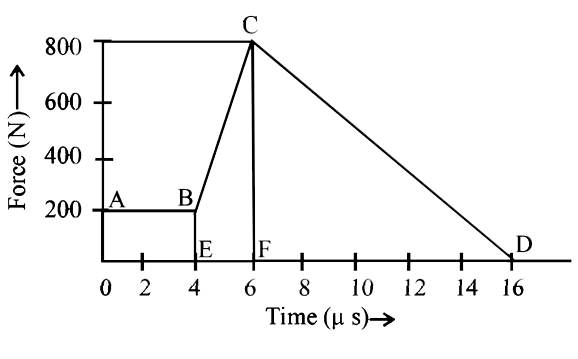
The magnitude of the force (in newtons) acting on a body varies with time t (in micro seconds) as shown in the fig AB, BC and CD are straight line segments. The magnitude of the total impulse of the force on the body from `t= 4 mus` to `t=16 mus` is ….Ns
Text Solution
Verified by Experts
The correct Answer is:
NA
We know that area under the `F-t` graph gives the impulse imparted to the body. The magitude of total impulse of force on the body from `t=4mu s` to `t=16mus=`area(`BCDFEB`) `=`area of `BCFEB+`area `CDFC` `=1/2(200+800)x2xx10^(-6)+1/2xx10xx800xx10^(-6)` `=0.001+0.004=0.005Ns`
Topper's Solved these Questions
CENTRE OF MASS
CENGAGE PHYSICS|Exercise SCQ_TYPE|12 Videos
CENTRE OF MASS
CENGAGE PHYSICS|Exercise MCQ_TYPE|4 Videos
CENTRE OF MASS
CENGAGE PHYSICS|Exercise Integer|16 Videos
CALORIMETRY
CENGAGE PHYSICS|Exercise Solved Example|13 Videos
DIMENSIONS & MEASUREMENT
CENGAGE PHYSICS|Exercise Integer|2 Videos
Similar Questions
Explore conceptually related problems
The magnitude of force (in Newtons) acting on a body varies with time (in micro second) as shown in the figure. The magnitude of total impulse of the force on the body from t = 4μs to t = 16μs is –
Power of a force acting on a block varies with time t as shown in figure. Then, angle between force acting on the block and its velocity is
A force acting on a body of mass 2 kg varies with time as shown in fig.5.11. Find impulse of the force.
Kinetic energy of a particle moving in a straight line is proportional to the time t. The magnitude of the force acting on the particle is :
The magnitude of force acting on a particle moving along x-axis varies with time (t) as shown in figure. If at t = 0 the velocity of particle is v_(0) , then its velocity at t=T_(0) will be
A force acting on a body of mass 2 kg varies with time as shown in fig . 20 find impulse of the force and final velocity of the body.
If the kinetic energy of a body is directly proportional to time t, the magnitude of the force acting on the body is
The displacement y (in metres) of a body varies with time t ( in seconds ) as y= (-2)/(3) t^(2)+16t-12 . How long does the body take to come to rest ?