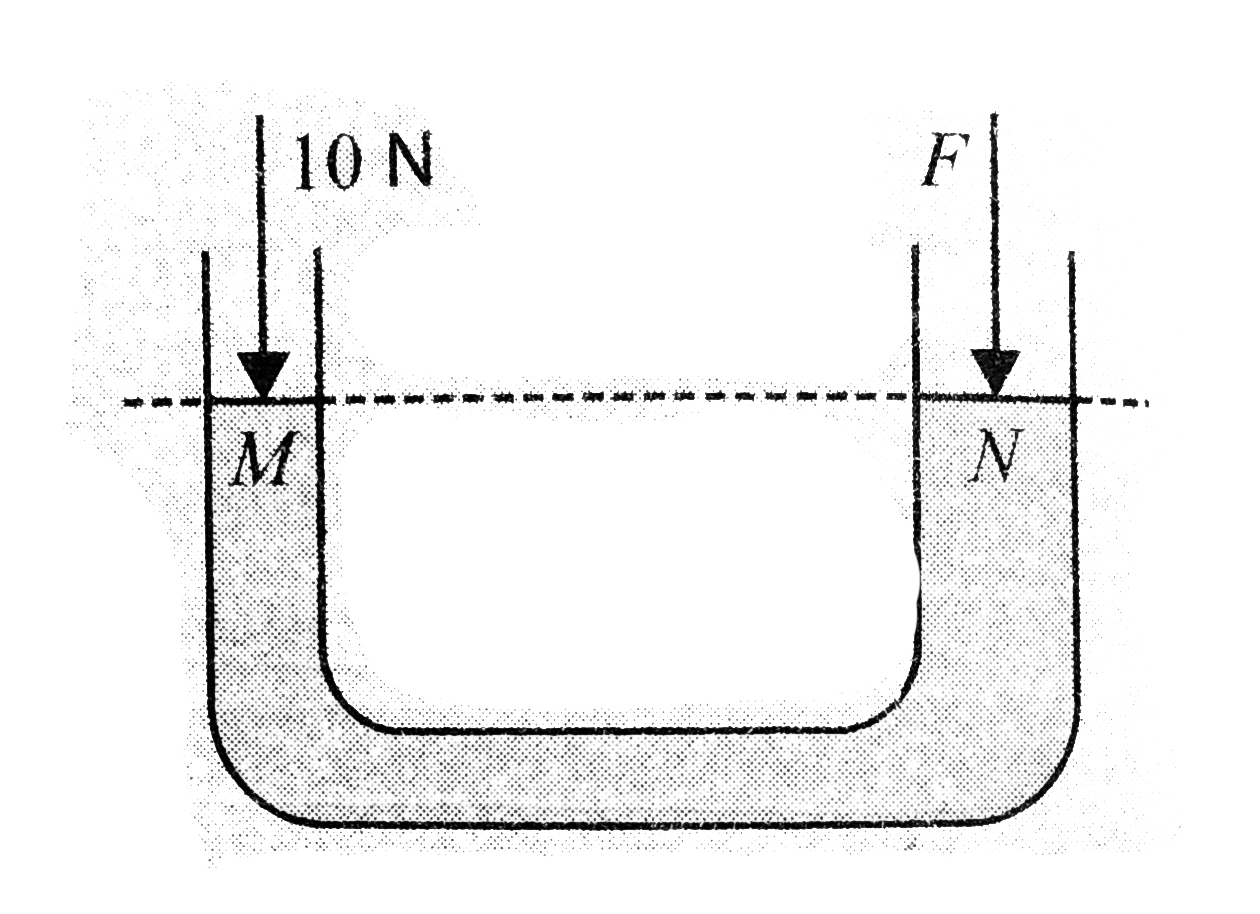
The area of cross section of the two arms of a hydraulic press is `1cm^(2)` and `20 cm^(2)` respectively. A force of `10 N` is applied on the water in the thinner arm. What force should be applied on the water in the thicker arms so that water may remain in equilibrium?
Text Solution
Verified by Experts
In equilibrium, the pressures at the two surfaces should be equal as they lie in the same horizontal level. If the atmospheric pressure is `P_(0)` and a force `F` is applied to maintain the equilibrium the pressur just below the pistons are `P_(M)=P_(0)+(10N)/(1cm^(2))` and `P_(N)=P_(0)+F/(10cm^(2))` These pressures should be the same i.e. `P_(M)=P_(n)`which gives `F=200N`.
Topper's Solved these Questions
FLUID MECHANICS
CENGAGE PHYSICS|Exercise Solved Examples|7 Videos
FLUID MECHANICS
CENGAGE PHYSICS|Exercise Exercise 4.1|11 Videos
DIMENSIONS & MEASUREMENT
CENGAGE PHYSICS|Exercise Integer|2 Videos
GRAVITATION
CENGAGE PHYSICS|Exercise INTEGER_TYPE|1 Videos
Similar Questions
Explore conceptually related problems
The area of cross section of the two arms of a hydraulilc press are 1 cm^2 and 10 cm^2 respectively figure. A force of 5N is applied on the water in the thinner arm. What force should be applied on the water in the thicker arm so that the water may remain in equilibrium? ,
The area of cross section of two cylinders of a Bramah press are 10cm^(2)and50cm^(2) , respectively. In order to move up a weight of 100 placed on the bigger piston. what force should be applied on the smaller piston of smaller area ?
The area of cross-section of the two vertical arms of a hydraulic press are 1 cm ^(2) and 10 cm^(2) respectively. A force of 10N applied. As shown in the figure, to a tight fitting light piston in the thinner arm balances a force F applied to the corresponding piston in the thicker arm. Assuming that the levels of water in both the arms are the same, we can conclude:-
In a simple hydraulic press, the cross sectional area of the two cylinders is 5xx10^(-1)m^(2) and 10^(-2)m^(2) respectively. A force of 20 N is applied at the small plunger. a. What is the pressure produced in the cylinders? b. What is the thrust exerted on the large plunger? c. How much work is done by the operator, if the smaller plunger moves down 0.1m ?
The radius of one arm of a hydraulic lift is three times the radius of the other arm. What force should be applied on the narrow arm so as to lift 50 kg at the wider arm?
The cross-section of two piston in hydraulic press are 2cm^(2) "and" 150 cm^(2) respectivley . Calculate the minimum force required to support a weight of 2000"kg" wt on the broader face of the press.
how much force should be applied on an area of 1 cm^2 to get a pressure of 15 Pa?
Radius of one arm of hyddraulic lift is foud times off radius of other arm. What force should be applied on narrow arm to lift 100 kg?