Water is retained by a curved gate `AB`. Compute the horizontal and vertical component of the resultant of the hydrostatic pressure dsitribution on the gate `AB`, which is a quarter of a cylinder. Assume that the gate is `4m` wide.
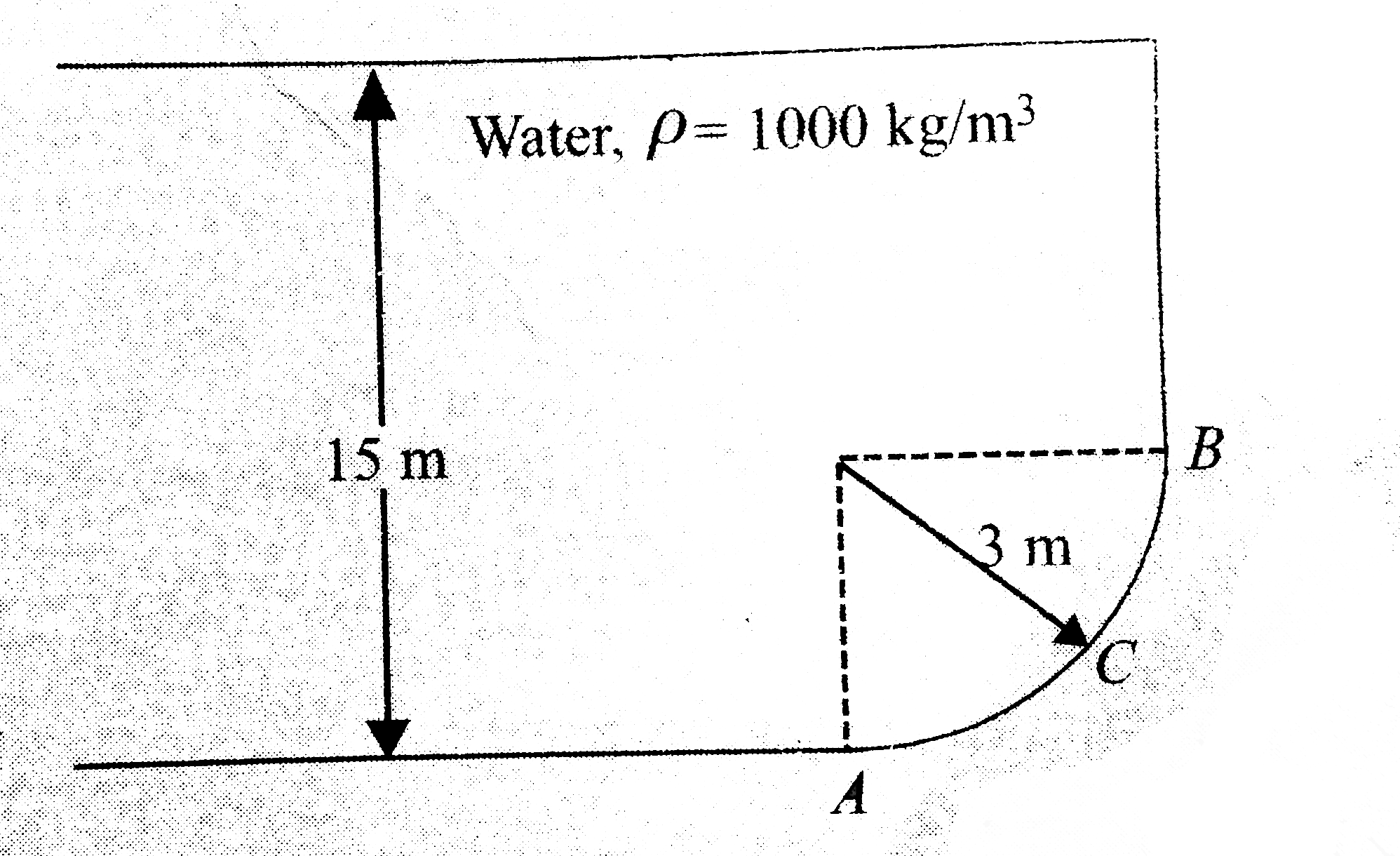
Water is retained by a curved gate `AB`. Compute the horizontal and vertical component of the resultant of the hydrostatic pressure dsitribution on the gate `AB`, which is a quarter of a cylinder. Assume that the gate is `4m` wide.
Text Solution
Verified by Experts
a. Horizontal component. The horizontal component of the resultant force on the gate is equal to the force on the vertical projection `BA'` of the gate. The pressure at a depth `y` from the free surface of the water is `P=rhogy`. The force on the strip of area `4dy` of the gate is ,
`dF_(H)=P(4dy)=rhogy(4dy)=4rhoydy`
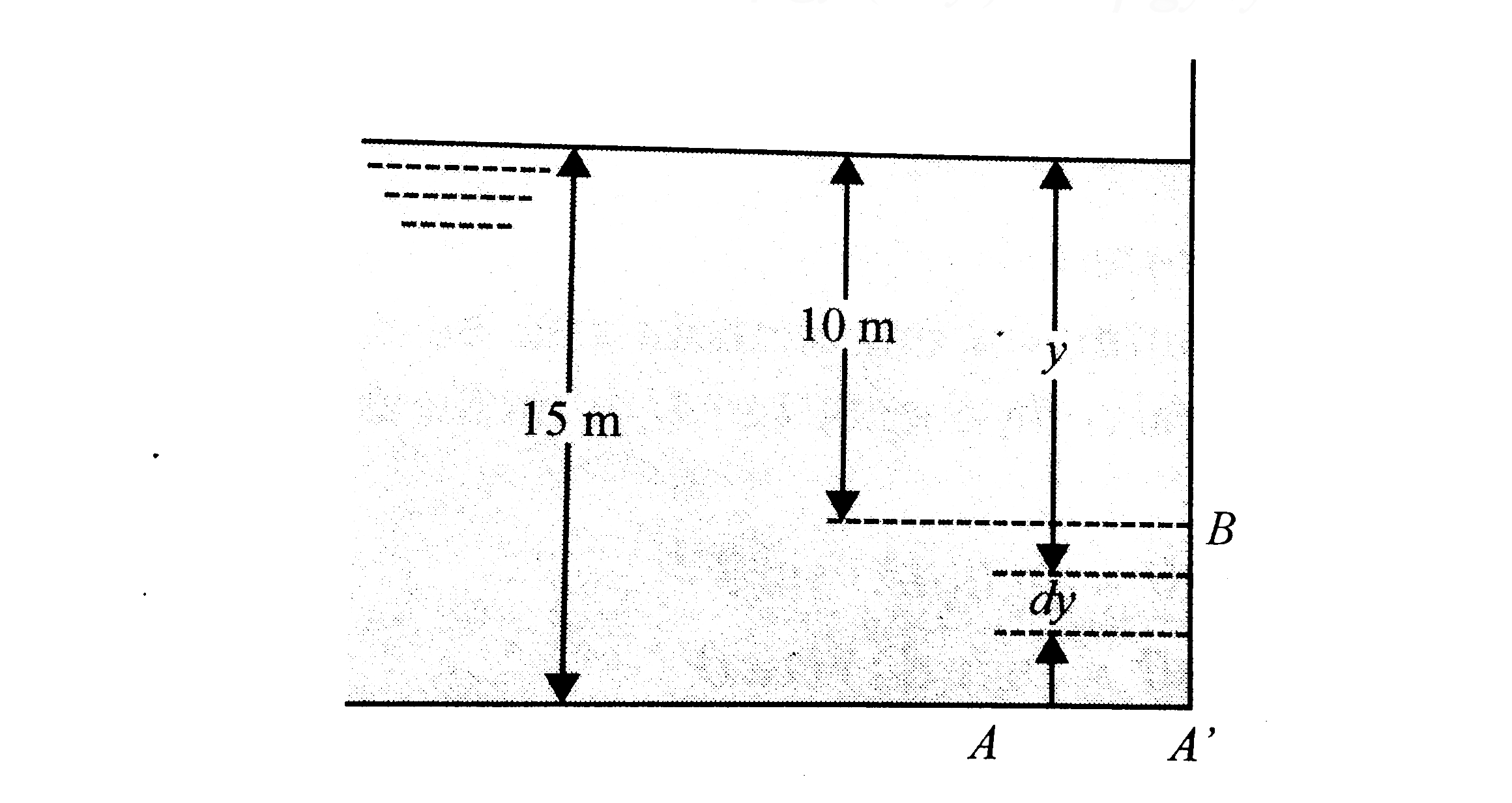
Total horizontal force is
`F_(H)=4rhogint_(10)^(15) ydy=4rhog|y^2/2|_10^15`
`=4xx1000xx10((15^(2)-10^(2))/2)=250xx10^(4)N`
b. Vertical component : It is equal to the weight of the water above the curved surface. Dividing the volume above the curved surface into a rectangular parallelepiped and a quarder cylinder, we thus have
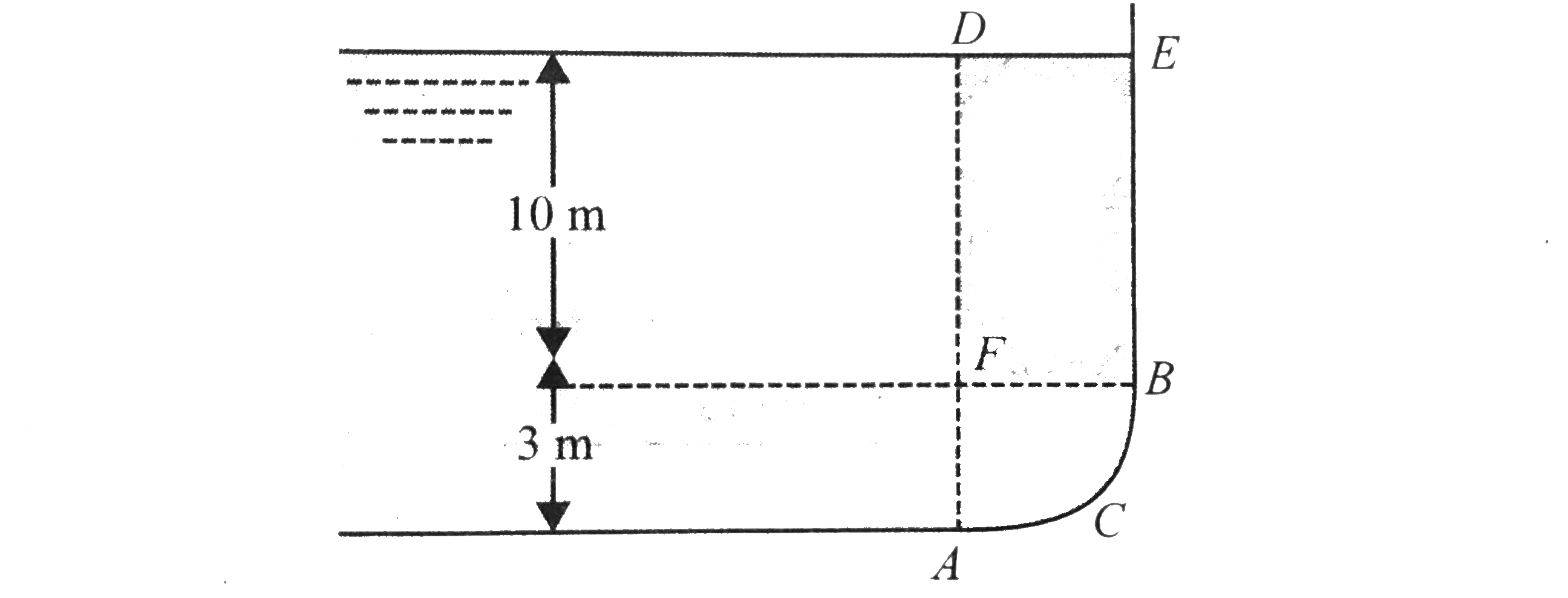
`F_(v)=` weight of water in `DEFB+` Weight of water in `ACBF`
`=rho[V_(1)+V_(2)]g=1000[10xx4xx4+(pi(5)^(2)xx4)/4]xx10`
`[8xxpi]xx10^(4)N`
After calculating the values of `F_(v)` and `F_(H)` we can calculate the resultant force on the gate `F=sqrt(F_(H)^(2)+F_(V)^(2))`
`dF_(H)=P(4dy)=rhogy(4dy)=4rhoydy`
Total horizontal force is
`F_(H)=4rhogint_(10)^(15) ydy=4rhog|y^2/2|_10^15`
`=4xx1000xx10((15^(2)-10^(2))/2)=250xx10^(4)N`
b. Vertical component : It is equal to the weight of the water above the curved surface. Dividing the volume above the curved surface into a rectangular parallelepiped and a quarder cylinder, we thus have
`F_(v)=` weight of water in `DEFB+` Weight of water in `ACBF`
`=rho[V_(1)+V_(2)]g=1000[10xx4xx4+(pi(5)^(2)xx4)/4]xx10`
`[8xxpi]xx10^(4)N`
After calculating the values of `F_(v)` and `F_(H)` we can calculate the resultant force on the gate `F=sqrt(F_(H)^(2)+F_(V)^(2))`



Topper's Solved these Questions
Similar Questions
Explore conceptually related problems
During a rainstorm the raindrops are observed to strike the ground at an angle of 37^(@) with the vertical. The wind speed is 4.5 m/s. Assuming that the horizontal velocity component of the raindrops is same as the speed of air, what is the vertical component of raindrops? What is their speed ?
A horizontally oriented uniform rod AB of mass m=1.40kg and length l_0=100cm rotates freely about a stationary vertical axis OO^' passing through its end A. The point A is located at the middle of the axis OO^' whose length is equal to l=55cm . At what angular velocity of the rod the horizontal component of the force acting on the lower end of the axis OO^' is equal to zero? What is in this case the horizontal component of the force acting on the upper end of the axis?
A horizontal cylinder closed from one end is rotated with a constant angular velocity omega about a vertical axis passing through the open end of the cylinder. The outside air pressure is equal to p_0 , the temperature to T , and the molar mass of air to M . find the air pressure as a function of the distance r from the rotate axis. The molar mass is assumed to be independent of r .
(i) In the figure shown, the heavy cylinder (radius R) resting on a smooth surface separates two liquids of densities 2rho and 3rho . Find the height 'h' for the equilibrium of cylinder. (ii) The cross section of a dam wall is an arc of a circle of radius R=20m subtending on angle of theta=60^(@) at the centre of the circle. the centre (O) of the circle lies in the water surface. The width of the dam (i.e., dimension perpendicular to the figure) is b=10m. Neglect atmospheric pressure is following calculations. (a) Calculate the vertical component of force (F_(x)) applied by water on the curved dam wall. (b) Calculate the horizontal component of force (F_(H)) applied by water on the curved dam wall. (c) Calculate the resultant force applied by the water on the curved dam wall.
Two metal bars are fixed vertically and are connected on top by a capacitor of capacitance C. A sliding conductor AB can slide freely on the two bars. Length of conductor AB is L and its mass is m. It is connected to a vertical spring of force constant k. The conductor AB is released at time t = 0, from a position where the spring is relaxed. Taking initial position of the conductor as origin and downward direction as positive x axis, write the x co-ordinate of the conductor as a function of time. The entire space has a uniform horizon- tal magnetic field B. Neglect resistance and inductance of the circuit and assume that the bar AB always remains horizontal.
A horizontal cylinderical tank (6)/(pi)m in diameter is half full of water. The space above the water is filled with a pressurized gas of unknown refractive index. A small laser can move along the curved bottom of the water and aims a light beam towards the centre of the water surface. When the laser has moved a distance s=1m or more (measured from curved face) from the lowest point in water, no light enters the gas. The refractive index of gas is (mu_("water") = 4//3)
A rod AB length 5 m which remains in vertical plane has its ends A and B constrained to remain contact with a horizontal floor and a vertical wall respectively. Determine the velocity of the end B and angular velocity at the position shown in Fig. , if the point A has a velocity of 3ms^(1) rightward.