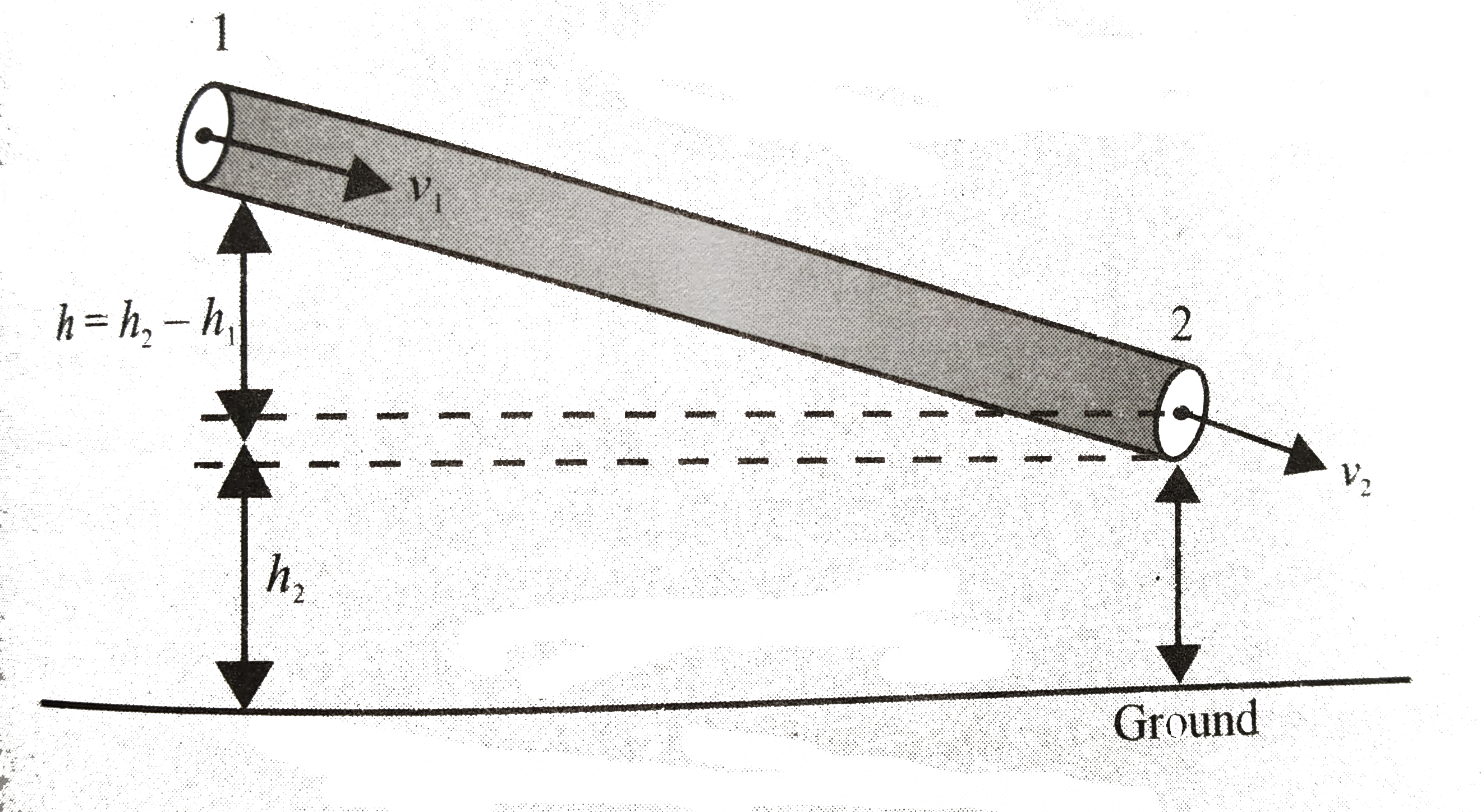
A liquid moves in a smoothh tube of uniform cross section. Find the pressure `P_(2)` at point `2` of the tube if the pressure at point `1` of the extended tube is `P_(1)` and the vertical distance between points `1` and `2` is `h`. brgt
Text Solution
Verified by Experts
Since the cross section of the tube is uniform. `A_(1)=A_(2)=A` Then applying equation of continuity at points `1` and `2`, we have `v_(1)=v_(2)`……i Substuting `v_(1)=v_(2)(=v)` in Bernoulli's equation we have `P_(1)+1/2rhov^(2)+rhogh_(1)=P_(2)+1/2rhov^(2)+rhogh_(2)` This gives `P_(1)+rhogh_(1)+P_(2)+rhogh_(2)` Since `h_(1)-h_(2)=h`, we have `P_(2)=P_(1)+rhogh`
Topper's Solved these Questions
FLUID MECHANICS
CENGAGE PHYSICS|Exercise Solved Examples|7 Videos
FLUID MECHANICS
CENGAGE PHYSICS|Exercise Exercise 4.1|11 Videos
DIMENSIONS & MEASUREMENT
CENGAGE PHYSICS|Exercise Integer|2 Videos
GRAVITATION
CENGAGE PHYSICS|Exercise INTEGER_TYPE|1 Videos
Similar Questions
Explore conceptually related problems
Find the distance between the points P(-2, 1) and Q(3, -7)
Compare the pressure at the point P in the three tubes shown in the figure .
Water is flowing through a long horizontal tube. Let P_A and P_B be the pressures at two points A and B of the tube
Suppose the pressure at the surface of mercury in as barometer tube is P_1 and the pressure at the surface of mercury in the cup is P_2 .
When a capillary tube of radius r is dipped vertically in a liquid of surface tension T, the liquid rises to a height h in the tube above the level outside the tube . If the angle of contact is theta the density of the liquid is rho then the pressure difference between the points A and B is
A tube of uniform cross section is used to siphon water from a vessel V as shown in the figure. The pressure over the open end of water in the vessel is atmospheric pressure (P_(0)) . The height of the tube above and below the water level in the vessel are h_(1) and h_(2) , respectively. Given h_(1) = h_(2) = 3.0 m , the gauge pressure of water in the highest level CD of the tube will be
A tube of uniform cross section is used to siphon water from a vessel V as shown in the figure. The pressure over the open end of water in the vessel is atmospheric pressure (P_(0)) . The height of the tube above and below the water level in the vessel are h_(1) and h_(2) , respectively. If h_(1)=h_(2) = 3.0 m , the maximum value of h_(1) , for which the siphon will work will be
The mass of the liquid flowing per second per unit area of cross section of the tube is proportional to P^(x) and v^(y) , where P is the pressure difference and v is the velocity , then the relation between x and Y is
A liquid flows in a tube from left to right as shown in figure. A_(1) and A_(2) are the cross-section of the portions of the tube as shown. Then the ratio of speeds v_(1)//v_(2) will be