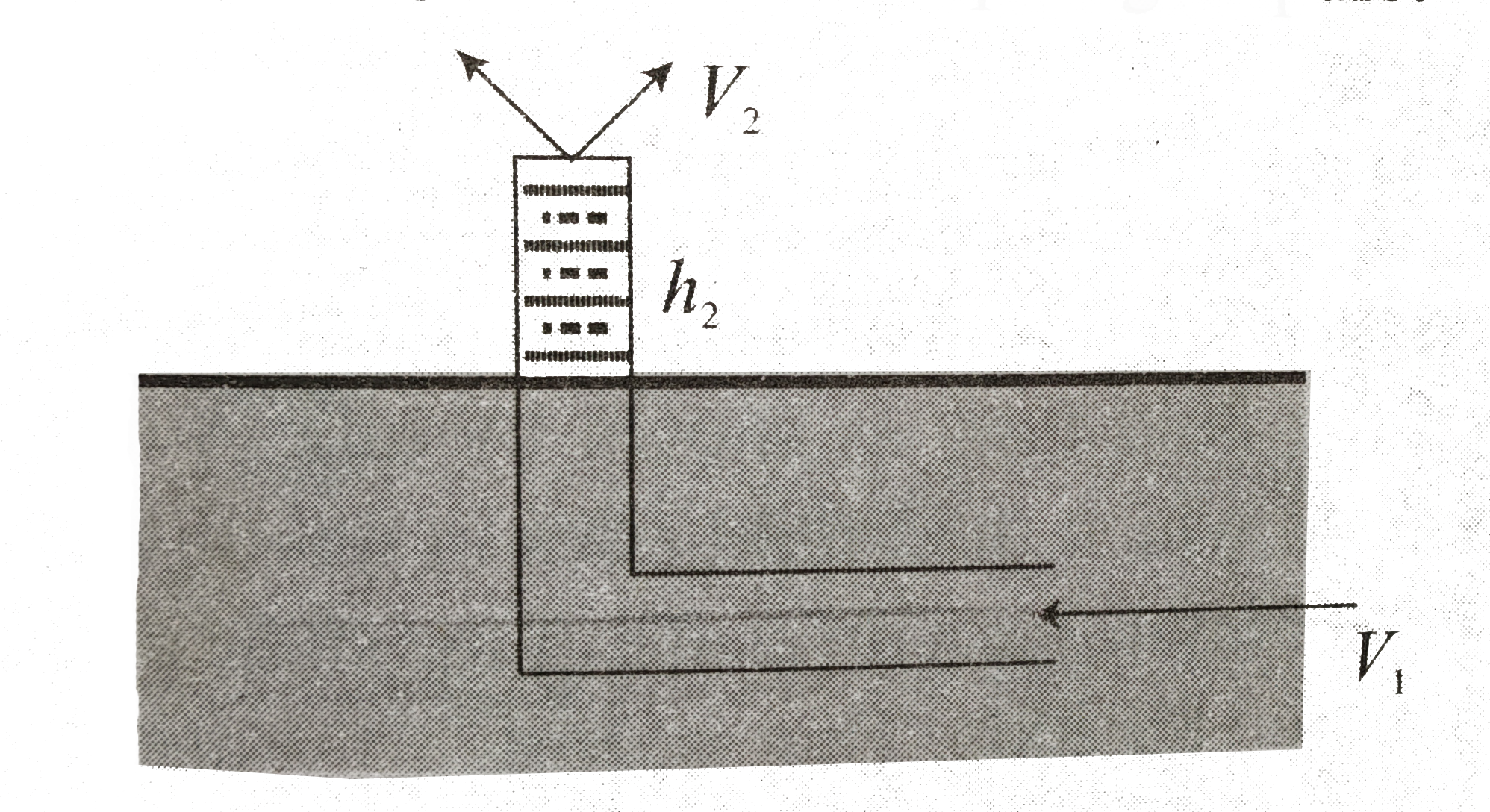
A bent tube is lowered into a water stream as shown in figure. The velocity of the stream is `V_(1)`. The closed upper end is located at a height `h_(0) ` and has a small orifice. To what height `h` will the liquid get spurt? brgt
Text Solution
Verified by Experts
`1/2rhov_(1)^(2)+P_(0)+0=1/2rhov_(2)^(2)+P_(0)+rhogh_(0)impliesV_(2)^(2)=V_(1)^(2)=2gh_(0)` If the liquid reaches a height `h` then `V_(2)^(2)=2gh`, `implies2gh, V_(1)^(2)-2gh_(0)implies h=(V_(1)^(2))/(2g)=h_(0)`
Topper's Solved these Questions
FLUID MECHANICS
CENGAGE PHYSICS|Exercise Solved Examples|7 Videos
FLUID MECHANICS
CENGAGE PHYSICS|Exercise Exercise 4.1|11 Videos
DIMENSIONS & MEASUREMENT
CENGAGE PHYSICS|Exercise Integer|2 Videos
GRAVITATION
CENGAGE PHYSICS|Exercise INTEGER_TYPE|1 Videos
Similar Questions
Explore conceptually related problems
A bent tube is lowered into a water stream as shown in figure. The velocity of the stream relative to the tube is equal to v=2.5 m/s. The closed upper end of the tube located at the height h_(0)=12 cm has a small orifice. To what height h will the water jet spurt ?
A bent tube is lowered into water stream as shown in figure. The velocity of the stream relative to the tube is equal to v=2.5m//s . The closed upper end of the tube located at a height of 12cm has a small orifice. To what height h will the water jet spurt ?
A bent tube is lowered into the stream as shown in the figure below. The velocity of the stream relative to the tube equal to v. The closed upper end of the tube located at the light h_(0) . To what height h will the water jet spurt ?
A bent tube is lowered into a water stream as shown in figure. The velocity of the stream relative to the tube is equal to v=2.5m//s . The closed upper end of the tube located at the height h_0=12cm has a small orifice. To what height h will the water jet spurt?
A bent tube is lowered into a stream of water as shown in the figure. The velocity of the stream is v=2m//s . The closed upper end of the tube is at a height h_(0)=10cm from the suface of water in the stream and has a small orifice. To what height will the water jet from the orifice spurt?
Water rises to a height h in a capillary tube lowered vertically into water to a depth l as shown in the figure. The lower end of the tube is now closed, the tube is the taken out of the water and opend again. The length of the eater column remaining in the tube will be .
An L-shaped tube with a small orifice is held in a water stream as shown in fig. The upper end of the tube is 10.6 cm above the surface of water. What will be the height of the jet of water coming from the orifice? Velocity of water stream is 2.45 m // s
An L-shaped tube with a small orifice is held in a water stream as shown in fig. the upper end of the tube is 10.6 cm above the surface of water. What will be the height of the jet of water coming from the orifice? (Velocity water steam is 2.45 m//s )
(i) Air (density= rho ) flows through a horizontal venturi tube that discharges to the atmosphere. The area of cross section of the tube is A_(1) and at the constriction it is A_(2) . The constriction is connected to a water (density =rho_(0) ) tank through a vertical pipe of lenght H. Find the volume flow rate (Q) of the air through tube that is needed to just draw the water into the tube. (ii) A non viscous liquid of constant density rho flows in a stremline motion along a tube of variable cross section. The tube is kept inclined in the vertical plane as shown in the figure. The area of cross section of the tube at two points P and Q at heights of h_(1) and h_(2) are respectively A_(1) and A_(2) . The velocity of the liquid at point P is v. Find the work done on a small volume DeltaV of fluid by the neighbouring fluid as the small volume moves from P to Q.
A simple accelerometer (an instrument for measuring acceleration) can be made in the form of a tube filled with a liquid and bent as shown. During motion, the level of the liquid in the left arm will be at a height h_(1) and in the right arm at a height h_(2) . Determine the acceleration a of a carriage in which the accelerometer is installed, assuming that the diameter of the tube is much smaller than h_(1) and h_(2) .