Home
Class 11
PHYSICS
Three particles, each of mass m, are sit...

Three particles, each of mass m, are situated at the vertices of equilateral triangle of side length a. The only forces. It is desired that each particle moves in a circle while maintaining the original mutual speration a. Find the intial velocity that should be given to each particle and also the time period of the circular motion.

Text Solution

Verified by Experts

Refer to figure, force of attraction on body at `C` due to body at `A` is
`F_(1)=(Gmm)/(r^(2))=(Gm^(2))/(r^(2))` along `CA`
Force of attraction on body at `C` due to body at `B` is
`F_(2)=(Gmm)/(r^(2))=(Gm^(2))/(r^(2))` along `CB`.
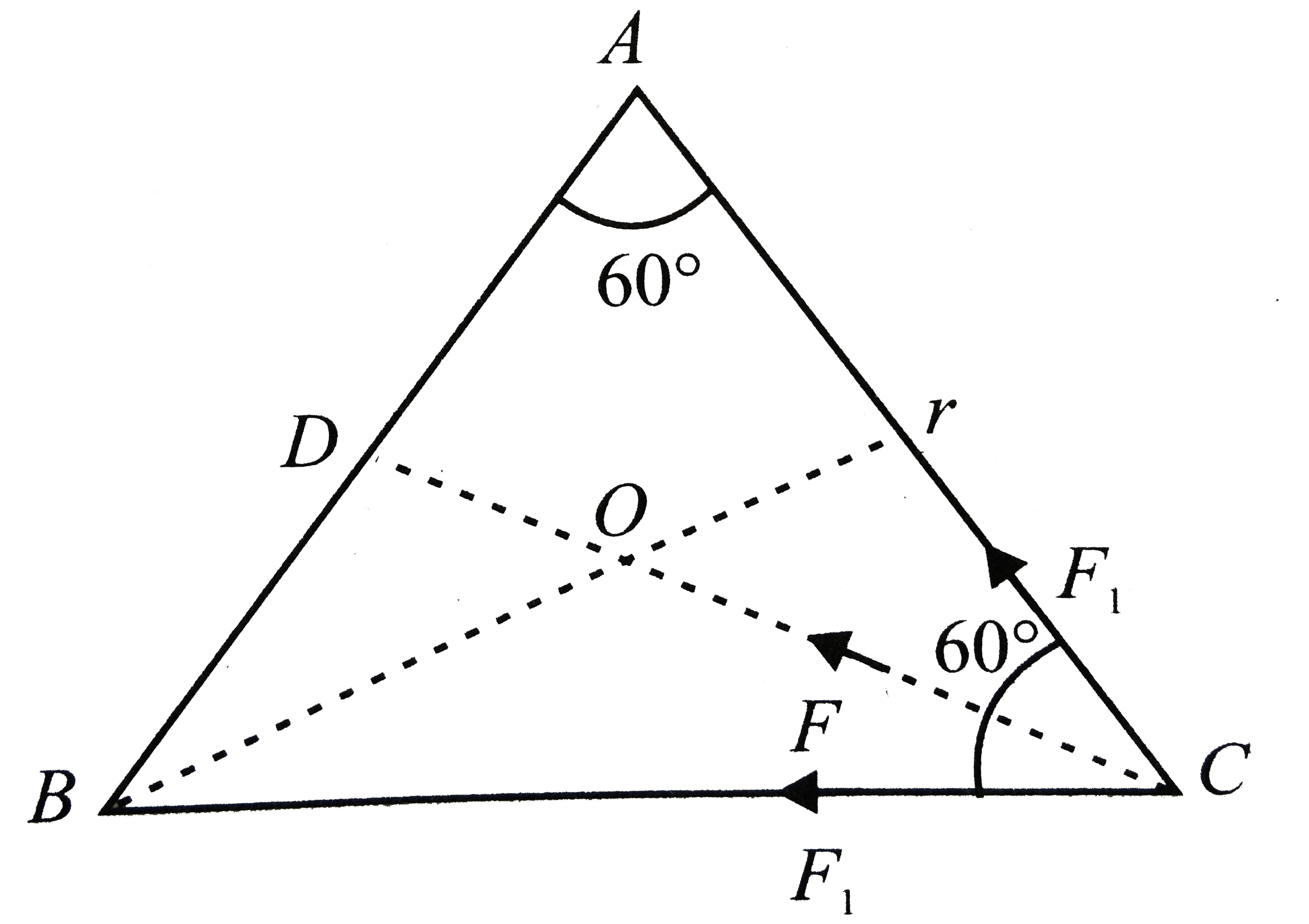
These force `vecF_(1)` and `vecF_(2)` are inclined at an angle `60^@`. the resultant force on the body at `C` is
`F=sqrt(F_(1)^(2)+F_(2)^(2)+2F_(1)F_(2)cos60^@)`
`=sqrt(F_(1)^(2)+F_(2)^(2)+2F_(1)F_(2)(1/2))`
`sqrt(3)F_(1)=sqrt(3)(Gm^(2))/(r^(2))` acting along CD
`:'F_(1)=F_(2)=[(Gm^(2))/(r^(2))]`
Here `OC=2/3 C=2/3ACsin60^@`
`=2/3rxx(sqrt(3))/2=r/(sqrt(3))`
When each body is describing a circular orbit with cenre of orbit at `O`, the force `F` provides the required centripetal force. The radius of the circular orbit is `OC=r//sqrt(3)`. If `v` is the speed of the body in circular orbit, then
`(Mv^(2))/(r//sqrt(3))=(sqrt(3)Gm^(2))/(r^(2))` or `v=sqrt((Gm)/r)`

Promotional Banner

Topper's Solved these Questions

  • GRAVITATION

    CENGAGE PHYSICS|Exercise Exercise 6.1|13 Videos
  • GRAVITATION

    CENGAGE PHYSICS|Exercise Exercise 6.2|15 Videos
  • FLUID MECHANICS

    CENGAGE PHYSICS|Exercise INTEGER_TYPE|1 Videos
  • KINEMATICS-1

    CENGAGE PHYSICS|Exercise Integer|9 Videos

Similar Questions

Explore conceptually related problems

Three particles, each of the mass m are situated at the vertices of an equilateral triangle of side a . The only forces acting on the particles are their mutual gravitational forces. It is desired that each particle moves in a circle while maintaining the original mutual separation a . Find the initial velocity that should be given to each particle and also the time period of the circular motion. (F=(Gm_(1)m_(2))/(r^(2)))

Three parties, each of mass m, are situated at the vertices of an equilateral triangle of side length a . The only forces acting on the pariclaes are th eir mutual gravitational forces. It is desired that each particles moves ina a circle while maintaining the original mutual separation a. Find the initial velocity that should be given to each particle and also the time period of teh circular motion.

Three particles each of mass m are kept at the vertices of an euilateral triangle of side L . The gravitational field at the centre due to these particle is

Three particles, each of mass m, are situated at the situated at the vertices of an equilateral triangle of side 'a'. The only forces acting on the particles are their mutual gravitational forces. It is intended that each particle moves along a circle while maintaining their original separation 'a'. Determine the initial velocity that should be given to each particle and the time period of the circular motion. The resultant force on particle at A due to other two particles is

Three particle each of mass m are placed at the corners of equilateral triangle of side l Which of the following is/are correct ?

Three particles of equal mass 'm' are situated at the vertices of an equilateral triangle of side L . The work done in increasing the side of the triangle to 2L is

Three particles each of mass m are kept at vertices of an equilateral triangle of side L. The gravitational field at centre due to these particle is

Three particles each of mass m are palced at the corners of an equilateral triangle of side b . The gravitational potential energy of the system of particle is

Three particles, each of mass m are fixed at the vertices of an equilateral triangle of side length a . The only forces acting on the particles are their mutual gravitational forces. Then answer the following questions. The gravitational potential at O is
