We consider the shaded elemetnal disc of radius `Rsintheta` and thickness `Rd theta`
its mass
`dM=M/(2/3piR^(3))pi(Rsintheta)^(2)(Rd thetasintheta)`
or `dM=(3M)/2sin^(3)theta d theta`
Field due to this plate at `O`,
`dE=(2GdM(1-costheta))/((Rsintheta)^(2))` (see field due to a uniform disc)
or `dE=(3GMsintheta(1-costheta)d theta)/(R^(2))`
Therefore, `E=int_(0)^((pi)/2) dE=int_(0)^((pi)/2) =(3GMsintheta(1=costheta))/(R^(2))d theta`
`=(3GM)/(R^(2))[-costheta+(cos^(2)theta)/2]_(0)^((p)i/2)`
or `E=(3GM)/(2R^(2))`
Now potential due to the element under consider at the cente of the baase of the hemisphere
`dV=-2GdM//r (cosectheta-cottheta)`
(See potential due to a circular plate)
or `dV=(-3GMsin^(3)theta(cosectheta-cottheta)d theta)/((Rsintheta)`
Therefore, `V=-(3GM)/Rint_(0)^((pi)/2) (sintheta-costhetasintheta)d theta`
`=-(3GM)/R[-costheta+(cos^2theta)/2]_0^(pi/2)`
or `V=(-3GM)/(2R)`
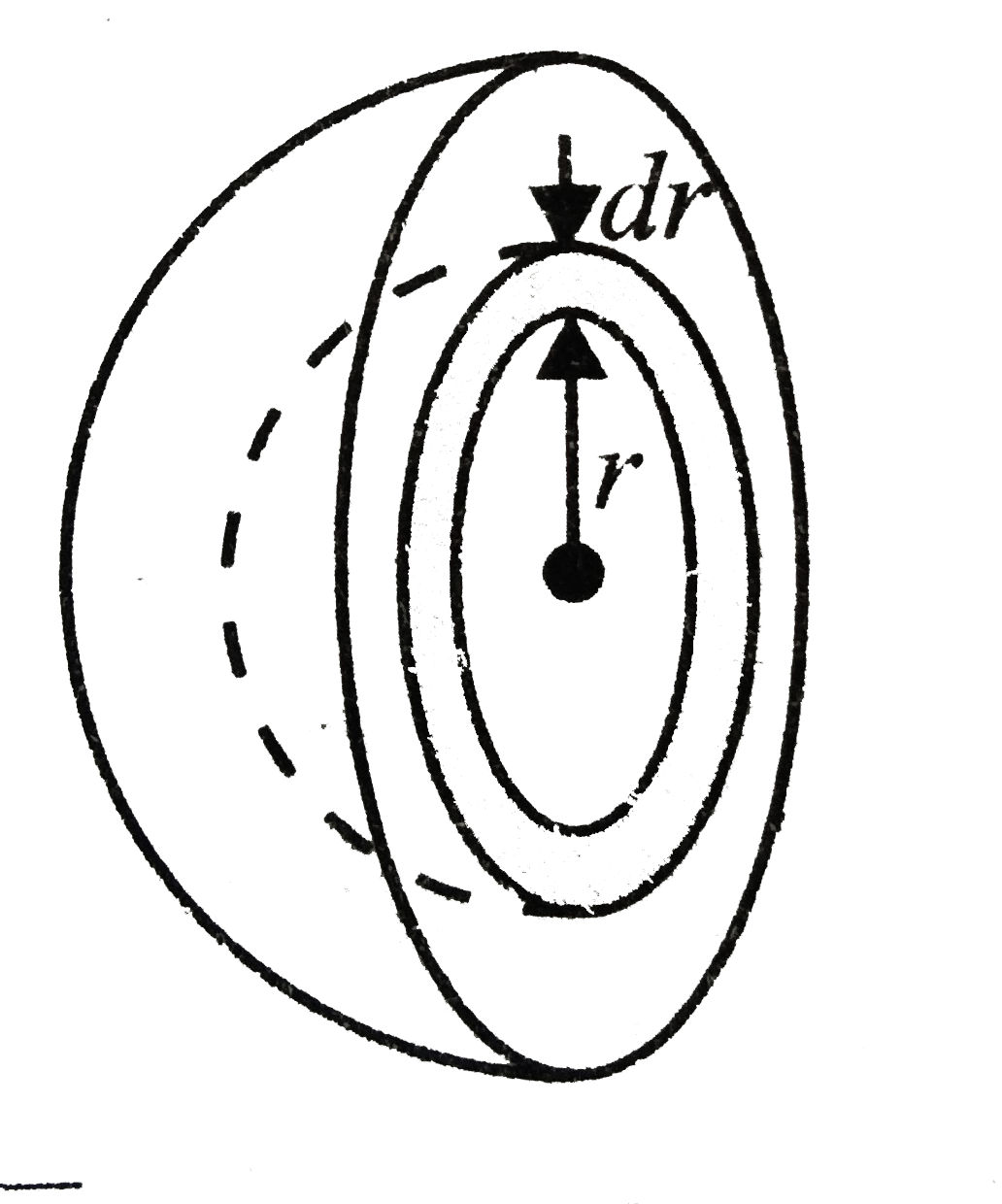
Alternative method: Consider a hemispherical shell of radius `r` and thicknes `dr`
It mass
`dm=M/(2/3piR^(3))(2pi^(2)dr)` or `dm=(3Mr^(2)dr)/(R^(3))`
Since all points of this hemispherical shell are at the same distnce `r` from `O` hence potential at `O` is
`dV=(-Gdm)/r=(-3GMrdr)/(R^(3))`
`:. V=int_(0)^(R)dV=(-3GM)/(2R)`


