Text Solution
Verified by Experts
The correct Answer is:
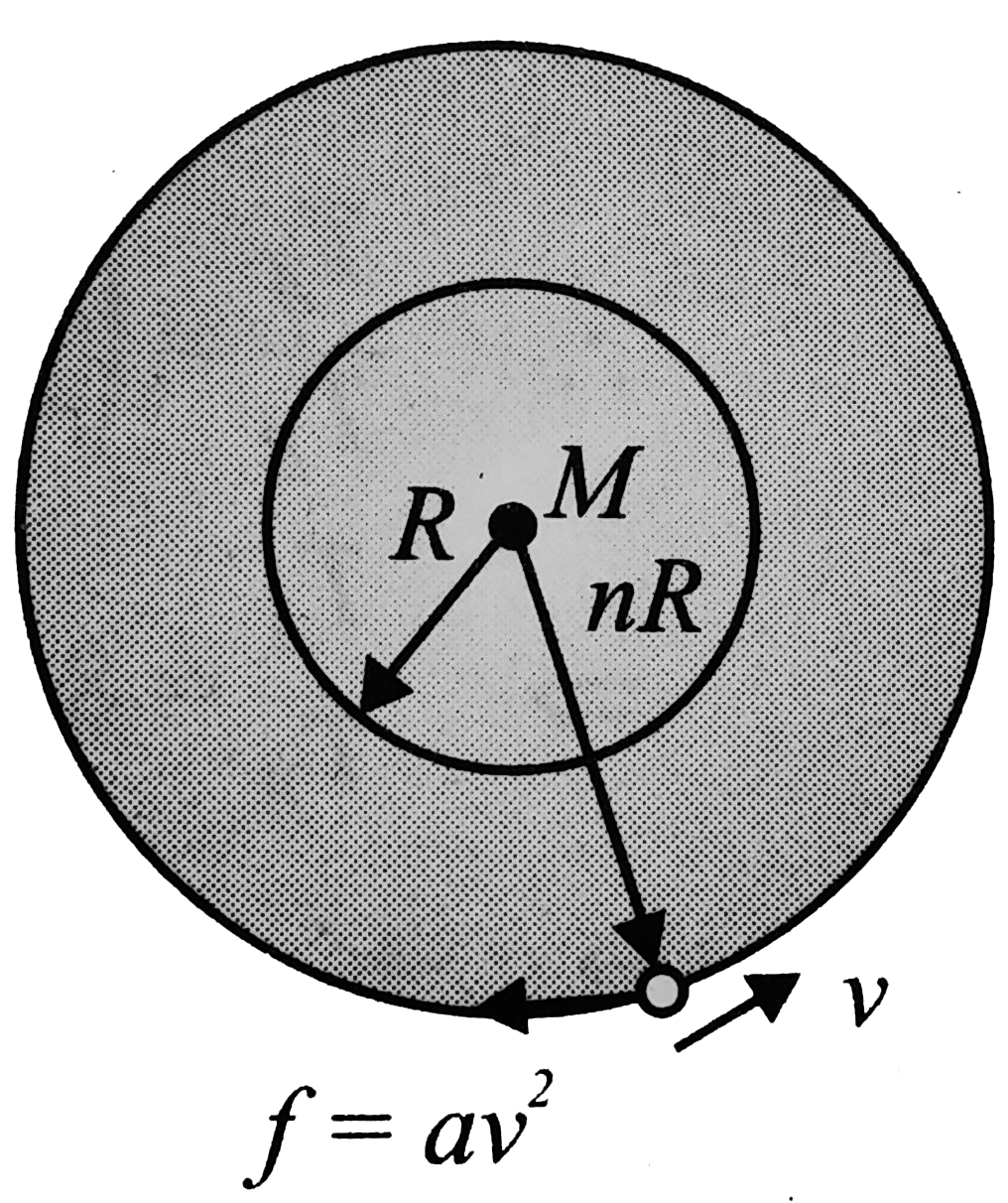



Topper's Solved these Questions
Similar Questions
Explore conceptually related problems
CENGAGE PHYSICS-GRAVITATION-Subjective
- Calculate the velocity with which a body must be thrown vertically upw...
Text Solution
|
- A sky laboratory of mass 2 xx 10^(3) kg has to be lifted from one circ...
Text Solution
|
- Estimate whether it takes more energy to get a satellite upto 1600 km ...
Text Solution
|
- The gravitational field in a region is given by vecE = (3hati- 4hatj) ...
Text Solution
|
- A body suspended on a spring balance in a ship weighs W(0) when the sh...
Text Solution
|
- A spaceship is sent to investigate a planet of mass M and radius R. Wh...
Text Solution
|
- Ravi can throw a ball at a speed on the earth which can cross a river ...
Text Solution
|
- A spaceship approaches the Moon (mass = M and radius = R along a parab...
Text Solution
|
- Taking the earth to be a uniform sphere of radius 6400 km and the valu...
Text Solution
|
- A satellite is to be put into an orbit 600 km above the surface of the...
Text Solution
|
- A pair of stars rotates about a common centre of mass. One of the star...
Text Solution
|
- The small dense stars rotate about their common centre of mass as a bi...
Text Solution
|
- A satellite revolving in a circular equatorial orbit of radius R = 2.0...
Text Solution
|
- An artificial satellite (mass m) of a planet (mass M) revolves in a ci...
Text Solution
|
- A satellite of mass m is orbiting the earth in a circular orbit of rad...
Text Solution
|