Home
Class 11
PHYSICS
Two concentric shells of masses M(1) and...

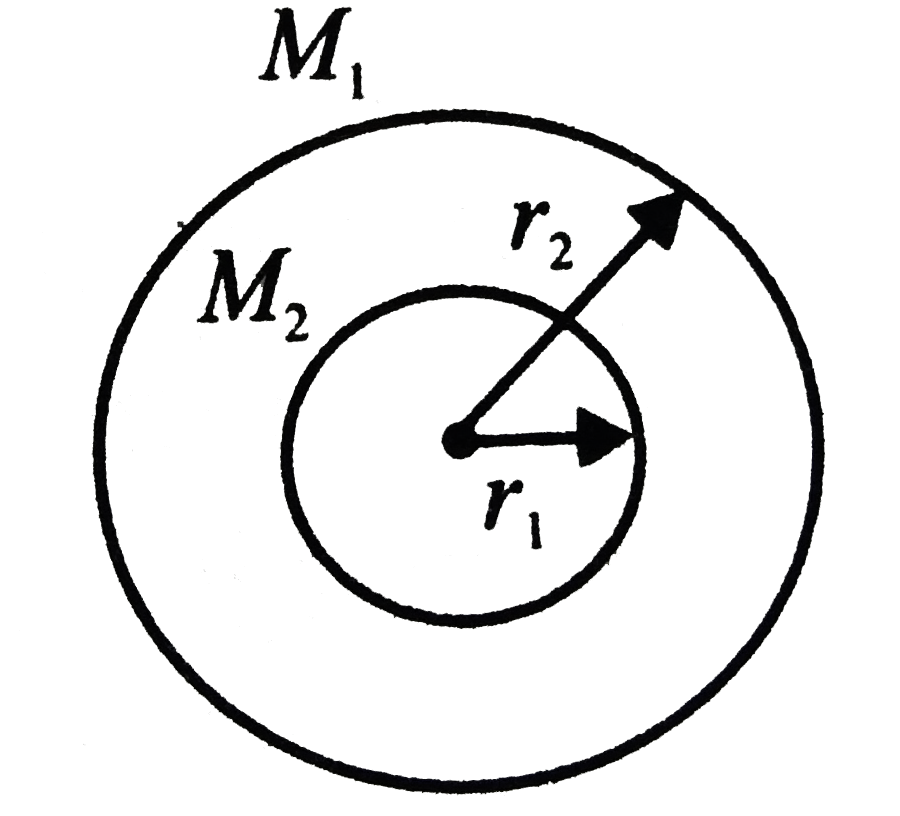
Two concentric shells of masses `M_(1)` and `M_(2)` are having radii `r_(1)` and `r_(2)`. Which of the following is the correct expression for the gravitational field on a mass `m`?

A

`F=(G(M_(1)+M_(2)))/(r^(2))`, for `rltr_(1)`

B

`F=(G(M_(1)+M_(2)))/((r^(2))`, for `rltr_(2)`

C

`F=(GM_(2))/(r^(2))`, for `r_(1)ltrltr_(2)`

D

`F=GM_(1)/(r^(2))`, for `r_(1)ltrltr_(2)`

Text Solution

Verified by Experts

The correct Answer is:

C

Gravitational field inside a shell is zero, but for points outside it, the shell behaves as if whole of its mass is concentrated at its centre. Hence, for a point lying in between the shells there will be a field only due to the inner shell `(=GM_(2)//r^(2))` because the point will be an external point for the inner shell but internal for the outer shell.
Promotional Banner

Topper's Solved these Questions

  • GRAVITATION

    CENGAGE PHYSICS|Exercise Multiple Correct|24 Videos
  • GRAVITATION

    CENGAGE PHYSICS|Exercise Assertion- Reasoning|13 Videos
  • GRAVITATION

    CENGAGE PHYSICS|Exercise Subjective|15 Videos
  • FLUID MECHANICS

    CENGAGE PHYSICS|Exercise INTEGER_TYPE|1 Videos
  • KINEMATICS-1

    CENGAGE PHYSICS|Exercise Integer|9 Videos

Similar Questions

Explore conceptually related problems

Assertion : Two spherical shells have masses m_(1) and m_(2) . Their radii are r_(1) and r_(2) . Let r be the distance of a point from centre. Then gravitational field strength and gravitational potential both are equal to zero for O lt r lt r_(1) Reason : In the region r_(1) lt r lt r_(2) , gravitational field strength due to m_(2) is zero. But gravitational potential due to m_(2) is constant (but non-zero).

Two concentric spherical shells have masses m_(1) and m_(2) and radii r_(1) and r_(2) (r_(2) gt r_(1)) . What is the force exerted by this system on a particle of mass m_(3) . If it is placed at a distance r(r_(1) lt r lt r_(2)) from the centre ?

Consider three concentric shells of masses M_(1),M_(2) and M_(3) having radii a,b and c respectively are situated as shown in Gravitational field at a point located at Q and P is

Two concentric shells of different mass m_(1) and m_(2) are having a sliding particle of mass m . The forces on the sliding at positions I,II and III are respectively

Two particles of masses m_(1) and m_(2) are moving in concentric circle of radii r_(1) and r_(2) such that their period are same. Then the ratio of their centripetal acceleration is

Two bodies of masses M_(1) and M_(2) , are placed at a distance R apart. Then at the position where the gravitational field due to them is zero, the gravitational potential is

Two concentric shells of masses M_(1) and M_(2) are concentric as shown. Calculate the gravitational force on m due to M_(1) at points P,Q and R .

The figure represents two concentric shells of radii R_(1) and R_(2) and masses M_(1) and M_(2) respectively. The gravitational field intensity at the point A at distance a (R_(1) lt a lt R_(2)) is

Two bodies of masses m_(1) and m_(2) are placed at a distance r apart. Show that the position where the gravitational field due to them is zero, the potential is given by -G (m_(1) + m_(2) + 2 sqrt(m_(1) + m_(2)))//r

Position vector of centre of two particles of masses m_(1) and m_(2) whose position vectors r_(1) and r_(2) then r_(cm) ?

CENGAGE PHYSICS-GRAVITATION-Single Correct
  1. A projectile is fired from the surface of earth of radius R with a vel...

    Text Solution

    |

  2. An artificial satellite is moving in a circular orbit around the earth...

    Text Solution

    |

  3. Two concentric shells of masses M(1) and M(2) are having radii r(1) an...

    Text Solution

    |

  4. A satellite of mass m is orbiting around the earth at a height h above...

    Text Solution

    |

  5. Two concentric shells have masses M and m and their radii are R and r,...

    Text Solution

    |

  6. A solid sphere of uniform density and radius 4 units is located with i...

    Text Solution

    |

  7. Three equal masses m are placed at the three corners of an equilateral...

    Text Solution

    |

  8. Figure shows a planet in an elliptical orbit around the Sun S. Where i...

    Text Solution

    |

  9. The escape velocity corresponding to a planet of mass M and radius R i...

    Text Solution

    |

  10. A planet is revolving around the Sun in an elliptical orbit. Its close...

    Text Solution

    |

  11. The radii of two planets are respectively R(1) and R(2) and their dens...

    Text Solution

    |

  12. Figure shows the motion of a planet around the Sun S in an elliptical ...

    Text Solution

    |

  13. A body is fired with a velocity of magnitude sqrt(gR)ltVltsqrt(2gR) at...

    Text Solution

    |

  14. A system of binary stars of mass m(A) and m(B) are moving in circular ...

    Text Solution

    |

  15. Two spherical bodies of mass M and 5M & radii R & 2R respectively are ...

    Text Solution

    |

  16. The change in the value of 'g' at a height 'h' above the surface of th...

    Text Solution

    |

  17. A particle of mass 10g is kept on the surface of a uniform sphere of ...

    Text Solution

    |

  18. A tunnel is dug along the diameter of the earth. There is particle of ...

    Text Solution

    |

  19. A cavity of radius R//2 is made inside a solid sphere of radius R. The...

    Text Solution

    |

  20. A satellite is seen after every 8 hours over the equator at a place on...

    Text Solution

    |
