Home
Class 11
PHYSICS
A tunnel is dug along a chord of the ear...

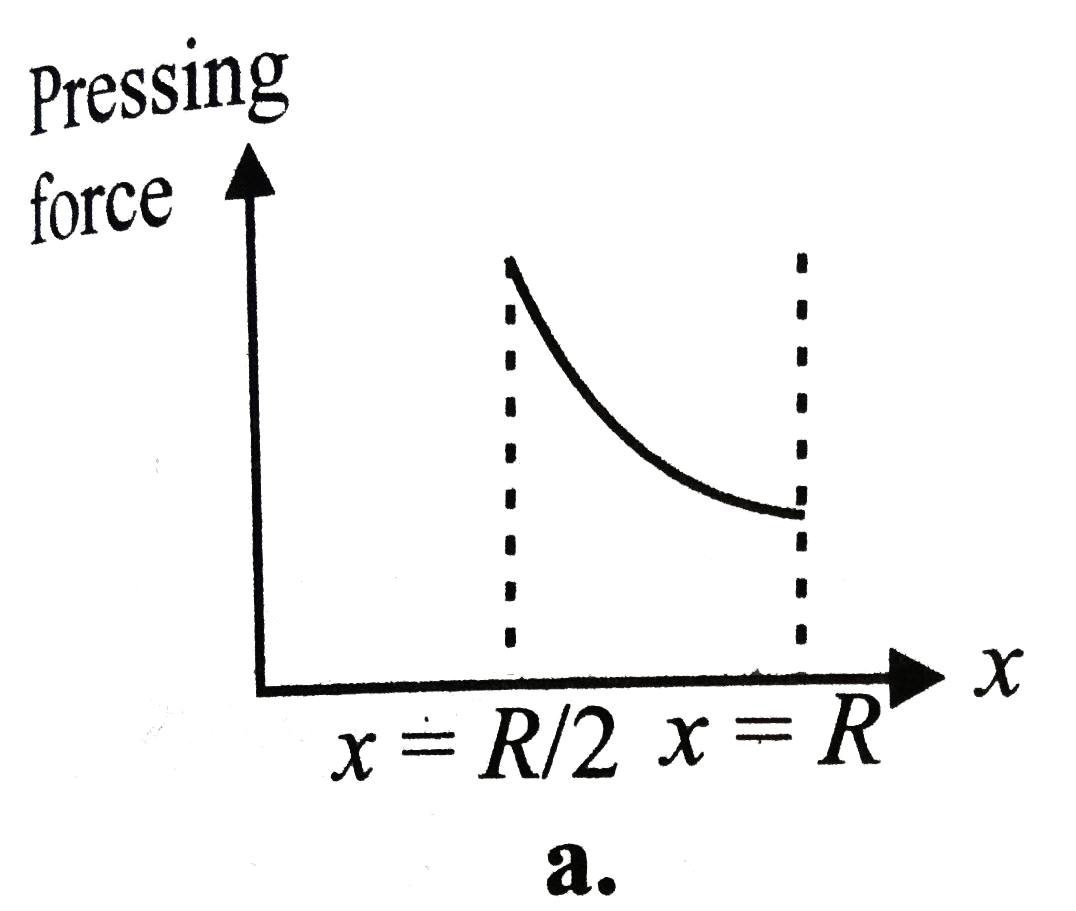
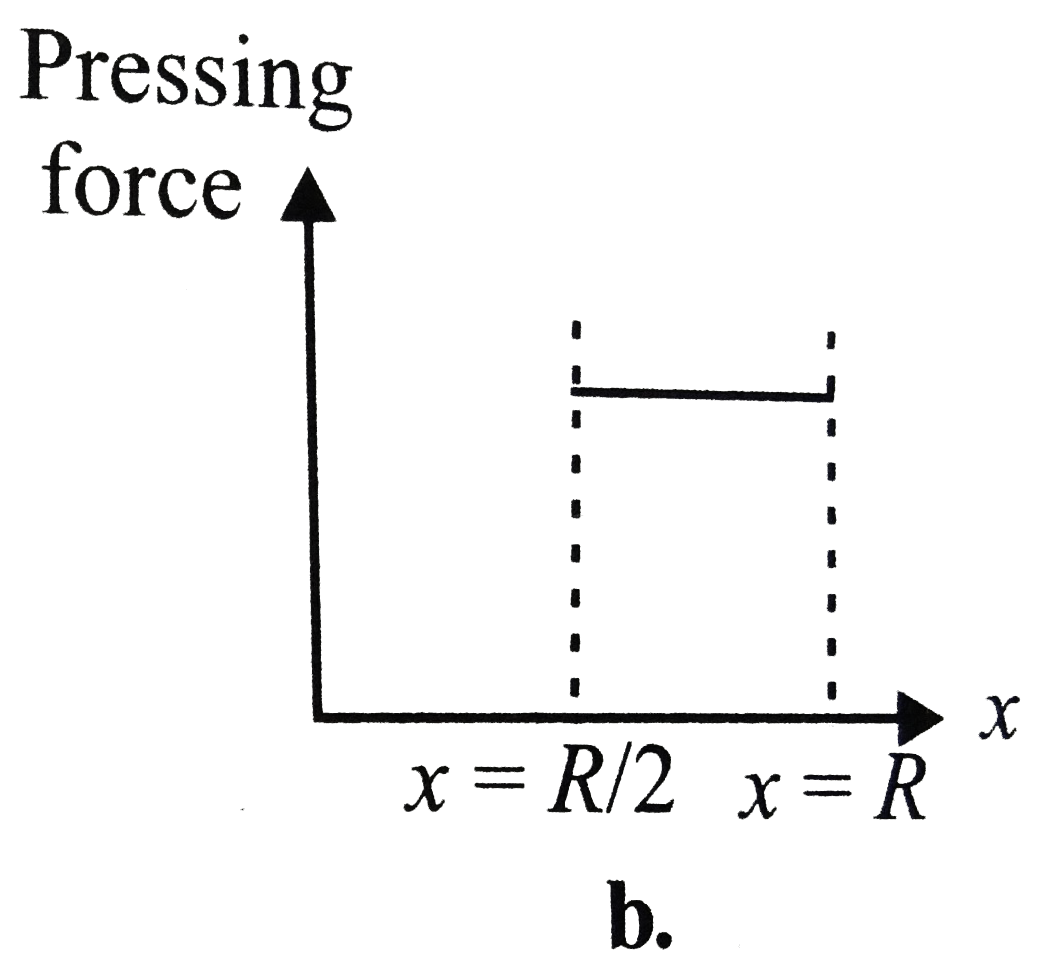
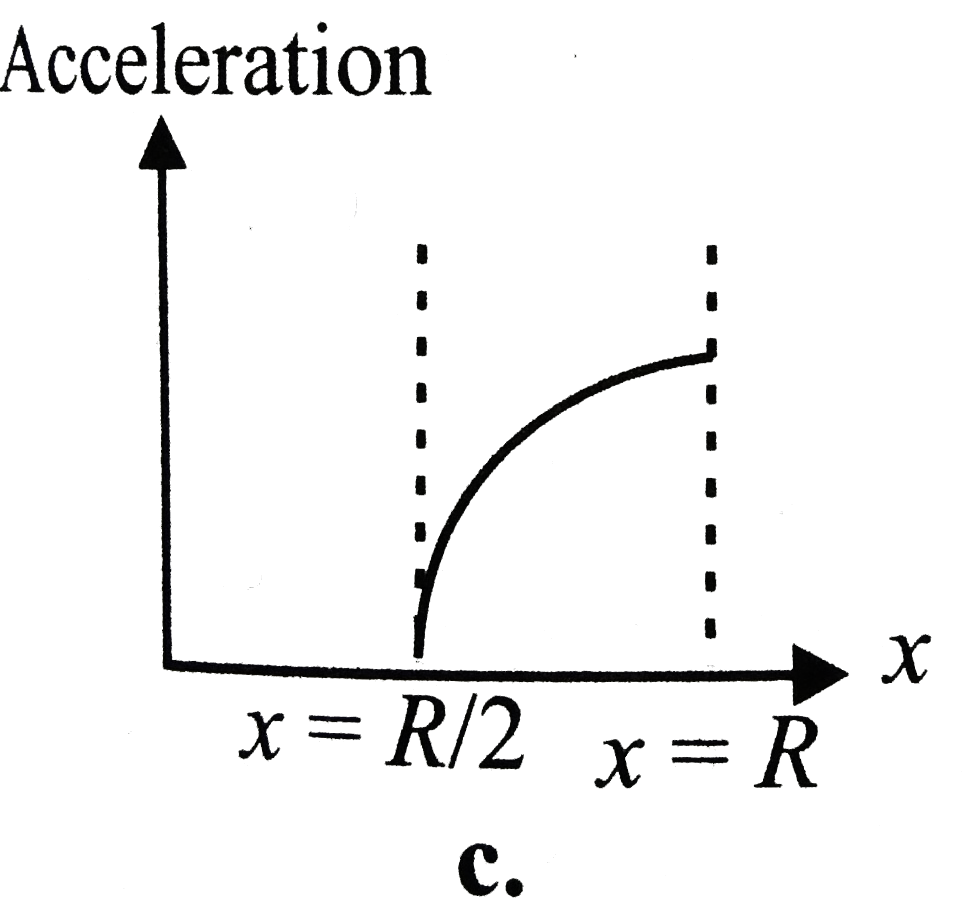
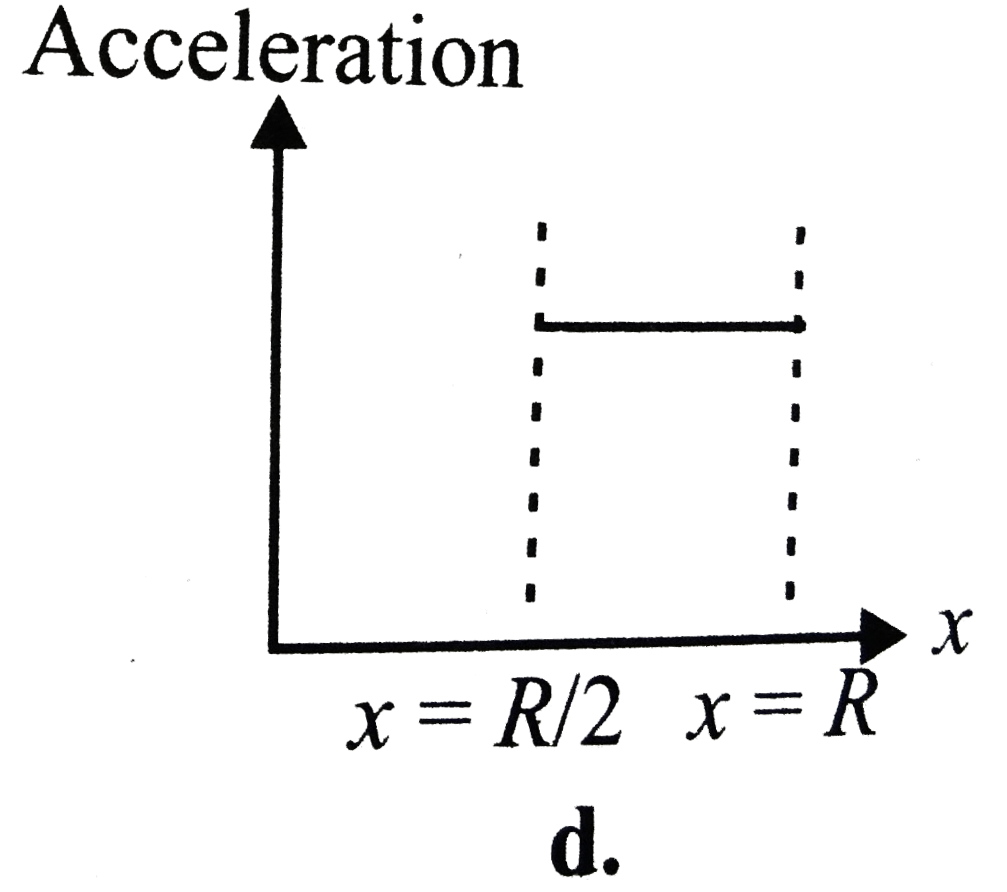
A tunnel is dug along a chord of the earth at a perpendicular distance `R//2` from the earth's centre. The wall of the tunnel may be assumed to be frictionless. A particle is released from one end of the tunnel. The pressing force by the particle on the wall, and the acceleration of the particle vary with `x` (distance of the particle from the centre) according to

A

B

C

D

Text Solution

AI Generated Solution

The correct Answer is:

To solve the problem, we need to analyze the situation of a particle released from one end of a frictionless tunnel dug along a chord of the Earth at a perpendicular distance of \( R/2 \) from the center of the Earth. We will derive the expressions for the pressing force by the particle on the wall of the tunnel and the acceleration of the particle as it moves through the tunnel. ### Step 1: Understanding the Geometry The tunnel is dug at a distance of \( R/2 \) from the center of the Earth. The distance of the particle from the center of the Earth is denoted as \( x \). The gravitational force acting on the particle varies with depth, and we need to find expressions for the forces acting on the particle. ### Step 2: Gravitational Force Inside the Earth Inside the Earth, the gravitational force \( g' \) at a distance \( x \) from the center can be given by: \[ g' = g \left(1 - \frac{d}{R}\right) \] where \( d \) is the depth below the surface. Since the depth \( d \) can be expressed as \( R - x \), we have: \[ g' = g \left(1 - \frac{R - x}{R}\right) = g \left(\frac{x}{R}\right) \] ### Step 3: Pressing Force on the Wall The pressing force \( N \) exerted by the particle on the wall of the tunnel can be derived from the component of the gravitational force acting perpendicular to the wall. The angle \( \theta \) can be determined from the geometry of the situation, where: \[ \sin \theta = \frac{R/2}{x} \] Thus, the normal force can be expressed as: \[ N = mg' \sin \theta \] Substituting \( g' \) and \( \sin \theta \): \[ N = mg \left(\frac{x}{R}\right) \left(\frac{R/2}{x}\right) = \frac{mg}{2} \] This shows that the pressing force \( N \) is constant and does not depend on \( x \). ### Step 4: Acceleration of the Particle The net force acting on the particle in the direction of the tunnel is given by: \[ F = mg' \cos \theta \] Using \( g' = g \left(\frac{x}{R}\right) \) and \( \cos \theta = \frac{\sqrt{x^2 - (R/2)^2}}{x} \): \[ F = mg \left(\frac{x}{R}\right) \left(\frac{\sqrt{x^2 - (R/2)^2}}{x}\right) = \frac{mg \sqrt{x^2 - (R/2)^2}}{R} \] The acceleration \( a \) of the particle can be expressed as: \[ a = \frac{F}{m} = \frac{g \sqrt{x^2 - (R/2)^2}}{R} \] ### Step 5: Analyzing the Acceleration Expression The expression for acceleration shows that it varies with \( x \) and is zero when \( x = R/2 \). The acceleration is a parabolic function of \( x \). ### Conclusion The pressing force by the particle on the wall of the tunnel is constant, while the acceleration of the particle varies parabolically with \( x \). Therefore, the correct options for the graphs representing these relationships are: - Pressing Force: Constant (Option B) - Acceleration: Parabolic (Option C)

To solve the problem, we need to analyze the situation of a particle released from one end of a frictionless tunnel dug along a chord of the Earth at a perpendicular distance of \( R/2 \) from the center of the Earth. We will derive the expressions for the pressing force by the particle on the wall of the tunnel and the acceleration of the particle as it moves through the tunnel. ### Step 1: Understanding the Geometry The tunnel is dug at a distance of \( R/2 \) from the center of the Earth. The distance of the particle from the center of the Earth is denoted as \( x \). The gravitational force acting on the particle varies with depth, and we need to find expressions for the forces acting on the particle. ### Step 2: Gravitational Force Inside the Earth Inside the Earth, the gravitational force \( g' \) at a distance \( x \) from the center can be given by: \[ ...
Promotional Banner

Topper's Solved these Questions

  • GRAVITATION

    CENGAGE PHYSICS|Exercise Multiple Correct|24 Videos
  • GRAVITATION

    CENGAGE PHYSICS|Exercise Assertion- Reasoning|13 Videos
  • GRAVITATION

    CENGAGE PHYSICS|Exercise Subjective|15 Videos
  • FLUID MECHANICS

    CENGAGE PHYSICS|Exercise INTEGER_TYPE|1 Videos
  • KINEMATICS-1

    CENGAGE PHYSICS|Exercise Integer|9 Videos

Similar Questions

Explore conceptually related problems

A tunnel ois dug along a chord of the earth a perpendicular distance R/2 from the earth's centre. The wall of the tunnel may be assumed to be frictionless. Find the force exerted by the eall on a particle of mass m when it is at a distance x from the centre of the tunnel.

Assume that a tunnel is dug along a chord of the earth, at a perpendicular distance (R//2) from the earth's centre, where 'R' is the radius of the Earth. The wall of the tunnel is frictionless. If a particle is released in this tunnel, it will execute a simple harmonic motion with a time period :

Assume that a tunnel is dug along a cord of earth at a perpendicular distance R/2 from earth's centre where R is the radius of earth. The wall of tunnel is frictionless. Find the time period of particle excuting SHM in tunnel

(a) A tunnel is dug along a diameter of the earth. Find the force on the a particle of mass m placed in the tunnel at a distance x from the centre. (b) A tunnel is dug along a chord of the earth at a perpendicular distance R//2 from the earth's centre. the wall of the tunnel may be assumed to be frictionless. Find the force exerted by the wall on a particle of mass m when it is at a distance x from the centre of the tunnel.

A tunnel is dug across the earth of mass 'M' and radius 'R' at a distance R//2 from the centre 'O' of the Earth as shown. A body is released from rest from one end of the smooth tunnel. The velocity acquired by the body when it reaches the centre 'C' of the tunnel is

If a smooth tunnel is dug across a diameter of earth and a particle is released from the surface of earth, the particle oscillate simple harmonically along it Time period of the particle is not equal to

If a smooth tunnel is dug across a diameter of earth and a particle is released from the surface of earth, the particle oscillate simple harmonically along it Maximum speed of the particle is

Suppose a tunnel is dug along a diameter of the earth. A particle is dropped from a point a distance h directly above the tunnel. The motion of the particle as seen from the earth is

CENGAGE PHYSICS-GRAVITATION-Single Correct
  1. Two rings having masses M and 2M respectively, having the same radius ...

    Text Solution

    |

  2. A point mass m is released from rest at a distance of 3R from the cent...

    Text Solution

    |

  3. A body is thrown from the surface of the earth with velocity (gR(e))//...

    Text Solution

    |

  4. The gravitational force exerted by the Sun on the Moon is about twice ...

    Text Solution

    |

  5. A tunnel has been dug into a solid sphere of non-uniform mass density ...

    Text Solution

    |

  6. A ring having non-uniform distribution of mass M and radius R is being...

    Text Solution

    |

  7. An artificial satellite of the earth is launched in circular orbit in ...

    Text Solution

    |

  8. A satellite is orbiting around the earth in a circular orbit of radius...

    Text Solution

    |

  9. Figure shows the kinetic energy (E(k)) and potential energy (E(p)) cur...

    Text Solution

    |

  10. A double star is a system of two stars of masses m and 2m, rotating ab...

    Text Solution

    |

  11. A tunnel is dug along a chord of the earth at a perpendicular distance...

    Text Solution

    |

  12. Consider a planet moving in an elliptical orbit around the Sun. The wo...

    Text Solution

    |

  13. Which of the following statements are true about acceleration due to g...

    Text Solution

    |

  14. Let V and E denote the gravitational potential and gravitational field...

    Text Solution

    |

  15. If a body is projected with a speed lesser than escape velocity, then

    Text Solution

    |

  16. An orbiting satellite will escape if

    Text Solution

    |

  17. In case of an orbiting satellite, if the radius of orbit is decreased

    Text Solution

    |

  18. If two satellites of different masses are revolving in the same orbit,...

    Text Solution

    |

  19. A double star is a system of two stars of masses m and 2m, rotating ab...

    Text Solution

    |

  20. Mark the correct statements.

    Text Solution

    |
