Home
Class 11
PHYSICS
Statement I: In free space a uniform sph...

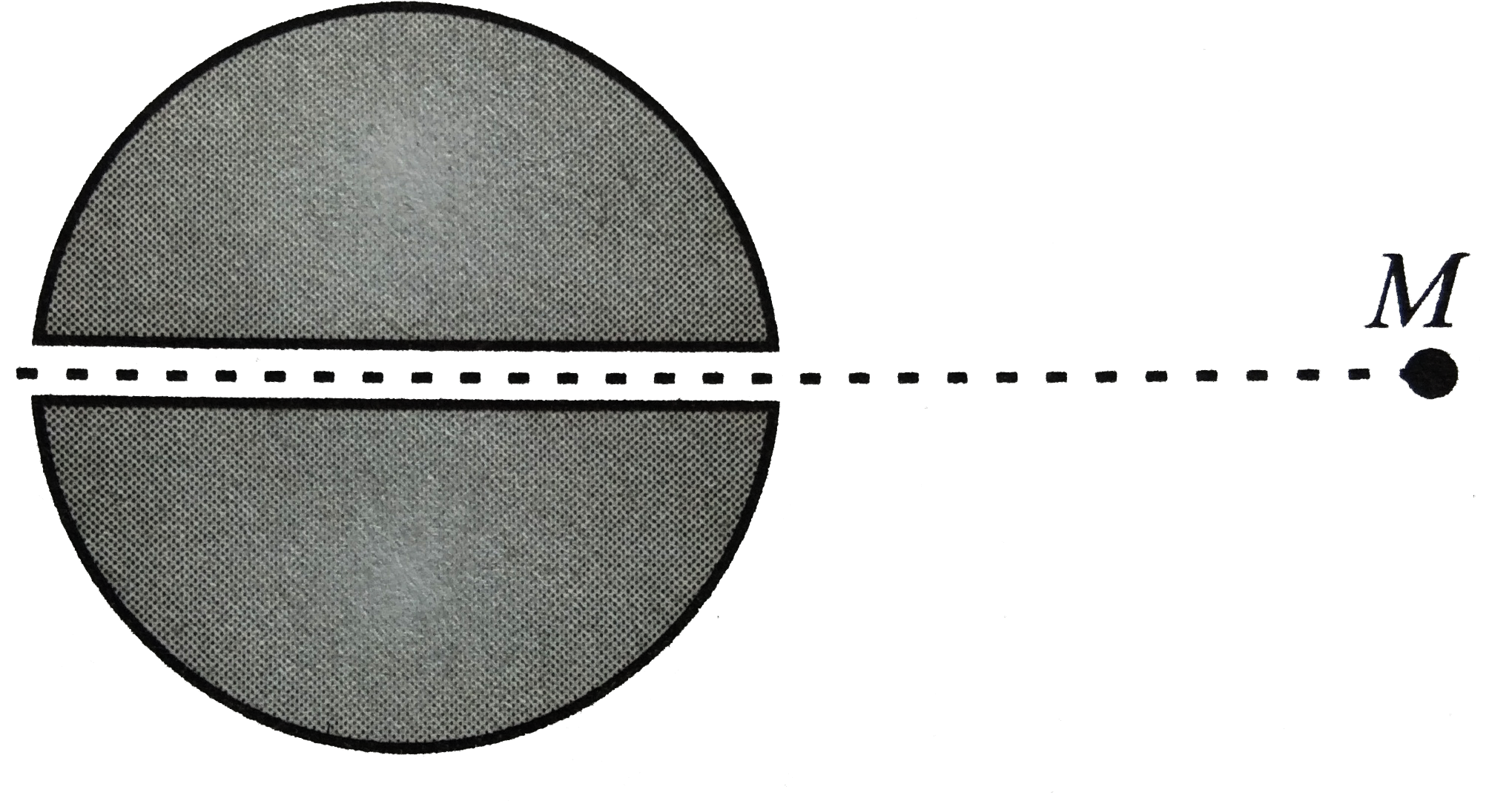
Statement I: In free space a uniform spherical planet of mass `M` has a smooth narrow tunnel along its diameter. This planet and another superdense small particle of mass `M` start approaching towards each other from rest under action of their gravitational forces. When the particle passes through the centre of the planet, sum of kinetic energies of both the bodies is maximum.

Statement II: When the resultant of all forces acting on a particle or a particle like object (initially at rest) is constant in direction, the kinetic energy of the particle keeps on increasing.

A

Statement I is True, Statement II is True: Statement II is a correct explanation for Statement I.

B

Statement I is True, Statement II is True: Statement II is Not a correct explanation for Statement I.

C

Statement I is True, Statement II is False.

D

Statement I is False, Statement II is True.

Text Solution

Verified by Experts

The correct Answer is:

A

Till particle reaches the centre of the planet, force on both the bodies are in direction on increasing. After the particle crosses the centre of the planet, forces on both are retarding in nature. Hence as the particle passes through the centre of the planet, sum of kinetic energies of oth the bodies is maximum. Therefore Statement 1 is true, Statement 2 is true: Statement 2 is a correct explanation for Statement 1.
Promotional Banner

Topper's Solved these Questions

  • GRAVITATION

    CENGAGE PHYSICS|Exercise Linked Comprehension|23 Videos
  • GRAVITATION

    CENGAGE PHYSICS|Exercise Integer|5 Videos
  • GRAVITATION

    CENGAGE PHYSICS|Exercise Multiple Correct|24 Videos
  • FLUID MECHANICS

    CENGAGE PHYSICS|Exercise INTEGER_TYPE|1 Videos
  • KINEMATICS-1

    CENGAGE PHYSICS|Exercise Integer|9 Videos

Similar Questions

Explore conceptually related problems

Two particles of mass m_(1) and m_(2) are approaching towards each other under their mutual gravitational field. If the speed of the particle is v, the speed of the center of mass of the system is equal to :

A tunnel is dug along a diameter of the earth. Find the force on a particle of mass m placed in the tunnel at a distance x from the centre.

Two particles each of mass M and equidistant from each other move along a circle of radius R under the action of their mutual gravitional attraction the speed of each particle is

A planet revolves around the sun under the effect of its gravitational force. The torque acting on the planet due to the gravitational force is zero

Four particles each of mass M, move along a circle of radius R under the action of their mutual gravitational attraction as shown in figure. The speed of each particle is :

Four particles, each of mass M and equidistant from each other, move along a circle of radius R under the action of their mutual gravitational attraction. The speed of each particle is:

A solid spherical planet of mass 2m and radius 'R' has a very small tunnel along its diameter. A small cosmic particle of mass m is at a distance 2R from the centre of the planet as shown. Both are initially at rest, and due to gravitational attraction, both start moving toward each other. After some time, the cosmic particle passes through the centre of the planet. (Assume the planet and the cosmic particle are isolated from other planets)

A particle at a distance r from the centre of a uniform spherical planet of mass M radius R (ltr) has a velocity of magnitude v.
