A
B
C
D
Text Solution
Verified by Experts
The correct Answer is:



Topper's Solved these Questions
Similar Questions
Explore conceptually related problems
CENGAGE PHYSICS-GRAVITATION-SCQ_TYPE
- If the radius of the earth were to shrink by one percent its mass rema...
Text Solution
|
- If g is the acceleration due to gravity on the earth's surface, the ga...
Text Solution
|
- Imagine a light planet revolving around a very massive star in a circu...
Text Solution
|
- If the distance between the earth and the sun were half its present va...
Text Solution
|
- A satellite S is moving in an elliptical orbit around the earth. The m...
Text Solution
|
- A simple pendulam has time period T(1) when on the earth's surface and...
Text Solution
|
- The geostationalry orbit oif the earth is at a distance of about 36000...
Text Solution
|
- A system of binary stars of mass m(A) and m(B) are moving in circular ...
Text Solution
|
- A spherically symmetric gravitational system of particles has a mass d...
Text Solution
|
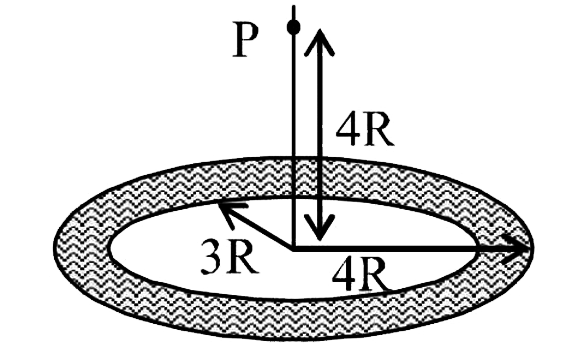
- A thin uniform disc (see figure) of mass M has outer radius 4R and in...
Text Solution
|
- A satellite is moving with a constant speed 'V' in a circular orbit ab...
Text Solution
|
- Two bodies, each of mass M, are kept fixed with a separation 2L. A par...
Text Solution
|