Home
Class 12
CHEMISTRY
How do you obtain the diffraction patter...

How do you obtain the diffraction pattern for a crystalline substance ?

Text Solution

Verified by Experts
Diffraction of electromagnetic radiation takes place when a beam of light is scattered by an object containing regularly spaced lines (or ) points . This scattering phenomenon can happen only if the spacing between the lines (or) points is comparable to the wave length of the radiation .
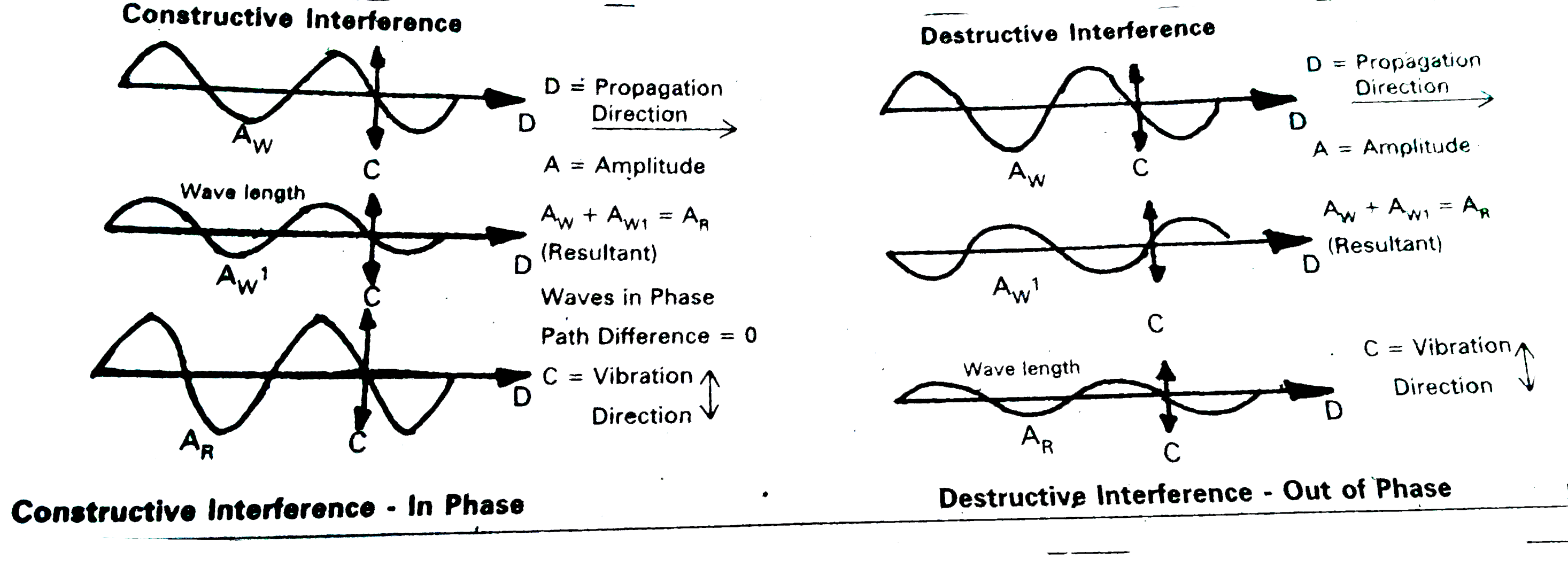
`to ` From the following figure diffraction is due to interface between two waves passing through the same region of space at the same time .
`to` If the waves are in phase , peak to peak and trough to trough , the interference is constructive and the combined wave is increased intensity .
`to` If the waves are out of phase , the interference to destructive interference and the wave is cancelled .
`to` Constructive interference gives rise to intense spots observed on Laue's photographic plate , while destructive interference causes the surrounding high areas .

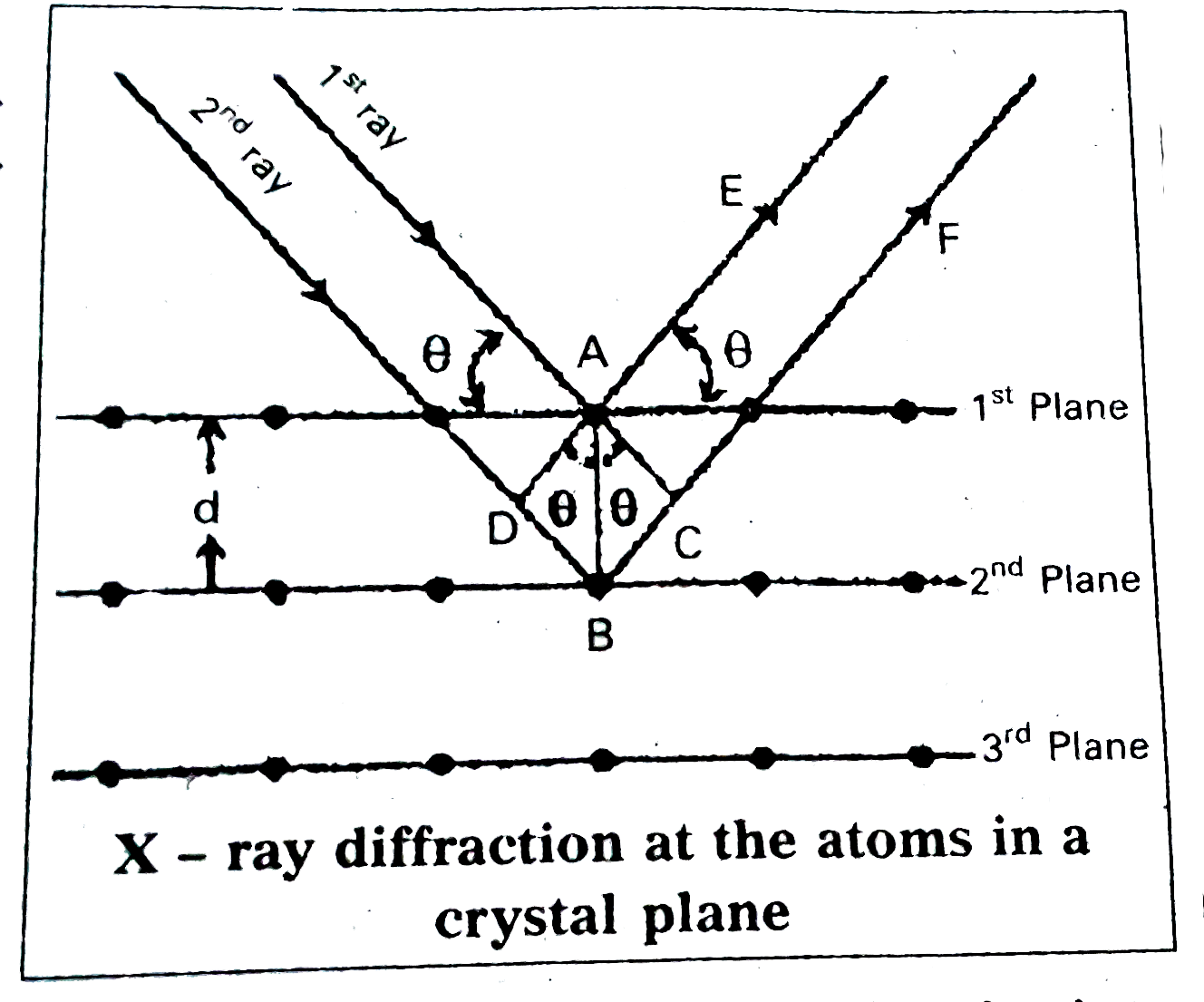
Derivation of Bragg's equation : When X- rays are incident on the crystal or plane , they are diffracted from the lattice points (lattice points may be atoms or ions or molecules) . In the crystal or plane , they are diffracted from the lattice points (lattice points may be atoms or ions or molecules) . In crystal the lattice points are arranged in regular pattern . When the waves are diffracted from these points , the waves may be constructive or destructive interference .
The `1^(st)` and `2^(nd)` waves reach the crystal surface .
They undergo constructive interference . Then from the figure `1^(st)` and `2^(nd)` rays are parallel ways . So , they travel the same distance till the wave front AD . The second ray travels more than the first by an extra distance (DB + BC) after crossing the grating for it to interfere with the first ray in a constructive manner . Then only they can be in the same phase with one another . If the two waves are to be in phase , the path difference between the two ways must be equal to the wavelength `(lambda)` or integral multiple of it `(n lambda` , where n = 1 , 2 , 3 ....)
(i.e.,) `n lambda = (DB + BC) " "` [where n = order of diffraction ]

`theta `= angle of incident beam ,
d = distance between the planes
`DB = BC = d sin theta`
`(DB + BC) = 2 d sin theta`
`n lambda = 2 d sin theta ` This relation is known as Bragg's equation .
Promotional Banner

Topper's Solved these Questions

  • SOLID STATE

    VIKRAM PUBLICATION ( ANDHRA PUBLICATION)|Exercise INTEXT QUESTIONS|27 Videos
  • SOLID STATE

    VIKRAM PUBLICATION ( ANDHRA PUBLICATION)|Exercise SHORT ANSWER QUESTIONS|16 Videos
  • POLYMERS

    VIKRAM PUBLICATION ( ANDHRA PUBLICATION)|Exercise INTEXT QUESTIONS|6 Videos
  • SOLUTIONS

    VIKRAM PUBLICATION ( ANDHRA PUBLICATION)|Exercise INTEXT QUESTIONS|10 Videos

Similar Questions

Explore conceptually related problems

How do you prove the Fermentation?

How do you know the percolation rate of soil?

How do we obtain radiographs?

How do you explain the functionality of a monomer?

How do you harvest the rainwater in your house ?

How do you obtain pure sodium chloride from a crude sample?

How do you think they are formed there?