Home
Class 12
CHEMISTRY
Describe the properties of colloids with...

Describe the properties of colloids with necessary diagrams wherever necessary.

Text Solution

Verified by Experts
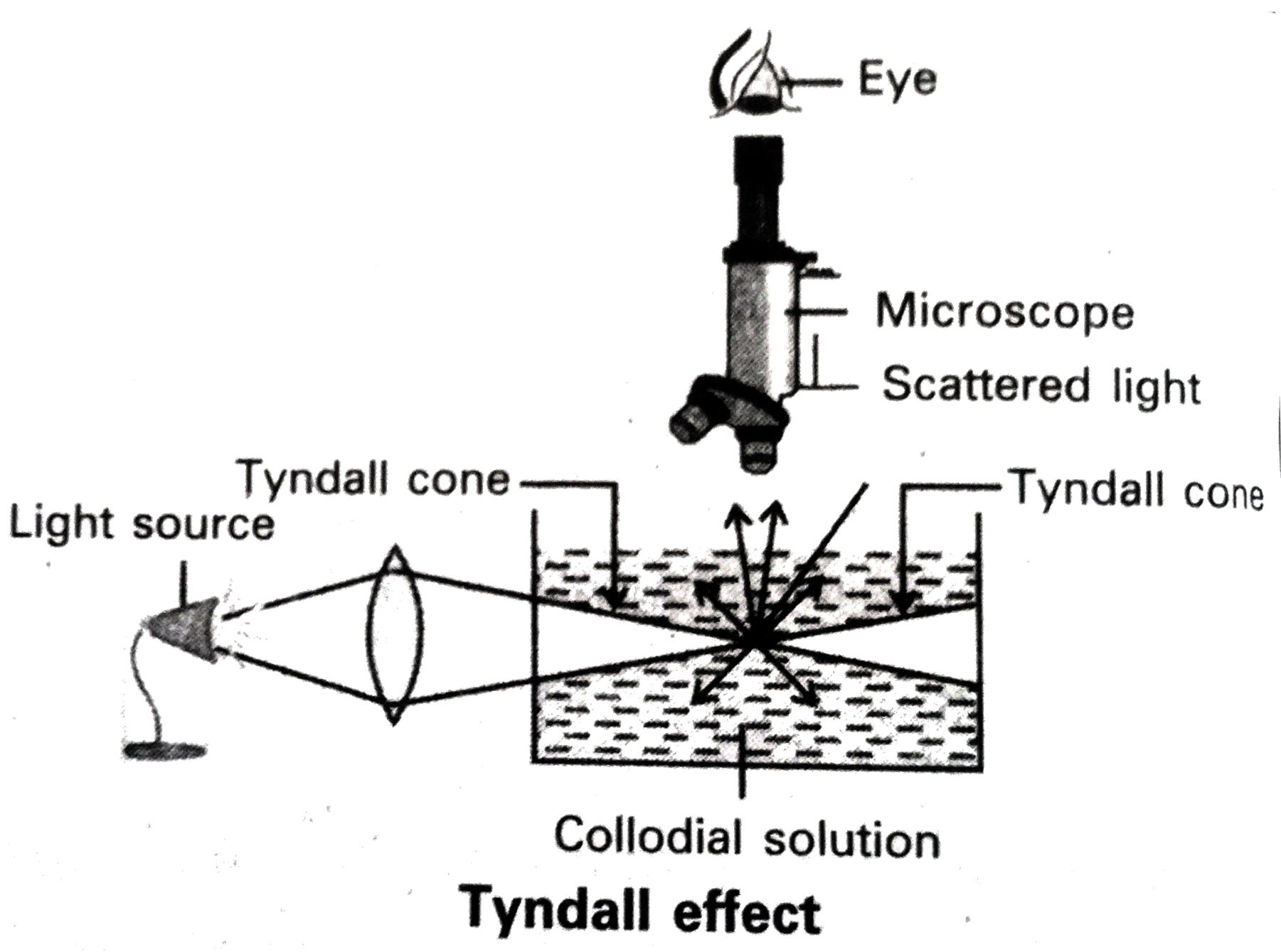
i) Tyndall effect : When light enters a colloidal solution, it is scattered by the large sized colloidal dispersed phase particles. Therefore when light passes through a solution we will be able to see the path of the light as a luminous beam. This is called dall effect.
This is an optical property exhibited by colloidal solution. This phenomenon is clearly seen with a microscope placed at right angles to the path of light. Colloidal particles become self luminous due to absorption of light.
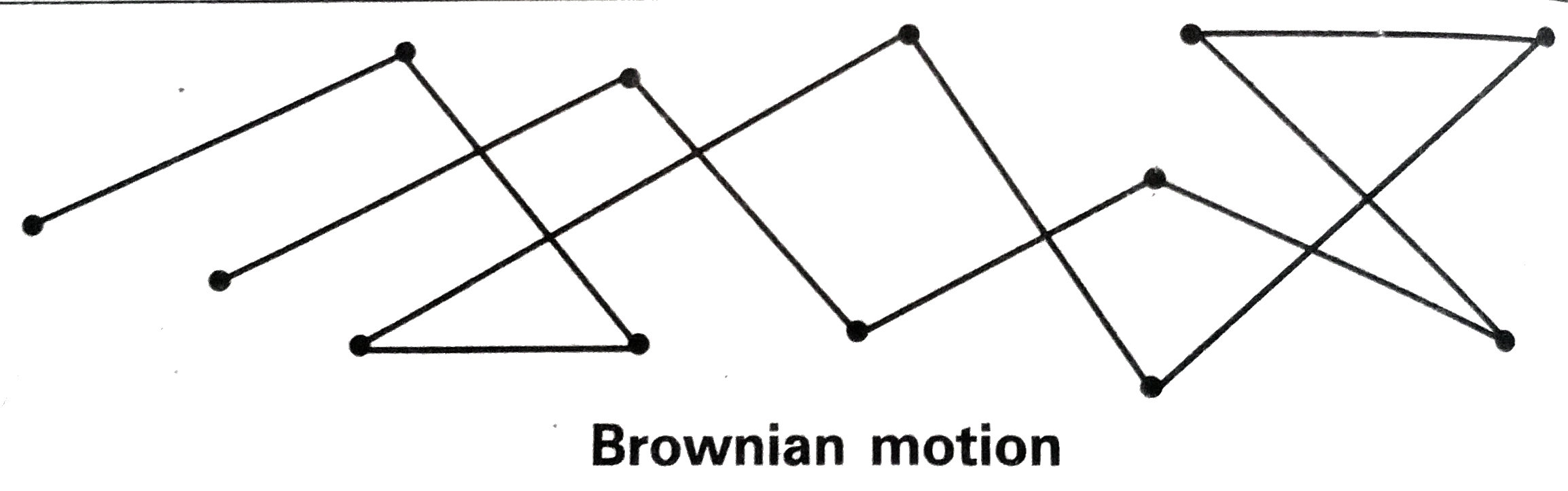
A true solution does not show Tyndall effect.ii) Brownion movement : This is a kinettc property of colloidal solution.When a colloidal solution is examined by ultramicroscope, the colloidal particles are seem to be moving in a rapid zig-zag motion.This rapid motion of colloidal particles is called Browninn movement.


This motion is due to unequal bombardment of colloidal particles by molecules of dispersion medium. Smaller the colloidal particles the more rapid is the Brownian movement.
iii) Charge on colloidal particles : The charge oin the colloidal particles is due to electron capture by sol particles during electro dispersion of metals and due to preferrential adsorption ions from solution (or) due to formulation of electrical double layer.
When a dilute `AgNO_(3)` solution is added to a dilute KI Solution taken in excess the precipitated AgI adsorbs `I^(-)` ions present in excess and a negatively charged Agl colloidal solution is formed . However when dilute KI solution is added to dilute `AgNO_(3)` solution taken in excess, AgI precipitate absorbs `Ag^(+)` ions present in excess and a positively charged Agl colloidal solution is formed.Generally the ion common to dispersed particle is adsorbed.
`{:(AgI//I^(-)" "AgI//Ag^(+)),("Negatively charged" "Positively charged"):}`
iv) Zeta Potential : In a colloidal sol the charges of opposite signs on the fixed and diffused parts of the double layer results in a difference in potential between these layers. The potential difference between the fixed layer and the diffused layer of opposite charge is called electro kinetic potential (or) zeta potential.
v) electrophoresis : When electric potential is applied across two platinum electrodes dipping in a colloidal solution, the colloidal particles move towards one or the other electrode. The movement of colloidal particles under an applied emf is called "electrophoresis".
If the movement of colloidal particles is arrested by some suitable means, the dispersion medium moves in opposite direction. This phenomenon is termed "electro osmosis".
vi) Coagulation : The stability of the lyophilic sols is due to the presence of charge on the colloidal particles. If this charge is neutralised the particles will come nearer to each other to form aggregates (or coagulate) and settle down under the force of gravity. This process of settling down of colloidal particles is called coagulation (or) flocculation (or) precipitation.
Promotional Banner

Topper's Solved these Questions

  • SURFACE CHEMISTRY

    VIKRAM PUBLICATION ( ANDHRA PUBLICATION)|Exercise INTEXT QUESTIONS|8 Videos
  • SURFACE CHEMISTRY

    VIKRAM PUBLICATION ( ANDHRA PUBLICATION)|Exercise SHORT ANSWER QUESTIONS|50 Videos
  • SOLUTIONS

    VIKRAM PUBLICATION ( ANDHRA PUBLICATION)|Exercise INTEXT QUESTIONS|10 Videos
  • TELANGANA MARCH-2019

    VIKRAM PUBLICATION ( ANDHRA PUBLICATION)|Exercise SECTION C|6 Videos

Similar Questions

Explore conceptually related problems

This is not a property of colloid.

Describe Bredig's arc method of preparation of colloids with a neat diagram.

Define Modulation. Why is it necessary ?

Compare the properties of suspensions and colloids.

Oxygen is necessary for -

What sort of crystals are necessary in Bragg's method.