Home
Class 12
PHYSICS
4 bar magnet, held horizontally, is set ...

4 bar magnet, held horizontally, is set into angular oscillations in the Earth's magnetic field. It has time periods `T_(1)` and `T_(2)` at two places, where the angles of dip are `theta_(1)` and `theta_(2)` respectively. Deduce an expression for the ratio of the resultant magnetic fields at the two places.

Text Solution

Verified by Experts
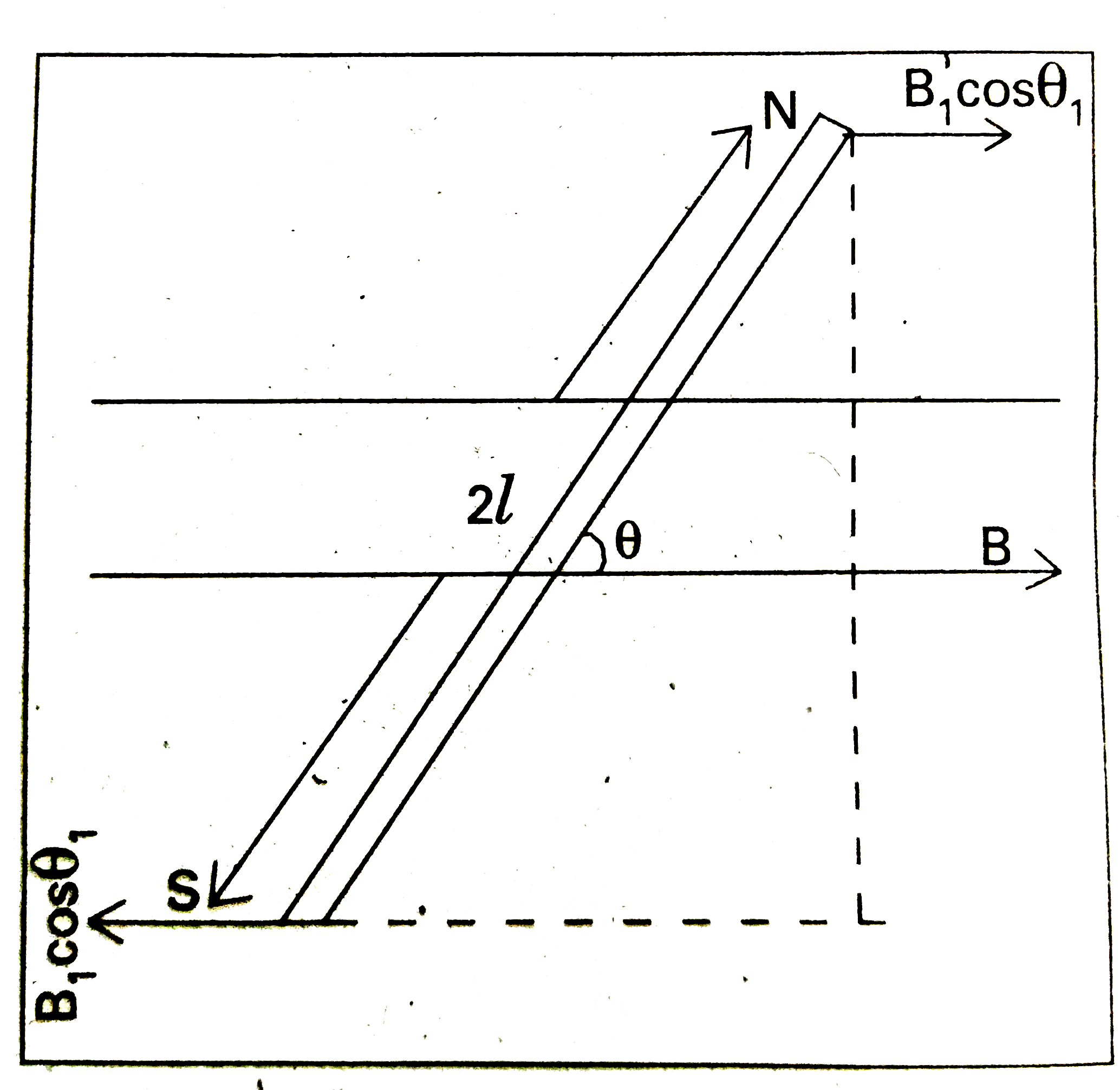
(1) Suppose, the resultant magnetic fields is to be compared at two places A and B.
(2) A barmagnet, field horizontally at A and which is set into angular oscillatins in the Earth's magnetic field.
(3) Let time period of a bar magnet at place 'A' is `T_(1)` and angular displacement or angle of dip is `theta_(1)`.
(4) As the bar magnet is free to rotate horizontally, it does not remain vertical component `(B_(1) sin theta_(1))`. It can have only horizontal component `(B_(1) cos theta_(1))`
(5) The time period of a bar magnet in uniform magnetic field is given by `T = 2pi sqrt((I)/(mB_(H)))`
(6) Now, in this case `T = T_(1)` and `B_(H) = B_(1) cos theta_(1)`
(7) Therefore time period of a bar magnet at place 'A' is given by
`T_(1) = 2pi sqrt((I)/(mB_(1) cos theta_(1)))` - (1) where I is moment of Inerfia of a barmagnet and m is magnitude of magnetic moment.
(8) Similarly, the same magnet is placed at B and which is set into angular oscillations in the earth's magnetic field.
(9) Let time period of a bar magnet at place B is `T_(2)` and angle of dip is `theta_(2)`.
(10) Since horizontal component of earth's field at B is `B_(H) = B_(2) cos theta_(2)`, time period, `T_(2) = 2pi sqrt((I)/(mB_(2) cos theta_(2)))` - (2)
(11) Dividing equation (1) by equation (2), we get `(T_(1))/(T_(2)) = sqrt((mB_(2) cos theta_(2))/(mB_(1) cos theta_(1)))`
Squaring on both sides, we have `(T_(1)^(2))/(T_(2)^(2)) = (B_(2) cos theta_(2))/(B_(1) cos theta_(1))`
(12) But `B_(1) = mu_(0)H_(1)` and `B_(2) = mu_(0) H_(2)`
`(T_(2)^(1))/(T_(2)^(2)) = (mu_(0) H_(2) cos theta_(2))/(mu_(0) H_(1) cos theta_(1))`
(13) Therefore, `(H_(1))/(H_(2)) = (T_(2)^(2) cos theta_(2))/(T_(1)^(2) cos theta_(1))`
(14) By knowing `T_(1), T_(2)` and `theta_(1), theta_(2)` at different places A and B, we can find the ratio of resultant magnetic fields.
Promotional Banner

Topper's Solved these Questions

  • MAGNETISM AND MATTER

    VIKRAM PUBLICATION ( ANDHRA PUBLICATION)|Exercise Textual Exercises|27 Videos
  • MAGNETISM AND MATTER

    VIKRAM PUBLICATION ( ANDHRA PUBLICATION)|Exercise Additional Exercises|19 Videos
  • MAGNETISM AND MATTER

    VIKRAM PUBLICATION ( ANDHRA PUBLICATION)|Exercise Short Answer Questions|10 Videos
  • ELECTROSTATIC POTENTIAL AND CAPACITANCE

    VIKRAM PUBLICATION ( ANDHRA PUBLICATION)|Exercise SAQs|4 Videos
  • MOVING CHARGES AND MAGNETISHM

    VIKRAM PUBLICATION ( ANDHRA PUBLICATION)|Exercise ADDITIONAL EXERCISES|26 Videos

Similar Questions

Explore conceptually related problems

A small magnetic needle is set into oscillations in a magnetic field B obtain an expression for the time period of oscillation.

If the Earth's magnetic field at the equator is about 4 xx 10^(-5)T , What is its approximate magnetic dipole moment ?

At a certain place the horizontal component of earth's magnetic field is (1)/(sqrt3) times the vertical component. The angle of dip at that place is

A telephone cable at a place has four long straight horizontal wires carrying a current of 1.0 A in the same direction east to west. The earth's magnetic field at the place is 0.39 G, and the angle of dip is 35^(@) . The magnetic declination is nearly zero. What are the resultant magnetic field at points 4.0 cm above and below the cable ?

The horizontal component of the earth's magnetic field at a certain place is 2.6 xx 10^(-5) T and the angle of dip is 60^(@) . What is the magnetic field of the earth at this location ?

At a certain place, the angle of dip is 60^(@) and the horizontal component of the earth's magnetic field (B_(H)) is 0.8xx10^(-4) T. The earth's overall magnetic field is

A short bar magnet of magnetic moment 0,21 A - m^(2) is placed with its axis perpendicular to the direction of the horizontal component of the earth 's magnetic field .The distance of the point on the axis of the magnet from the centre of the magnet where the resultant magnetic field is inclined at 45^(@) with the horizontal component of the earth's field direction is (horizontal component of the earth's magnetic field 4.2xx10^(-5)

