Home
Class 12
PHYSICS
Describe a transistor and explain its wo...

Describe a transistor and explain its working.

Text Solution

Verified by Experts
Transistor `:` It is a device which consists of two p-n junctions joined back to back.Transistor means transfer of resistance.
(i)Emitter (E ) `:` The section at one end of transistor is called emitter. It is heavily doped region.It emitts charge carriers.
(2) Base ( B) `:` The middle section of transistor is called base. This is lightly doped and very thin and almost of the charge carriers injected into it toflow into collector with out neutralised.
(3) Collector (C ) `:` The section at the other end is called collector.It is moderately doped. It collects the charge carrers. Physically it is large.
.Note `:` Usually the emitter-base junction is forward biased and collector-base junction is revrse biased.
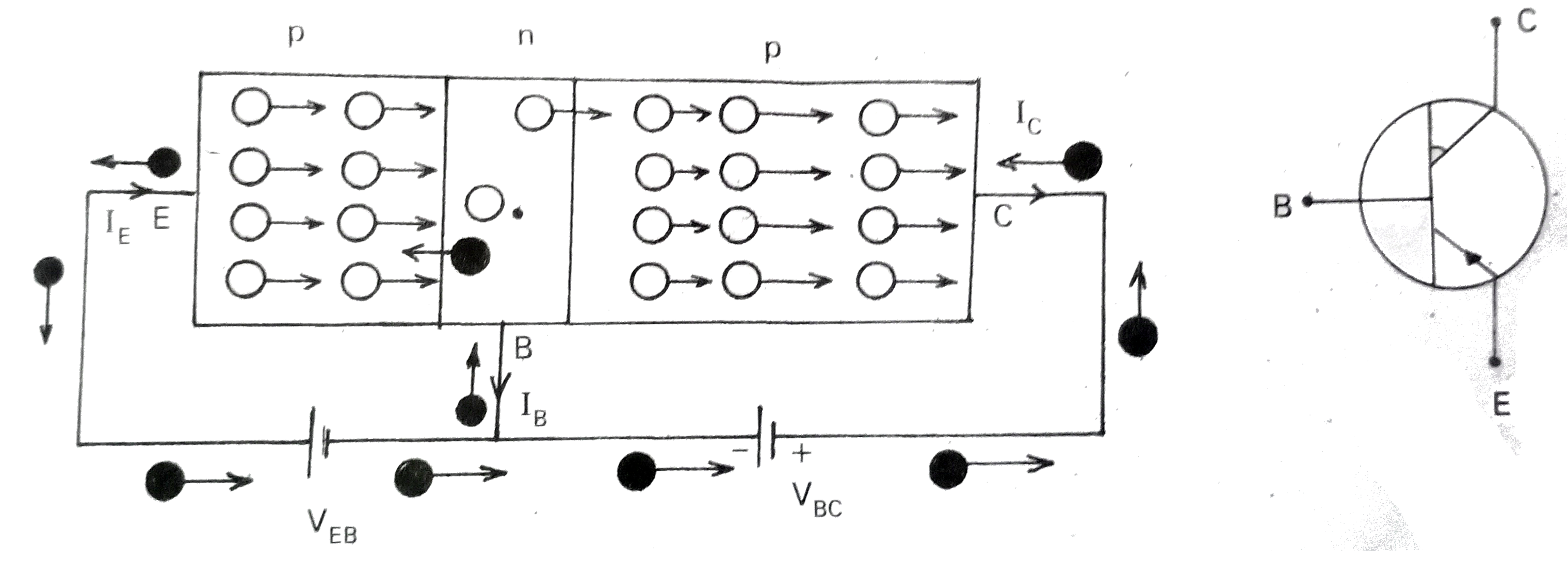
Working of p-n transistor `:` The base part is made of n-type, emitter and collector parts are made ofp-type . The circuit symbol of p-n-p transistor is shown in figure.

The emitter junction is forward biased by connecting positive terminal of battery to the emitter and negative to the base. The collector junction is reverse biased by connecting negative to the collector and positive to the base.
The holesin p-region(emitter) are repelledby the positive terminal and crossing ther emitter junction,enterthe base region causing emitter current `I_( E) `.Few holes are combined with electrons in base region, this constitue base current `( I_(B))`.Majority of holes enters through the collector region. The negative terminal battery rapidly sweeps the holes in the collector region causing collector current `( I_(C ))`.
`I_( E ) = I_(B ) + I_(C ) `
IN p-n-p transistor inside the circuit charge carriers are holes and outside the circuit charge carriers are electrons.
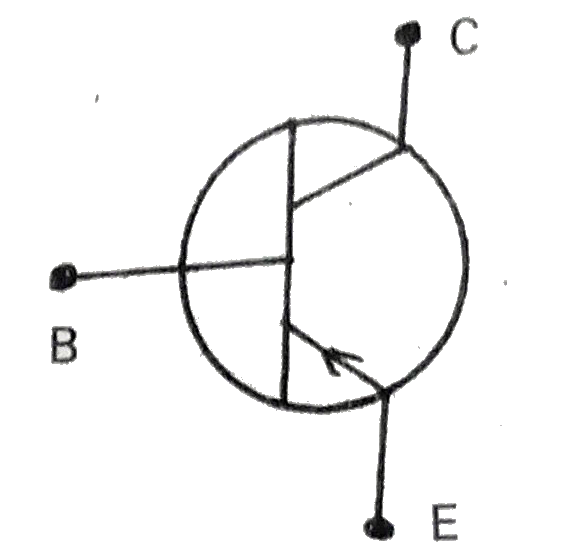
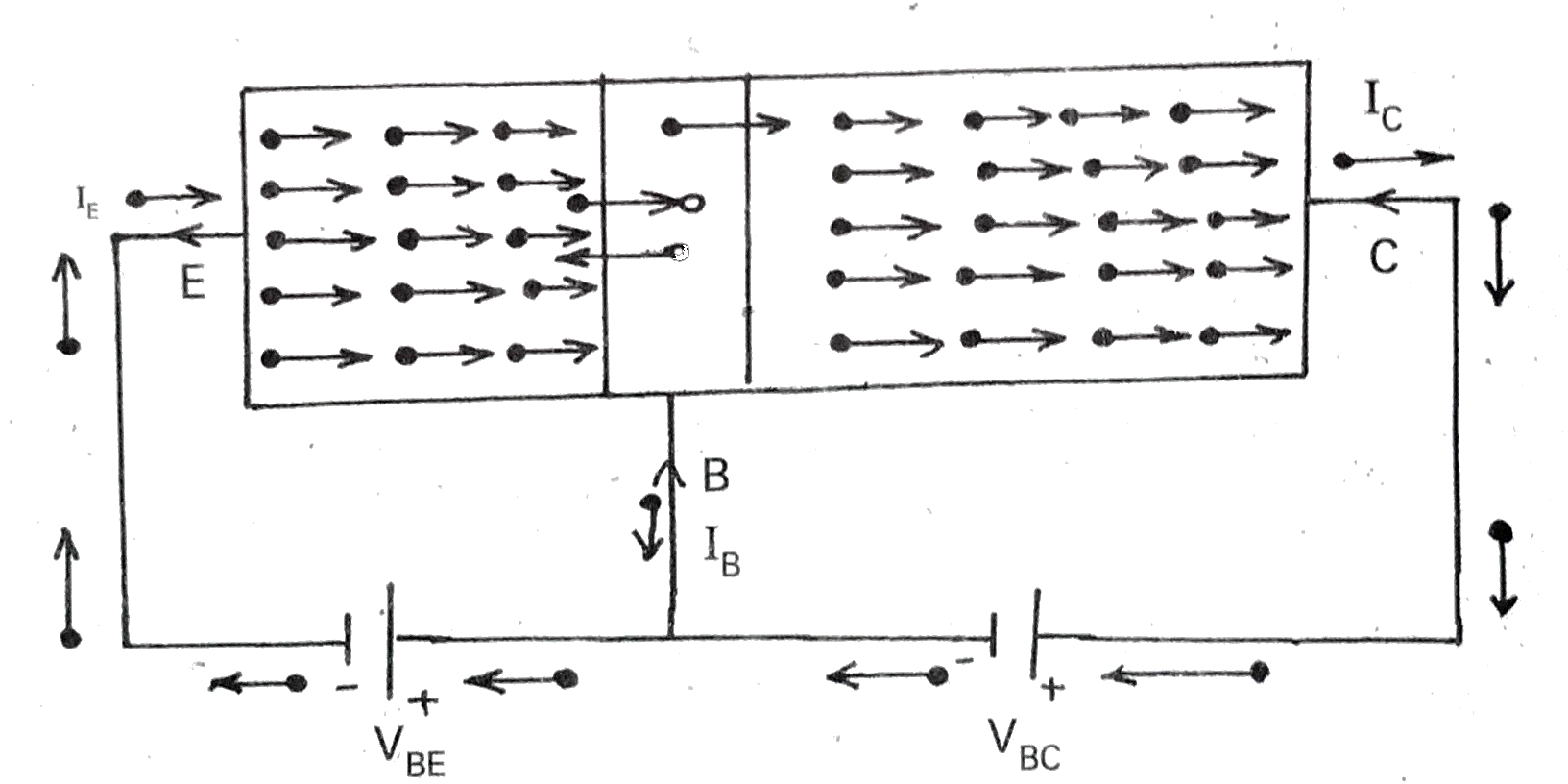
n-p-n transistor `:` If the basepart is made of p-type, emitter and collector parts aremade of n-type,we get n-p-n transistor. The circuit symbol of n-p-n transistor is shown in figure.


The emitter junction is forward biased with negative end of a battery connectedto emitter and positive to the base. The collector junction is reverse biased with collector positive end of a battery and negative to the base.
The electrons in the emitter ( n - region) are repelled by the negative terminal of a battery and cross the base region constituting the emitter current `I_ ( E ) `. A small number of electrons may recombine with holes in base region constituting base current `I_(B ) `.
Majority charge carriers ( electrons ) enter into the collector region. The positive terminal of a battery rapidly sweeps the electrons in collector, constituting collector current `I_( C ) `.
`I_(E )= I_(B ) + I_( C ) `
In n-p-n transistor charge carriers inside and outside the circuit are electrons.
Promotional Banner

Topper's Solved these Questions

  • SEMICONDUCTOR ELECTRONICS : MATERIALS , DEVICES , AND SIMPLE CIRCUITS

    VIKRAM PUBLICATION ( ANDHRA PUBLICATION)|Exercise TEXTUAL EXERCISES|11 Videos
  • SEMICONDUCTOR ELECTRONICS : MATERIALS , DEVICES , AND SIMPLE CIRCUITS

    VIKRAM PUBLICATION ( ANDHRA PUBLICATION)|Exercise ADDITIONAL EXERCISES|8 Videos
  • SEMICONDUCTOR ELECTRONICS : MATERIALS , DEVICES , AND SIMPLE CIRCUITS

    VIKRAM PUBLICATION ( ANDHRA PUBLICATION)|Exercise SHORT ANSWER QUESTIONS|16 Videos
  • RAY OPTICAL AND INSTRUMENTS

    VIKRAM PUBLICATION ( ANDHRA PUBLICATION)|Exercise TEXTUAL EXERCISES|60 Videos
  • TELANGANA MARCH-2019

    VIKRAM PUBLICATION ( ANDHRA PUBLICATION)|Exercise SECTION -B|5 Videos

Similar Questions

Explore conceptually related problems

Describe an activity to explain the situation that "the speed changes but the direction of motion remains constant".

Describe Aufbau principle. Explain its significance in the electronic build up of atoms.

State Joule's law in thermodynamics and explain it. Give the relation between work and heat.