Home
Class 12
PHYSICS
Point charge are placed at the verticas ...

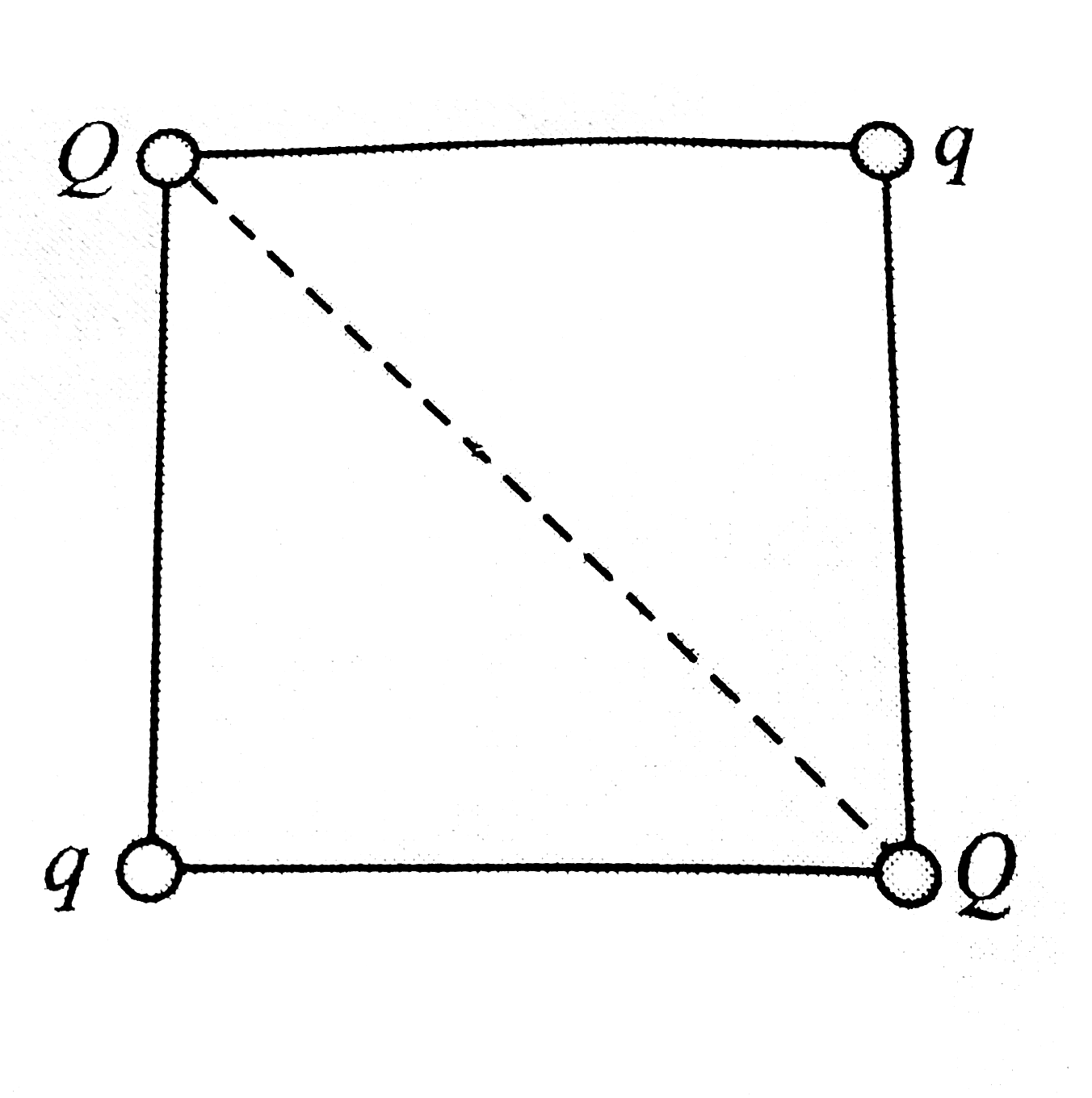
Point charge are placed at the verticas of a squre of side a as shown in fig. What should be the sign of charge q and magnitude of the ratio `|q//Q|` so that
(i) net force on each Q is zero?
(ii) net force on each q is zero?
Is it possible that the entire system could be in electrostatic equilibrium?

A

`(1)/(2 sqrt(2))` `20 sqrt2``

B

`(1)/(2 sqrt(2))` `2 sqrt2`

C

`(1)/(2 sqrt(2))` `12 sqrt2`

D

`(1)/(2 sqrt(12))` `2 sqrt2`

Text Solution

Verified by Experts

The correct Answer is:
B

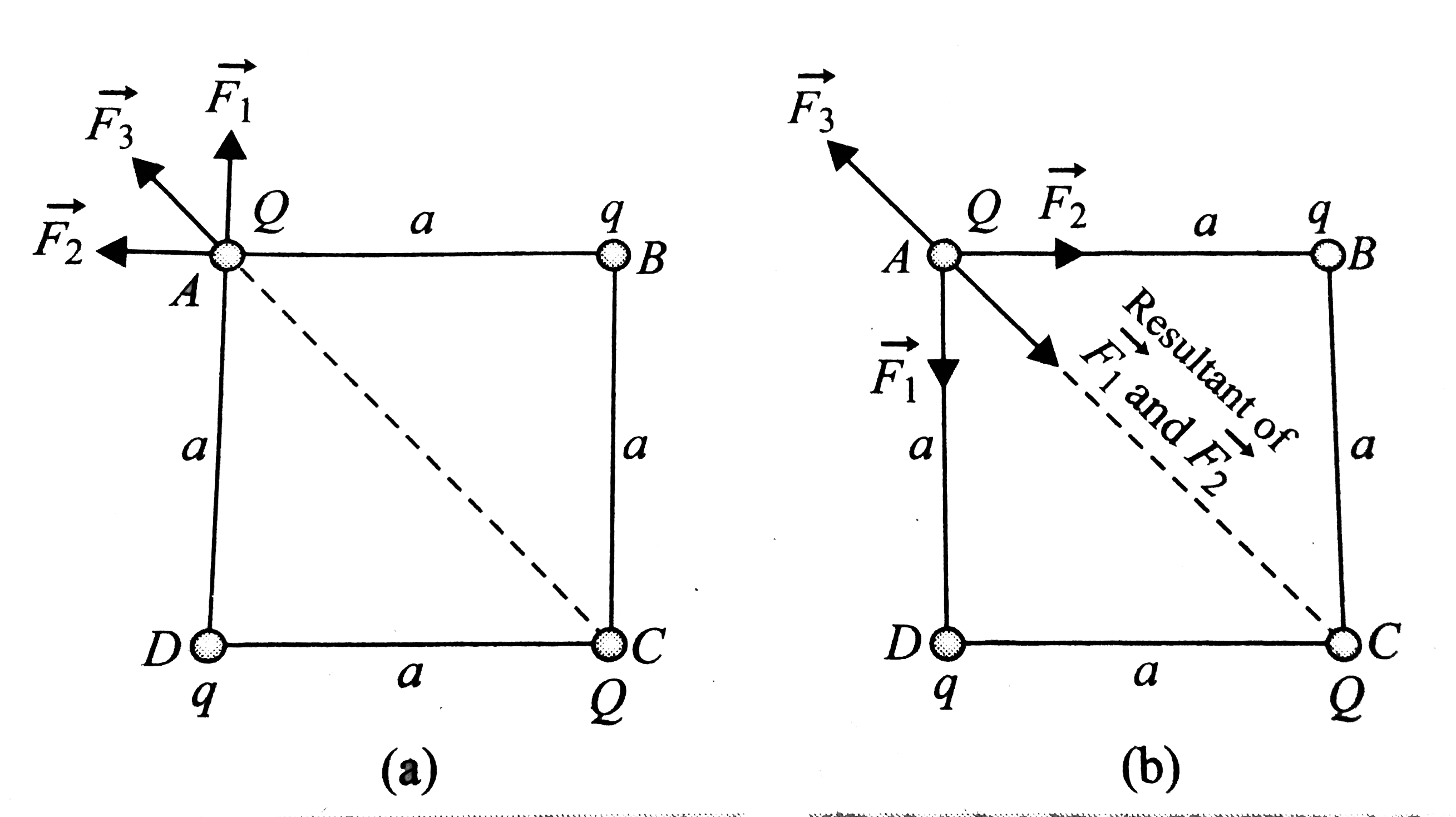
Consider the force action on charge Q placed at (shown in fig. )
Case I. Let the charge q and Q be of same sign.
here,
`(F_1)=1/(4 pi epsilon_(0)) (qQ)/(a^2)` (force of q at D on Q at A)
,
`(F_2)=1/(4 pi epsilon_(0)) (qQ)/(a^2)` (force of q atB on Q at A)
`(F_3)=1/(4 pi epsilon_(0)) (qQ)/(a^2)` (force of q atC on Q at A)
In fig. the resultant of force `vec(F_1)` and `vec(F_2)` will along `vec(F_3)` so that the net force on Q can not be zero. Hence, q and Q have to be of opposite signs.
Case II. Let the charges q and Q be of opposite signs. In this case, as shown in fig. resultant of `vec(F_1)` and `vec(F_2)` will be opposite to `vec(F_3)` so that it bexomes possible to obtain a condition of zero net force. Let us write `vecF_(R ) =vecF_(1) + vecF_(2)`. so
`sqrt(F_(1)^(2)+F_(2)^(2)) = (1)/(4 pi epsilon_(0)) (qQ)/(a^(2))sqrt(2)`
The direction of `vecF_(R )` will be along AC (`vecF_(R )`, being the resultant of force of equal magnitude, bisects the angle between the two). `vecF_(R )` and `vecF_(3)` are omn opposite directions. Theat force on Q can be zero if their magnitudes are also equal. i,e.
`(1)/(4 pi epsilon_(0)) (qQ)/(a^(2))sqrt(2)=(1)/(4 pi epsilon_(0)) (Q Q)/(2a^(2))` or `(Q)/(4 pi epsilon_(0))(q sqrt(2)-(Q)/(2))=0`
or `q=(Q)/(2 sqrt(2))` or `|(q)/(Q)|=(1)/(2 sqrt(2)) {Q!=0}`
Therefore, the sign of q should be the negative of Q.
(ii) Consider now the forces acting on charge q placed at B. In a similar manner, as dicussed in (i) , for the net force on q to be zero. q and Q have to be of opposite signs. This is also shown in the given figure.
`F_(1)=(1)/(4 pi epsilon_(0)) (qQ)/(a^(2))` (force of Q at A on q at B)
`F_(2)=(1)/(4 pi epsilon_(0)) (qQ)/(a^(2))` (force of Q at C on q at B)
`F_(3)=(1)/(4 pi epsilon_(0)) (qQ)/(a^(2))` (force of q at D on qat B)
,
From fig. we can write
`vecF_(R ) =vecF_(1) + vecF_(2)`
`:. F_(R) =sqrt(F_(1)^(2)+F_(2)^(2))=(1)/(4 pi epsilon_(0)) (Qq)/(a^(2)) sqrt(2)`
The resultant of `vecF_(1)` and `vecF_(2)` i.e `vecF_(R)` is opposite to `vecF_(3)` . Net force can become zero if their magnitudes are also equal i.e.
`(1)/(4 pi epsilon_(0)) (Qq)/(a^(2))sqrt(2) =(1)/(4 pi epsilon_(0)) (q^(2))/(2a^(2))` or `(q)/(4 pi epsilon_(0)a^(2)) [sqrt(2)Q-(q)/(2)]=0`
or `Q=(q)/(2 sqrt(2))` or `|(q)/(Q)| = 2 sqrt(2) {q!=0}`
Therefore, the sign of q should be negative of Q. In this case, we need not to repeat the calculation as the present situation id same as the previous one, we can directly write `|q//Q|=2 sqrt(2)`. The entire system cannot be in equilibrium since both conditions i.e. `q=-Q//2 sqrt(2)` and `Q=-q//2sqrt(2)` cannot be satisfied together.
Promotional Banner

Topper's Solved these Questions

  • COULOMB LAW AND ELECTRIC FIELD

    CENGAGE PHYSICS|Exercise Solved examples|10 Videos
  • COULOMB LAW AND ELECTRIC FIELD

    CENGAGE PHYSICS|Exercise Exercises|58 Videos
  • COMMUNICATION SYSTEM

    CENGAGE PHYSICS|Exercise QUESTION BANK|19 Videos
  • Current Electricity

    CENGAGE PHYSICS|Exercise QUESTION BANK|40 Videos

Similar Questions

Explore conceptually related problems

Four charges Q-Q, Q-Q are placed at the corners of a square as shown . The potential is zero at points

Four point charges Q.q Q and q are placed at the corners of a square side 'a' as shown in the figures. Find the resultant electric force on a charge Q,

Consider the charges q,q and -q placed at the vertices of an equilateral triangle of each side l. What is the force on each charge ?

A charge Q is placed at the centre of the line joining two point charges +q and +q as shown in figure. The ratio of charges Q and q is

Point charge are placed the corners of square of side 'a'. The value and nature of q can be best represented, to make the net force on Q zero as -

Four point charges Q, q, Q and q are placed at the corners of a square of side' a' as shown in the figure. Find the . (a) resultnat electric force on a charge Q and . (b) potential energy of this system.

CENGAGE PHYSICS-COULOMB LAW AND ELECTRIC FIELD-Single Answer Correct Type
  1. Point charge are placed at the verticas of a squre of side a as shown ...

    Text Solution

    |

  2. The given figure gives electric line of force due to two charges q(1) ...

    Text Solution

    |

  3. Consider the four field patterns shown. Assuming there are no charge i...

    Text Solution

    |

  4. A charge Q is fixed at a distance d in front of an infinite metal plat...

    Text Solution

    |

  5. The lines of force of the electric field due to two charges q and Q ar...

    Text Solution

    |

  6. Two ideantical point charges are placed at a separation of d. P is a p...

    Text Solution

    |

  7. The bob of a pendulum of mass 8 mu g carries an electric charge of 39....

    Text Solution

    |

  8. Two charges each equal to eta q(eta^(-1) lt sqrt(3)) are placed at the...

    Text Solution

    |

  9. Two point charges (+Q) and (-2Q) are fixed on the X-axis at positions ...

    Text Solution

    |

  10. A hemispherical shell is uniformly charge positively .the electric fie...

    Text Solution

    |

  11. An electron falls through a small distance in a uniform electric field...

    Text Solution

    |

  12. There is a uniform electric field of strength 10^(3)V//m along y-axis....

    Text Solution

    |

  13. In the figure shown there is a large sheet of charge of uniform surfac...

    Text Solution

    |

  14. Three charges of (+2q), (-q) and (-q) are placed at the corners A,B an...

    Text Solution

    |

  15. An electric dipole is placed along the x-axis at the origin O.A point ...

    Text Solution

    |

  16. An electric dipole is placed at the origin O and is directed along the...

    Text Solution

    |

  17. Three identical dipoles are arranged as shown below. What will be the ...

    Text Solution

    |

  18. Two electric dipoles of moment P and 64P are placed in opposite direct...

    Text Solution

    |

  19. Two point charges (+Q) and (-2Q) are fixed on the X-axis at positions ...

    Text Solution

    |

  20. An electric dipole is kept on the axis of a uniformly charged ring at ...

    Text Solution

    |

  21. Two short dipoles phat(k) and P/2 hat(k) are located at (0,0,0) & (1m,...

    Text Solution

    |