Home
Class 12
PHYSICS
A rod of length l, has a uniform positiv...

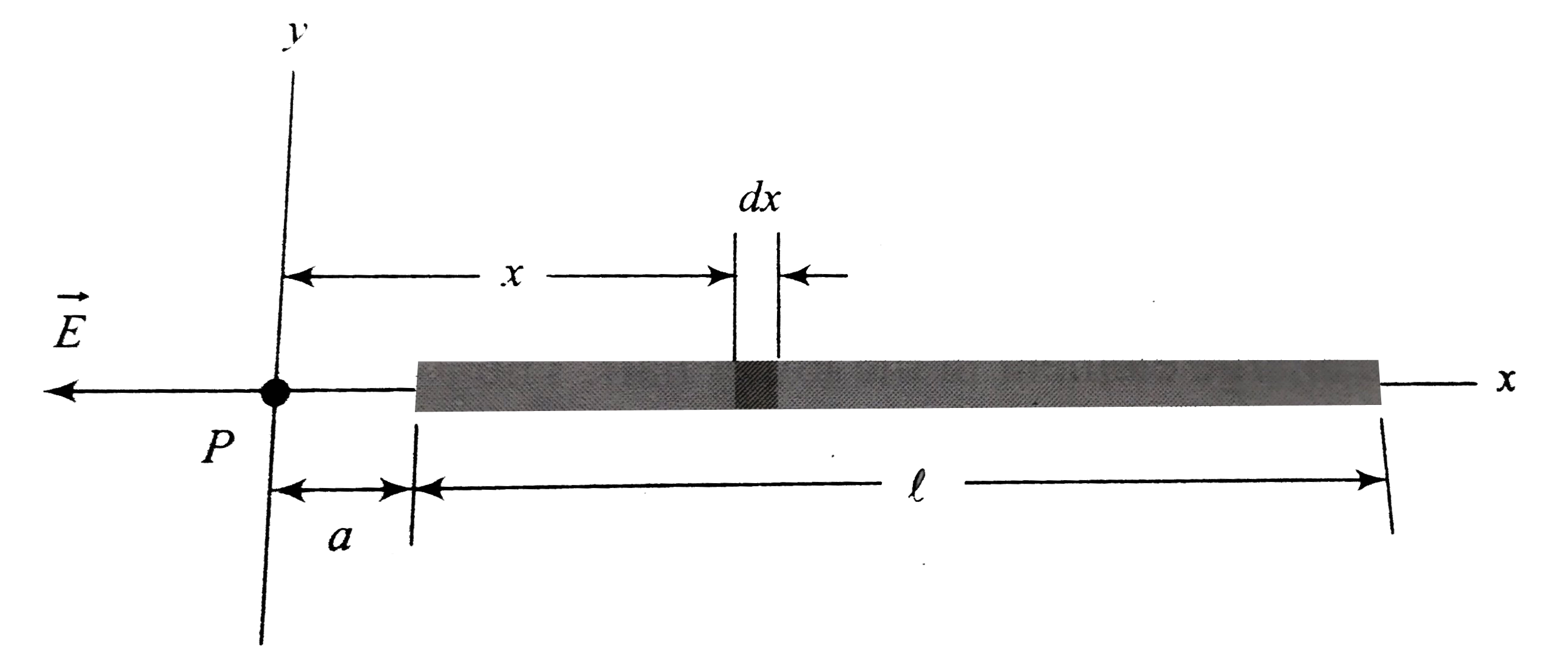
A rod of length l, has a uniform positive charge per unit length and a total charge Q. calculate the electric foeld at a point P located along the long axis of the rod and at a distance a from one end

Text Solution

Verified by Experts

The field `dvec(E )` at P due to each segment of charge on the rod is in the negative x direction because every segment carries a positive charge.
Because the rod is continous we are evaluating the field due to a continuous charge distribution rather than a group of individual charges. Because every segment of the negative x direction, the sum of their contributions can be handled without the need to add vectors.
Let us assume the rod is lying along the x-axis , dx is the length of one small segment and dq is the charge on that segment. Beacuse the rod has a charge per unt length 1, the charge dq on the small segment is `dq=lambda dx`. The magnitude of the electric field at P due to one segment of the rod having a charge dq is
`dE=k_(e)(dq)/(x^(2))=k_(e)(lambda dx)/(x^(2))`
The total field at P is
`E=int_(a)^(l+a)K_(e )lambda(dx)/(x^(2))`
If `K_(e )` and `lambda = Q//l` are constants and can be removed from the integral, them
`E=int_(a)^(l+a) k_(e)lambda (dx)/(x^(2))[-(1)/(x)]_(a)^(l+a)`
`=k_(e) Q/l(1/a-1/(l+a))=(k_(e)Q)/(a(l+a))`
If a to b, which corresponds to sliding the bar to the left until its left end is at the origin, then `E to oo` that represents the condition in wich the observation point P is at zero distance from the charge at the end of the rod, so the field become infinite.
Promotional Banner

Topper's Solved these Questions

  • COULOMB LAW AND ELECTRIC FIELD

    CENGAGE PHYSICS|Exercise Solved examples|10 Videos
  • COULOMB LAW AND ELECTRIC FIELD

    CENGAGE PHYSICS|Exercise Exercises|58 Videos
  • COMMUNICATION SYSTEM

    CENGAGE PHYSICS|Exercise QUESTION BANK|19 Videos
  • Current Electricity

    CENGAGE PHYSICS|Exercise QUESTION BANK|40 Videos

Similar Questions

Explore conceptually related problems

A rod length l is uniformly charged with charge q. Calculate potential at point P.

A cylinder of length L has a charge of magnitude q. The electric intensity at a point at a distance r from the axis of the cylinder is

A thin straight rod of length 2a carrying a uniformly distributed charge q is located in vacumm. Find the magnitude of the electric field strength as a function of the distatance r from the rod's centre along the streaight line (a) perpendicular to the rod and passing through its centre , (b) coinciding with the rod's direction (at the point lying outside the rod).

The moment of inertia of a thin rod of mass M and length L about an axis perpendicular to the rod at a distance L/4 from one end is

A thin straight rod of length l carrying a uniformly distributed charge q is located in vacuum. Find the magnitude of the electric force on a point charge 'Q' kept as shown in the figure.

The electric field at a distance r from a long wire having charge per unit length lambda is

A massless rod of length L has two equal charges (q) tied to its ends. The rod is free to rotate in horizontal plane about a vertical axis passing through a point at a distance (L)/(4) from one of its ends. A uniform horizontal electric field (E) exists in the region. (a) Draw diagrams showing the stable and unstable equilibrium positions of the rod in the field. (b) Calculate the change in electric potential energy of the rod when it is rotated by an angle Deltatheta from its stable equilibrium position. (c) Calculate the time period of small oscillations of the rod about its stable equilibrium position. Take the mass of each charge to be m.

A 10 cm long rod carries a charge of +150 muC distributed uniformly along its length. Find the magnitude of the electric field at a point 10 cm from both the ends of the rod.

CENGAGE PHYSICS-COULOMB LAW AND ELECTRIC FIELD-Single Answer Correct Type
  1. A rod of length l, has a uniform positive charge per unit length and a...

    Text Solution

    |

  2. The given figure gives electric line of force due to two charges q(1) ...

    Text Solution

    |

  3. Consider the four field patterns shown. Assuming there are no charge i...

    Text Solution

    |

  4. A charge Q is fixed at a distance d in front of an infinite metal plat...

    Text Solution

    |

  5. The lines of force of the electric field due to two charges q and Q ar...

    Text Solution

    |

  6. Two ideantical point charges are placed at a separation of d. P is a p...

    Text Solution

    |

  7. The bob of a pendulum of mass 8 mu g carries an electric charge of 39....

    Text Solution

    |

  8. Two charges each equal to eta q(eta^(-1) lt sqrt(3)) are placed at the...

    Text Solution

    |

  9. Two point charges (+Q) and (-2Q) are fixed on the X-axis at positions ...

    Text Solution

    |

  10. A hemispherical shell is uniformly charge positively .the electric fie...

    Text Solution

    |

  11. An electron falls through a small distance in a uniform electric field...

    Text Solution

    |

  12. There is a uniform electric field of strength 10^(3)V//m along y-axis....

    Text Solution

    |

  13. In the figure shown there is a large sheet of charge of uniform surfac...

    Text Solution

    |

  14. Three charges of (+2q), (-q) and (-q) are placed at the corners A,B an...

    Text Solution

    |

  15. An electric dipole is placed along the x-axis at the origin O.A point ...

    Text Solution

    |

  16. An electric dipole is placed at the origin O and is directed along the...

    Text Solution

    |

  17. Three identical dipoles are arranged as shown below. What will be the ...

    Text Solution

    |

  18. Two electric dipoles of moment P and 64P are placed in opposite direct...

    Text Solution

    |

  19. Two point charges (+Q) and (-2Q) are fixed on the X-axis at positions ...

    Text Solution

    |

  20. An electric dipole is kept on the axis of a uniformly charged ring at ...

    Text Solution

    |

  21. Two short dipoles phat(k) and P/2 hat(k) are located at (0,0,0) & (1m,...

    Text Solution

    |
