Home
Class 12
PHYSICS
A point charge +Q is placed at the centr...

A point charge +Q is placed at the centre of an uncharged spherical conducting shell of inner radius a and outer radius b.
i. Find the electric field for `rlta`.
ii. What is the magnitude and sigh of the induced charge q' on the inner shell surface?
iii. What is the electric field at points `rgtb`?
iv. What id the surface charge on the outer surface of the conductor?

Text Solution

Verified by Experts
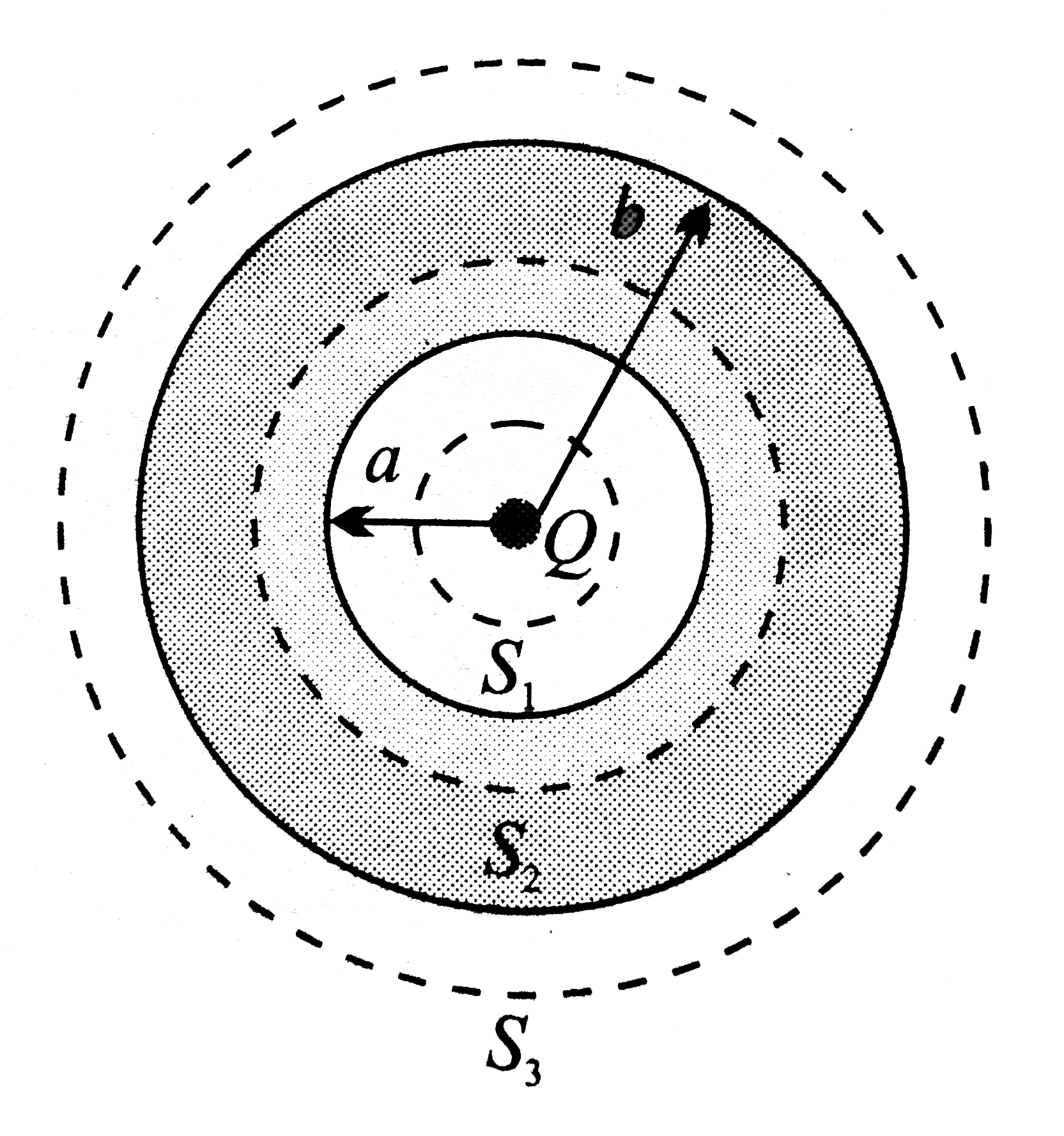
i. Consider a Gaussian surface `S_1` of radius `rltR` inside
the cavity , centered on charge Q. From Gauss's law,
`phi_E = oint E* dA = E(4pir^2) = (+Q)/epsilon_0`
From this we find the electric field to be
`E = 1/(4piepsilon_0) Q/r^2`
ii. Consider a Gaussian surface `S_2` inside the conducting material. We do not know if there is a charge on the inside surface of the conductor or not. We assume that the charge is q', if q' is zero, the result of Gauss's law will show it. Because the Gaussian surface is inside the conductor, the electric field is zero. From Gauss's law,
`oint vecE * dvec(A) = E (4pir^2) = Q_(enclosed)/epsilon_0= 0`

or `Q_(enclosed)/epsilon_0 = (Q+q')/epsilon_0 = 0 or q' = -Q`
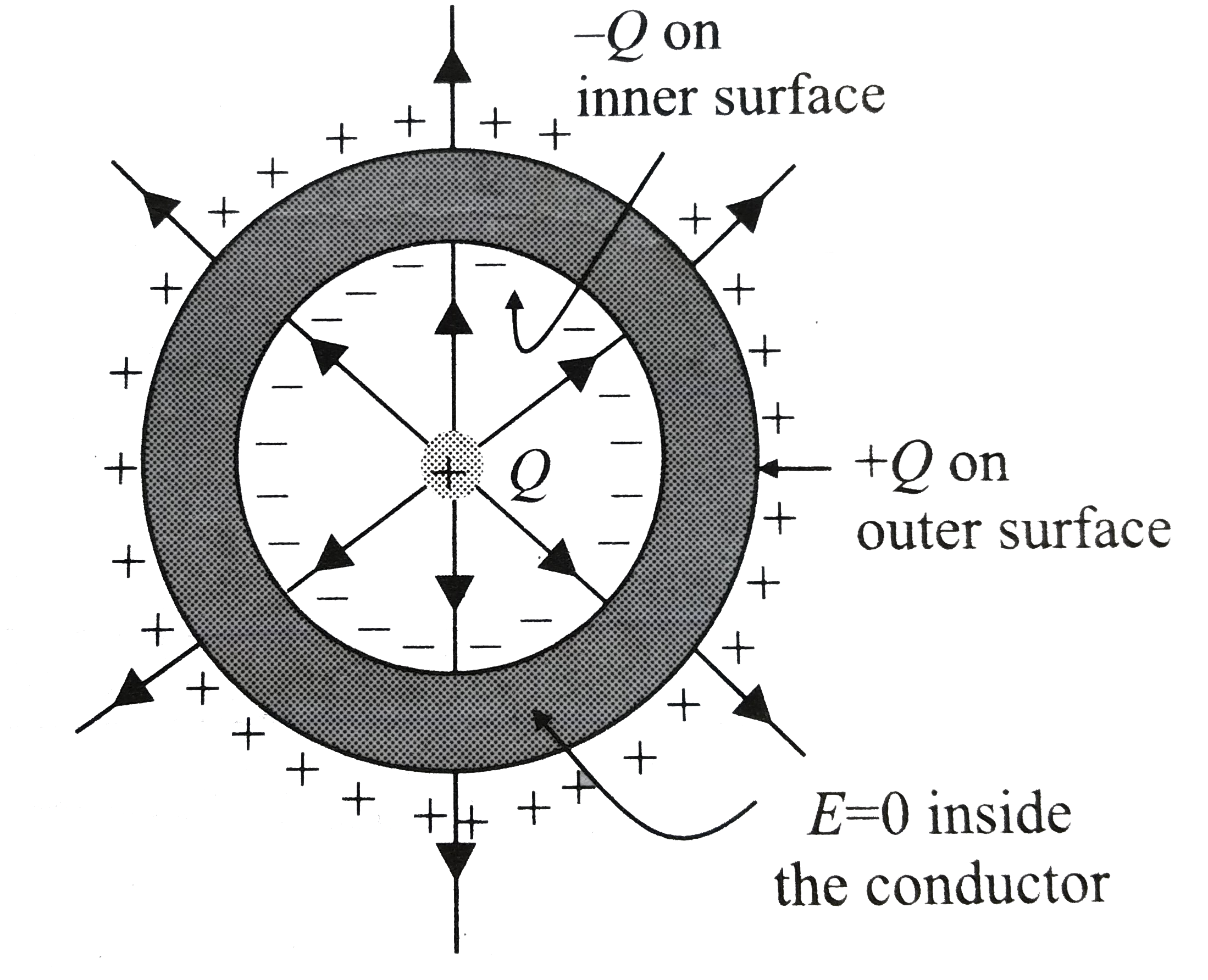
There is a charge on the inside surface of the conductor. The total charge induced on the inside surface of the cavity is the charge placed at its center.
iii. For `E, (rgtb)`, consider a Gaussian surface `S_3`. From Gauss's law,
`phi_E = ointE*dA = Q_(enclosed)/epsilon_0`
or `E(4pir^2) = (+Q)/epsilon_0`
or `E = Q/(4piepsilon_0r^2)`
It was stated in the problem that the conducting sphere has no net charge. Consequently, the total charge inside our Gaussian surface `S_3` is the sum of charge `+Q` and induced charges `-Q` on the inner surface of the conductor and `+Q` on the surface. Once more we can see that the field outside the sphere is the same as for a point charge. The conducting sphere has no shielding effect at all.
However, such a conducting shield prevents
electrostatic fields from charges outside the shell from
entering it.
iv. The conducting shell has no net charge, yet there is a surface charge -Q on its surface. Because the net charge on the shell is zero and no charge can reside inside a conductor, there must be +Q on the outer surface of the conductor
Promotional Banner

Topper's Solved these Questions

  • ELECTRIC FLUX AND GAUSS LAW

    CENGAGE PHYSICS|Exercise Example|7 Videos
  • ELECTRIC FLUX AND GAUSS LAW

    CENGAGE PHYSICS|Exercise Exercise 2.1|16 Videos
  • ELECTRIC CURRENT AND CIRCUIT

    CENGAGE PHYSICS|Exercise Interger|8 Videos
  • ELECTRIC POTENTIAL

    CENGAGE PHYSICS|Exercise DPP 3.5|14 Videos

Similar Questions

Explore conceptually related problems

A point charge +q is placed at the centre of a conducting spherical shell of inner radius a and outer radius b. Find the charge appearing on the inner and outer surface of the shell.

A point charge q is placed at a distance of r from the centre O of an uncharged spherical shell of inner radius R and outer radius 2R. The electric potential at the centre of the shell will be

A point charge q is brought slowly from infinity and is placed at the centre of a conducting neutral spherical shell of inner radius a and outer radius b, then find work done by external agent :

A point charge Q is located at the centre of a hollow spherical conductor having inner radius as R_(1) and outer radius R_(2) . The conductor being uncharged initially. The potential at the inner surface will be

A spherical conducting shell of radius r_(0) carry a charge q_(0) . Then value of electric field inside it is :-

A point charge q is placed at a distance d from centre of a uniformly charged conducting spherical shell of radius R and having charge Q as shown. Magnitude of electric field intensity at point P just inside the shell due to charge on shell is

A point charge Q is placed at the centre of an uncharged spherical shell of inner radius a and outer radius b. There is a small tunnel in the body of the shell. Calculate the work done to transfer the charge through the tunnel to infinity. [Hint: Remove the charge bit by bit and calculate the total work done.]

CENGAGE PHYSICS-ELECTRIC FLUX AND GAUSS LAW-MCQ s
  1. A point charge +Q is placed at the centre of an uncharged spherical co...

    Text Solution

    |

  2. Electric flux through a surface area 10 m^(2) lying in the xy plane in...

    Text Solution

    |

  3. A cylinder of radius R and length L is placed in a uniform electric fi...

    Text Solution

    |

  4. A point charge q is placed near hemisperical suface without base, cyli...

    Text Solution

    |

  5. A linear charge having linear charge density lambda pentrates a cube d...

    Text Solution

    |

  6. A ring of radius R is placed in the plane its centre at origin and its...

    Text Solution

    |

  7. A position charge q is placed at a distance of 4R above the centre of ...

    Text Solution

    |

  8. Figure shows. In cross section m three solid cylinders, each of length...

    Text Solution

    |

  9. Figure shown four solid spheres, each with charge Q uniformly distribu...

    Text Solution

    |

  10. In the figure a hemispherical bowl of bowl of radius R is shown Electr...

    Text Solution

    |

  11. figure shows, in cross section, two Gaussian spheres and two Gaussian ...

    Text Solution

    |

  12. Figure shows four Gaussian surfaces consisting of identical cylindrica...

    Text Solution

    |

  13. In figure , a solid sphere of radius a = 2.00cm is concentric with a s...

    Text Solution

    |

  14. A uniform charge density of 500 nC//m^(3) is distributed throughout a ...

    Text Solution

    |

  15. the net electric flux through each face of a die (singular of dice) ha...

    Text Solution

    |

  16. A Gaussian surface S encloses two charges q(1)= q and q(2) = -q the fi...

    Text Solution

    |

  17. The electric field in a region is radially outward with magnitude E=A...

    Text Solution

    |

  18. A charge q is placed at the centre of the open end of a cylindrical ve...

    Text Solution

    |

  19. Electric charge is uniformly distributed along a along straight wire o...

    Text Solution

    |

  20. In a region of space having a spherical symmetric distribution of cha...

    Text Solution

    |

  21. In a region of space the electric field in the x-direction and proport...

    Text Solution

    |