Home
Class 12
PHYSICS
A dipole lies on the x-axis, with the po...

A dipole lies on the x-axis, with the positive charge `+q` at `x = +d//2` and the negative charge at `x = -d//2`. Find the electric flux `phi_E` through the yz plane midway between the charges.

Text Solution

Verified by Experts
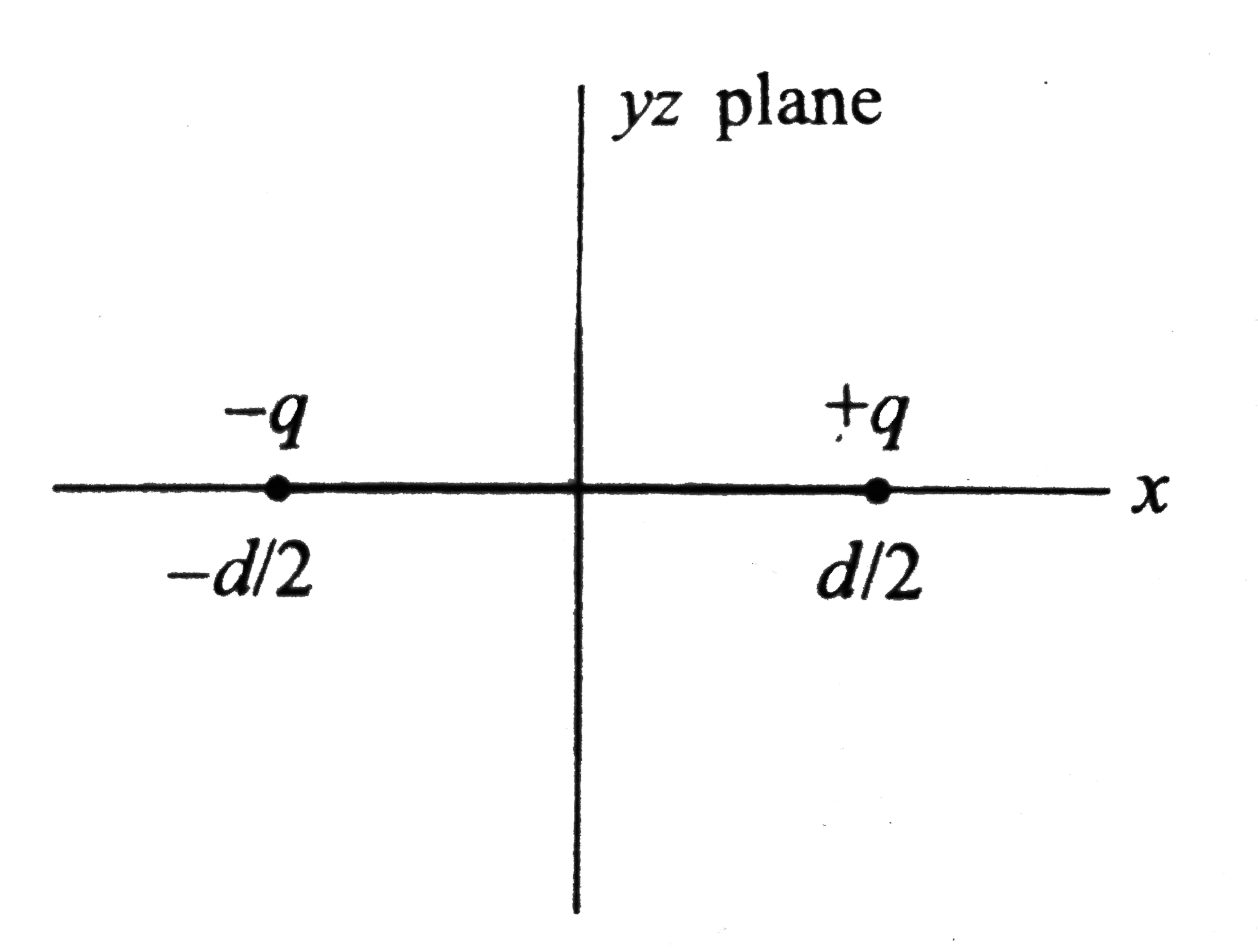
Net flux though yz plane is `2(q/(2epsilon_0)) = q/epsilon_0`.

So flux depends upon q but is independent of d.
Promotional Banner

Topper's Solved these Questions

  • ELECTRIC FLUX AND GAUSS LAW

    CENGAGE PHYSICS|Exercise Exercise 2.2|14 Videos
  • ELECTRIC FLUX AND GAUSS LAW

    CENGAGE PHYSICS|Exercise Subjective|12 Videos
  • ELECTRIC FLUX AND GAUSS LAW

    CENGAGE PHYSICS|Exercise Example|7 Videos
  • ELECTRIC CURRENT AND CIRCUIT

    CENGAGE PHYSICS|Exercise Interger|8 Videos
  • ELECTRIC POTENTIAL

    CENGAGE PHYSICS|Exercise DPP 3.5|14 Videos

Similar Questions

Explore conceptually related problems

A charge q is placed at point D of the cube. Find the electric flux passing through the EFGH and face AEHD .

A uniformly charged square plate having side L carries a uniform surface charge density sigma . The plate lies in the y - z plane with its centre at the origin. A point charge q lies on the x-axis. The flux of the electric field of q through the plate is phi0 , while the foce on the point charge q due to the plate is F_(0) , along the x-axis. Then,

A point charge q is placed at a distance d form the center of circular disc of radius R . Find electric flux through the disc due to that charge

A charge q is located at the centre of a cube. The electric flux through any face is

A charge q is located at the centre of a cube. The electric flux through any face is

Electric flux through a closed surface in free space enclosing a charge q is

Two point charges Q_(1) and Q_(2) are positioned at points I and 2. The field intensity to the right of the charge Q_(2) on the line that passes through the two charges varies according to a law that is represented in the figure. The field intensity is assumed to be positive if its direction coincides with the positive direction on the x-axis. The distance between the charges is l. (a) Find the sign of each charge (b) Find the ratio of the absolute values of the charges |(Q_(1))/(Q_(2))| (c) Find the value of b where the field intensity is maximum [(a) Q_(2) is negative and Q_(1) is positive (b) ((l +a)/(a))^(2) , (c) (l)/(((l+a)/(a))^(2//3)-1)]

CENGAGE PHYSICS-ELECTRIC FLUX AND GAUSS LAW-Exercise 2.1
  1. A thin metallic spherical shell contains a charge Q on it. A point cha...

    Text Solution

    |

  2. If we introduce a large thin metal plate between two point charges, wh...

    Text Solution

    |

  3. A dipole lies on the x-axis, with the positive charge +q at x = +d//2 ...

    Text Solution

    |

  4. A Charge Q is distributed uniformly on a ring of radius r. A sphere of...

    Text Solution

    |

  5. Figure shown an imaginary cube of edge L/2. A uniformly Charged rod o...

    Text Solution

    |

  6. A hemispherical body is placed in a uniform electric field E. What is ...

    Text Solution

    |

  7. What is the field in the cavity if a conductor having a cavity is char...

    Text Solution

    |

  8. Figure shows a closed surface which intersects a conducting sphere. If...

    Text Solution

    |

  9. Figure shows a charge q placed at the centre of a hemisphere. A second...

    Text Solution

    |

  10. A charge Q is placed at the centre of an imaginary hemispherical surfa...

    Text Solution

    |

  11. In figure, a cone lies in a uniform electric field E. Determine the el...

    Text Solution

    |

  12. A uniform electric field ahati +bhatj intersects a surface of area A. ...

    Text Solution

    |

  13. A charge Q is placed at a distance alpha/2 above the centre of a horiz...

    Text Solution

    |

  14. Calculate the total electric flux through the paraboloidal surface due...

    Text Solution

    |

  15. Consider a closed surface of arbitatry shape as shown in figure. Suppo...

    Text Solution

    |

  16. If Coulomb's law involved 1/r^3 (instead of 1/r^2), would Gauss's law ...

    Text Solution

    |

