Home
Class 12
PHYSICS
A capacitor has rectangular plates of le...

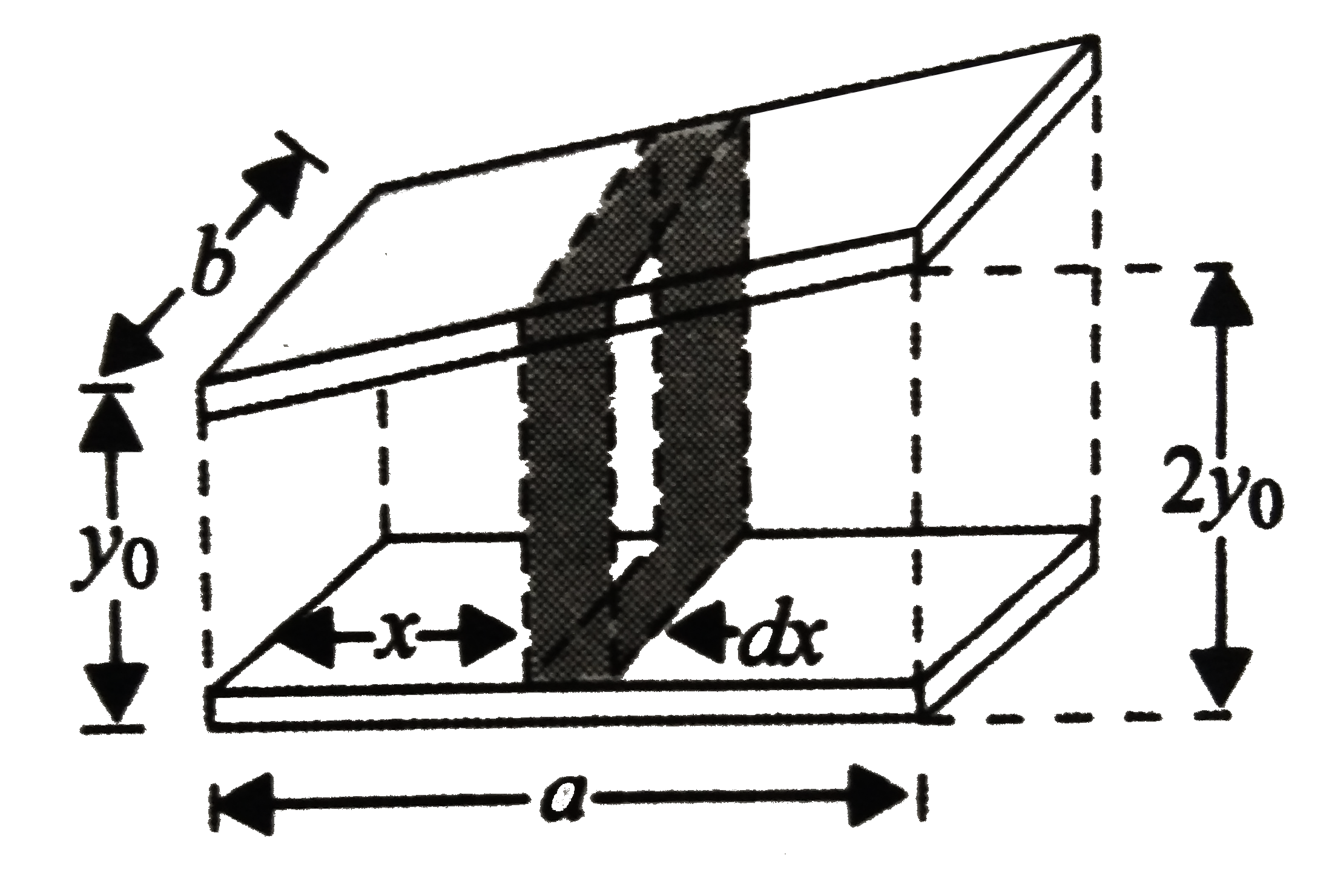
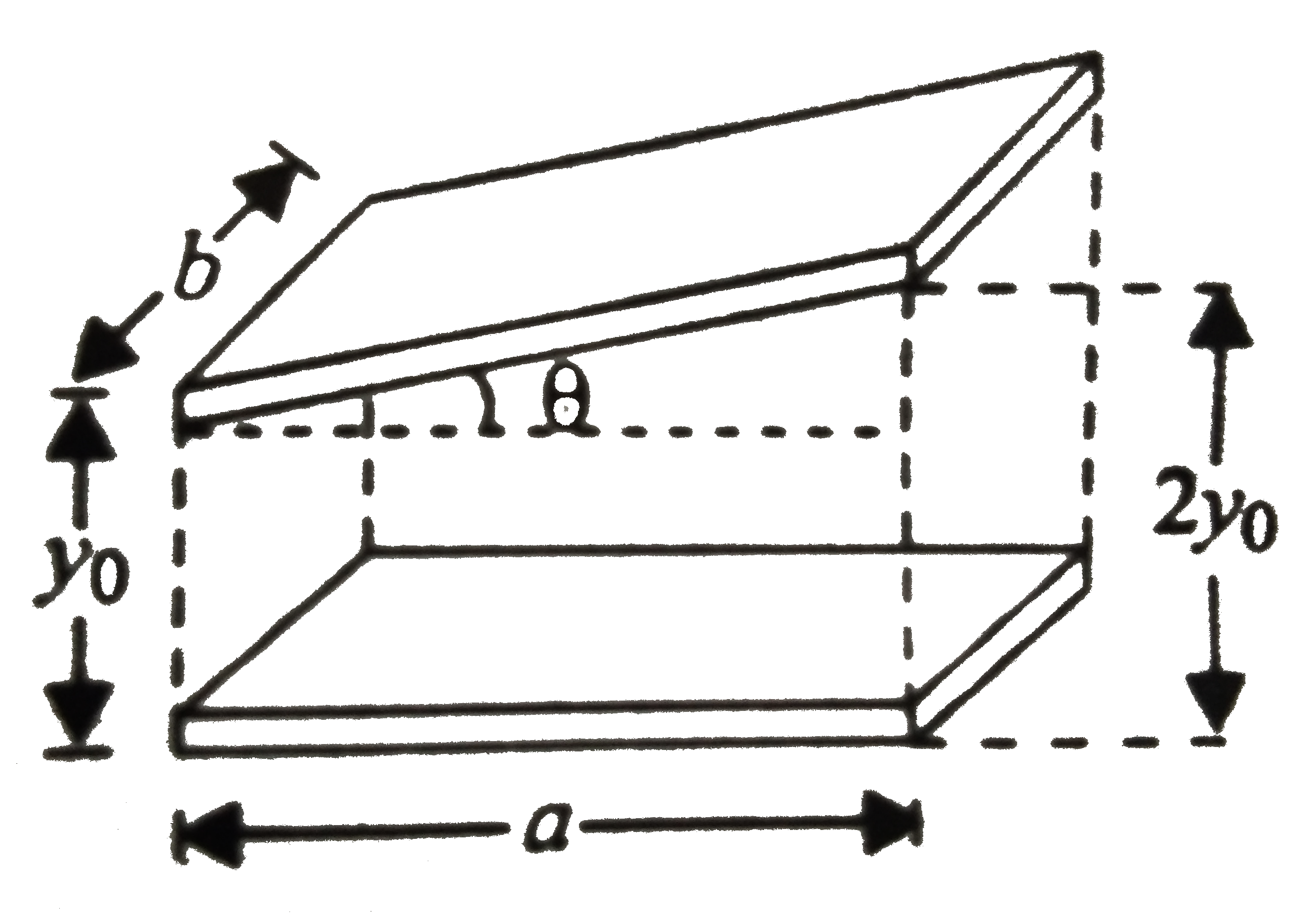
A capacitor has rectangular plates of length a and width b. The top plate is inclined at a small angle as shown in. The plate separation varies from `dy_(0)` at the left to `d=y_(0)` at the right, where `y_(0)` is much less than a or b. system.
.

Text Solution

Verified by Experts

We consider a differential strip of width `dx` and length b to approximate a differential capacitor of area `bdx` and separation

`d=y_(0)+(y_(0)/a)x`.
All such differential capcitors are in parallel arrangement. Thus,
`dC=(epsilon_(0)(bdx))/(y_(0)+(y_(0)/a)x)` or `C=intdC`
or `C=epsilon_(0)bint_(0)^(a)(dx)/(y_(0)+y_(0)/ax)`
`=(epsilon_(0)b)/((y_(*0)//a))[In((y_0+y_(0)/axxa)/y_(0))]=(epsilon_(0)ab)/y_(0) In 2`
We can determine the expression for capacity in terms of `theta` as
`d =(y_(0)+x tan theta)`
`C =intdC =int_(b)^(a)(epsilon_(0)b dx)/(y_(0)+x tan theta)`
`=(epsilon_(0))/(tan theta)` In `(y_(0)+tan theta)/y_(0)`
For small `theta`,
`tan theta=theta` or `C=(epsilon_(0)b)/theta In(1+(atheta)/y_(0))`
Now, we can use the expansion
`log (1+x)=x-1/2x^(2)+`...
For `xlt1`, we can negleet higher powers. Thus,
`C=(epsilon_(0)b)/(theta)[(atheta)/y_(0)-1/2((atheta)/y_(0))^(2)]=(epsilon_(0)ab)/y_(0)[1-(atheta)/(2y_(0))]`
Promotional Banner

Topper's Solved these Questions

  • CAPACITOR AND CAPACITANCE

    CENGAGE PHYSICS|Exercise Solved Examples|10 Videos
  • CAPACITOR AND CAPACITANCE

    CENGAGE PHYSICS|Exercise Exercise 4.1|13 Videos
  • ATOMS

    CENGAGE PHYSICS|Exercise QUESTION BANK|40 Videos
  • CENGAGE PHYSICS DPP

    CENGAGE PHYSICS|Exercise subjective type|51 Videos

Similar Questions

Explore conceptually related problems

Figure shown a parallel-plate capacitor having square plates of edge a and plate-separation d. The gap between the plates is filled with a dielectric of dielectric constant K which varies parallel to an edge as where K and a are constants and x is the distance from the left end. Calculate the capacitance.

A parallel plate capacitor has plate A and separation d between the plates. The capacitor is connected to a battery of emf V . (a) find the charge on the capacitor. (b) the plate separation is decreases to d//2 . Find the extra charge given by the battery to the positive plate. (c) work done in reducing separation between plates.

A capacitance balance is shown in the figure. The balance has a block pulley system attached on one side and a capacitor that has a variable gap width on the other side. Assume upper plate of the capacitor has negligible mass. When the separation between the plate is 1/(sqrt(5)) meter, the attractive force between the plates balances the pulley block system. Then find value of V_(0) in volts (EMF of battery). (Take area of the plate =20/(3epsilon_(0))m^(2) )

A parallel plate capacitor has square plates of side length L kept at a separation d. The space between them is filled with a dielectric whose dielectric constant changes as K = e^(betax) where x is distance measured from the left plate towards the right plate, and b is a positive constant. A poten- tial difference of V volt is applied with left plate positive. (i) What happens to capacitance of the capacitor if d is increased ? What is the smallest possible capacitance that can be obtained by changing d ? (ii) Write the expression of electric field between the plates as a function of x .

A parallel plate capacitor has square plates of side length L. Plates are kept vertical at separation d between them. The space between the plates is filled with a dielectric whose dielectric constant (K) changes with height (x) from the lower edge of the plates as K = e^(betax) where b is a positive constant. A potential difference of V is applied across the capacitor plates. (i) Plot the variation of surface charge density (s) on the positive plate of the capacitor versus x. (ii) Plot the variation of electric field between the plates as a function of x. (iii) Calculate the capacitance of the capacitor.

A thin rectangular plate with sides of length 'a' and 'b' has mass per unit area varying as alpha =alpha_(0) ((xy)/(ab)) where alpha_(0) is a constant. The co-ordinated of centre of mass of the plate is

An air capacitor consists of two parallel plates B as shown in the figure. Plate A is given a change and plate B is given a charge 3Q. P is the plane of the capacitor. If C_(0) is the capacitor capacitor, then

Figure shows two parallel plate capacitors with fixed plates and connected to two batteries. The separation between the plates is the same for the two capacitors. The plates are rectangular in shape with width b and length l_(1) and l_(2) . The left half of the dielectric slab has a dielectric constant k_(1) and the right half k_(2) Neglecting any friction, find the ratio of the voltage of ihe left battery for that of the right battery for which the dielectric. slab mayremain in equilibrium.

A parallel plate capacitor has plates of area A separated by distance ‘d’ between them. It is filled with a dielectric which has dielectric constant that varies as K (y) = k _(0) (1+ alpha y) where ‘y’ is the vertical distance measured from base of the plates. The total capacitance of the system is best given by: (K _(0) is constant)

A rectangular plate of dimensions l xx b is in x -y plane as shown in Fig. If the portion of this plate lying in quadrant I is removed, find the position of centre of mass of remaining part of plate.