Home
Class 12
PHYSICS
What is V(A)-V(B) in the arrangement sho...

What is `V_(A)-V_(B)` in the arrangement shown in.What is the condition such that `V_(A)-V_(B)=0`

Text Solution

Verified by Experts
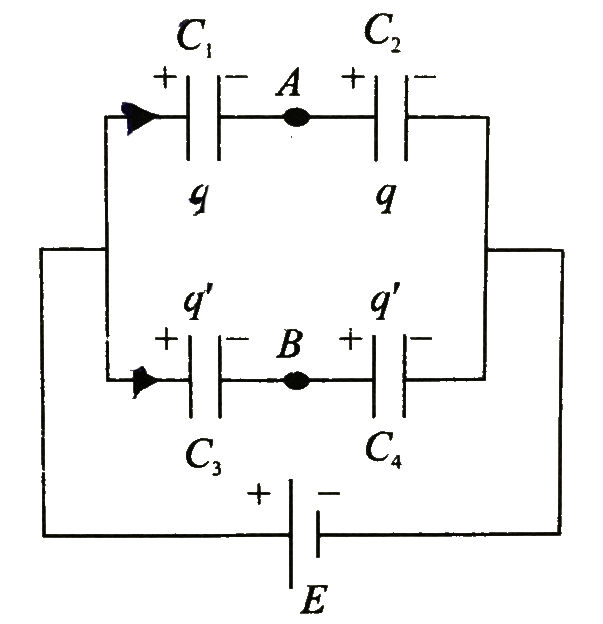
Let the charge be as shown in. We know that capacitors in series have the same charge. Considering the loop containing `C_(1),C_(2)` and `E`, we get

`q/C_(1)+q/C_(2)-E=0`
or `q=E[(C_(1)C_(2))/(C_(1)+C_(2))]`
from the loop containting `C_(3),C_(4)`, and `E`, we get
`(q')/C_(3)+(q')/C_(4)-E=0` or `q'=E[(C_(3)C_(4))/(C_(3)+C_(4))]`
Now
`V_(A)-V_(B)=q/C_(2)-(q')/C_(4)=E[C_(1)/(C_(1)+C_(2))-C_(3)/(C_(3)+C_(4))]`
`=E[(C_(1)C_(4)-C_(3)C_(2))/((C_(1)+C_(2))(C_(3)+C_(4))]]`
For `V_(A)-V_(B)=0, C_(1)C_(4)=C_(2)C_(3)=0`. If `(C_(1)//C_(2))=(C_(3)//C_(4))`, the potential difference across `A` and `B` will be zero . This statement is very important is capacitor circuit solving. This type of the situation is callede balacned Wheatstone bridge.
Promotional Banner

Topper's Solved these Questions

  • CAPACITOR AND CAPACITANCE

    CENGAGE PHYSICS|Exercise Solved Examples|10 Videos
  • CAPACITOR AND CAPACITANCE

    CENGAGE PHYSICS|Exercise Exercise 4.1|13 Videos
  • ATOMS

    CENGAGE PHYSICS|Exercise QUESTION BANK|40 Videos
  • CENGAGE PHYSICS DPP

    CENGAGE PHYSICS|Exercise subjective type|51 Videos

Similar Questions

Explore conceptually related problems

Find V_(A)-V_(B)

Potential difference V_(A) - V_(B) in the network shown in

In the arrangement shown in figure the ratio of velocity V_(1)&V_(2) of block (1)&(2) is

Potential difference V_(B)-V_(A) in the network shown is

In the circuit shown, what is the potential difference V_(PQ) ?

In the circuit shown , what is the potential difference V_(PQ) ?

In the circuit shown, what is the potential different V_(PQ) ?

Three block 1, 2 and 3 are arranged as shown in the figure. The velocities of the blockes v_(1) , v_(2) and v_(3) are shown in the figure. What is the relationship between v_(1) , v_(2) and v_(3) ?

