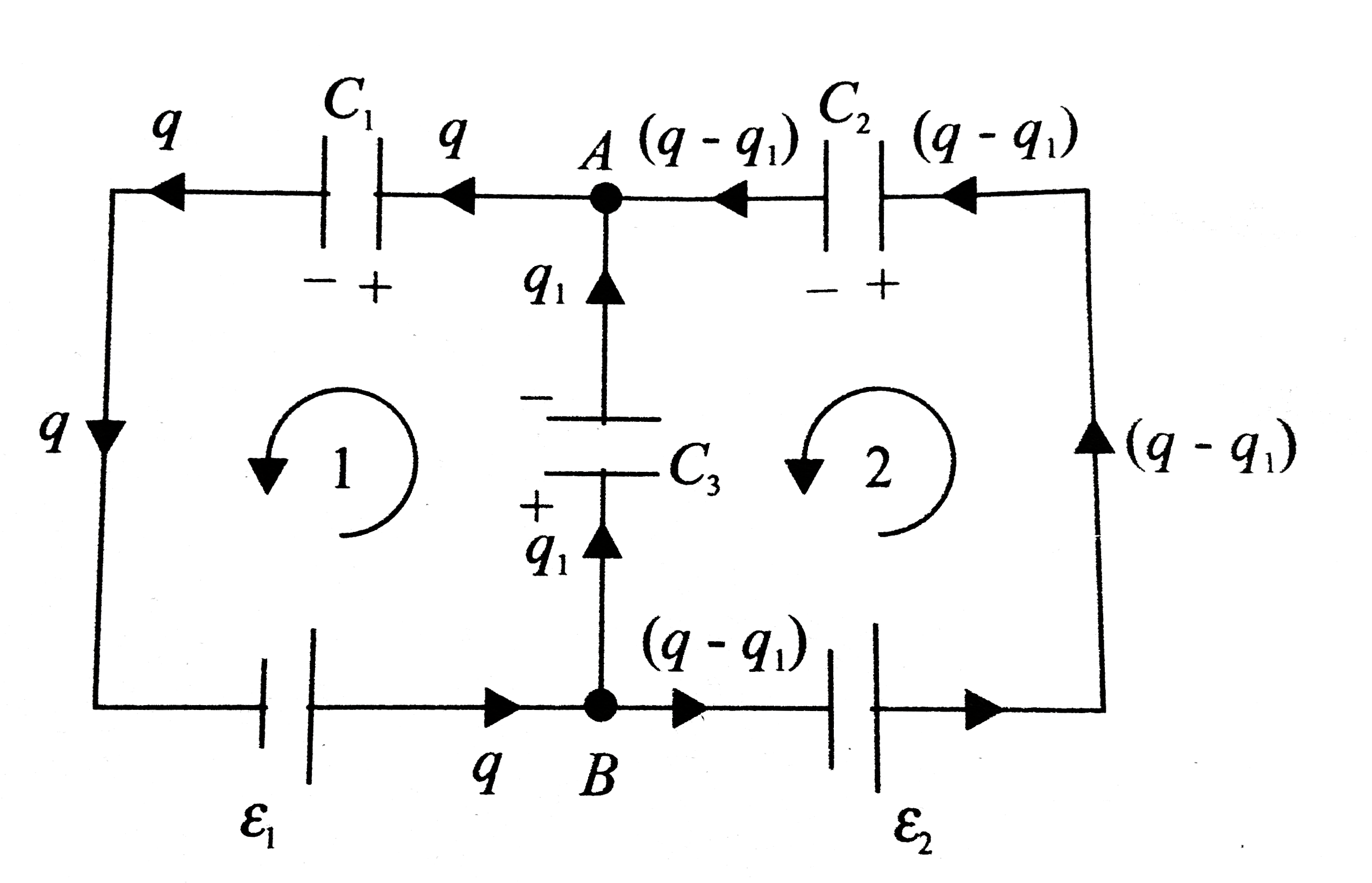
Method 1: The distribution of electric charge is shown in Fig. 4. 78.
.
In loop (1) ,
`epsilon_(1)-q_(1)/C_(3)-q/C_(1)=0` (i)
In loop (2),
`-((q-q_(1))/C_(1))+q_(1)/C_(3)+epsilon_(2)=0` (ii)
Solving Eqs. (i) and (ii), we get
`q_(1)=(-C_(3)(C_(2)epsilon_(2)-C_(1)epsilon))/((C_(1)+C_(2)+C_(3)))`
`:. V_(A)-V_(B)=-{q_(1)/C_(3)}=((C_(2)epsilon_(2)-C_(1)epsilon_(1))/(C_(1)+C_(2)+C_(3)))`
Method 2: The algebraic sum of the charge at junction `A` should be zero . suppose the chartes `q_(1),q_(2), and q_(3)` are moving away from the junction. Let us assume that potential of unction B is zero . Now we will write the potentials of various junctons as shown in. After knowing the potential difference across the capacitors. we can weite relations of `q_(1), q_(2)` and `q_(3)` in terms of their capacitance and potential differece.
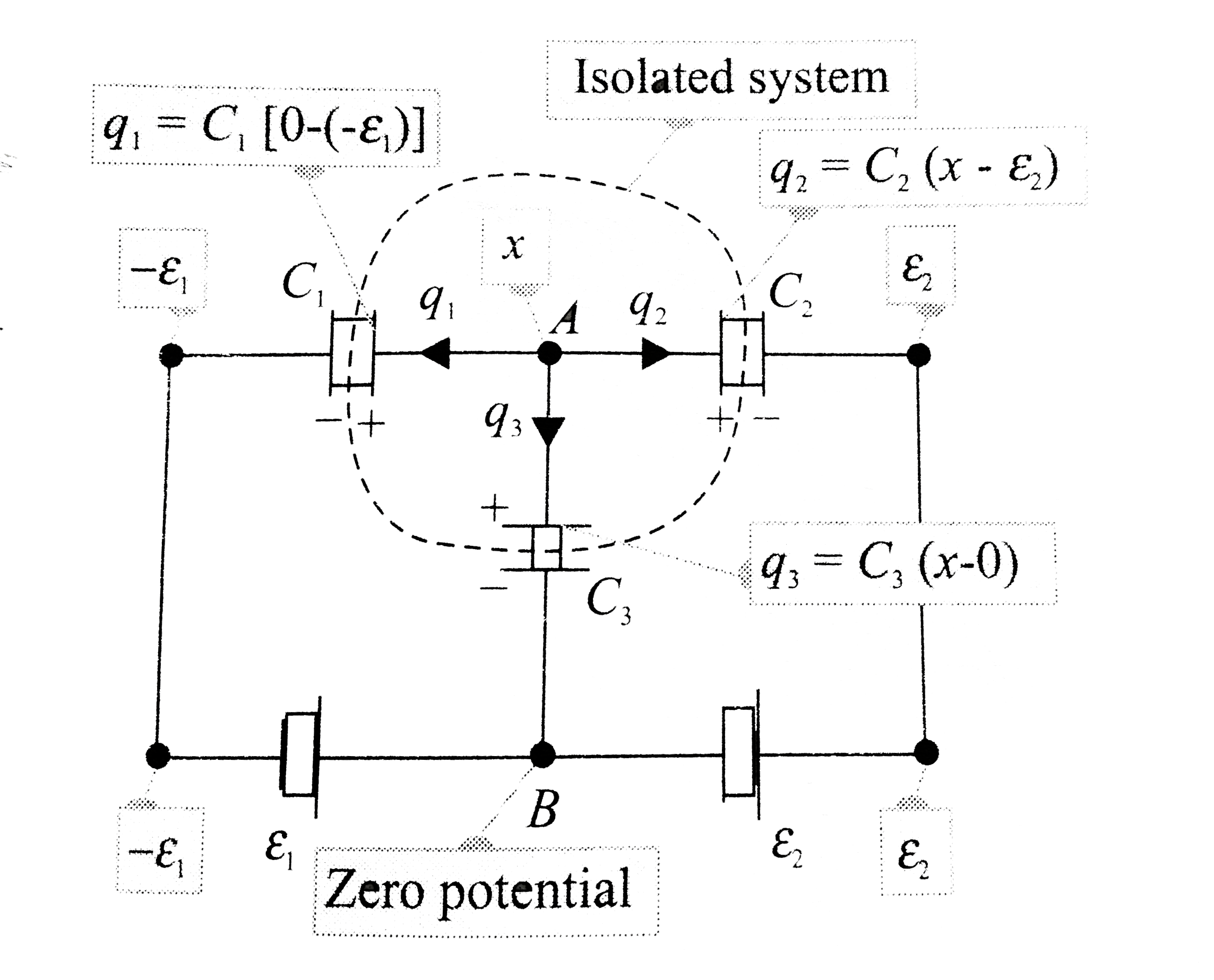
At junction (A),
`sumq=0`
or `q_(1)+q_(2)+q_(3)=0`
or `C_(1)(x+epsilon_(1))+C_(2)(x-epsilon)+C_(3)(x-0)=0`
or `x(C_(1)+C_(2)+C_(3))=epsilon_(2)C_(2)-epsilon_(1)C`
`:. x=(epsilon_(2)C_(2)-epsilon_(1)C_(1))/(C_(1)+C_(2)+C_(3))`
`: . V_(A) + V_(B) = x - 0 = x = (epsilon_(2)C_(2)-epsilon_(1)C_(1))/(C_(1) + C_(2) + C_(3))`
Method 3: The electric charge enclosed by the isoated system shown in. should be zero. Therefore,
`q_(1)+q_(2)+q_(3)=0`
or `(x+epsilon_(1))/C_(1)+(x-epsilon_(2))/C_(2)+(x-0)/C_(3) =0` or `x=(C_(2)epsilon_(2)-C_(1)epsilon_(1))/(C_(1)+C_(2)+C_(3))`
`:.V_(A)-V_(B)=x-0=(C_(2)epsilon_(2)-C_(1)epsilon_(1))/(C_(1)+C_(2)+C_(3))`
 .
. 

