Home
Class 12
PHYSICS
When switch S is thrown to the left in f...

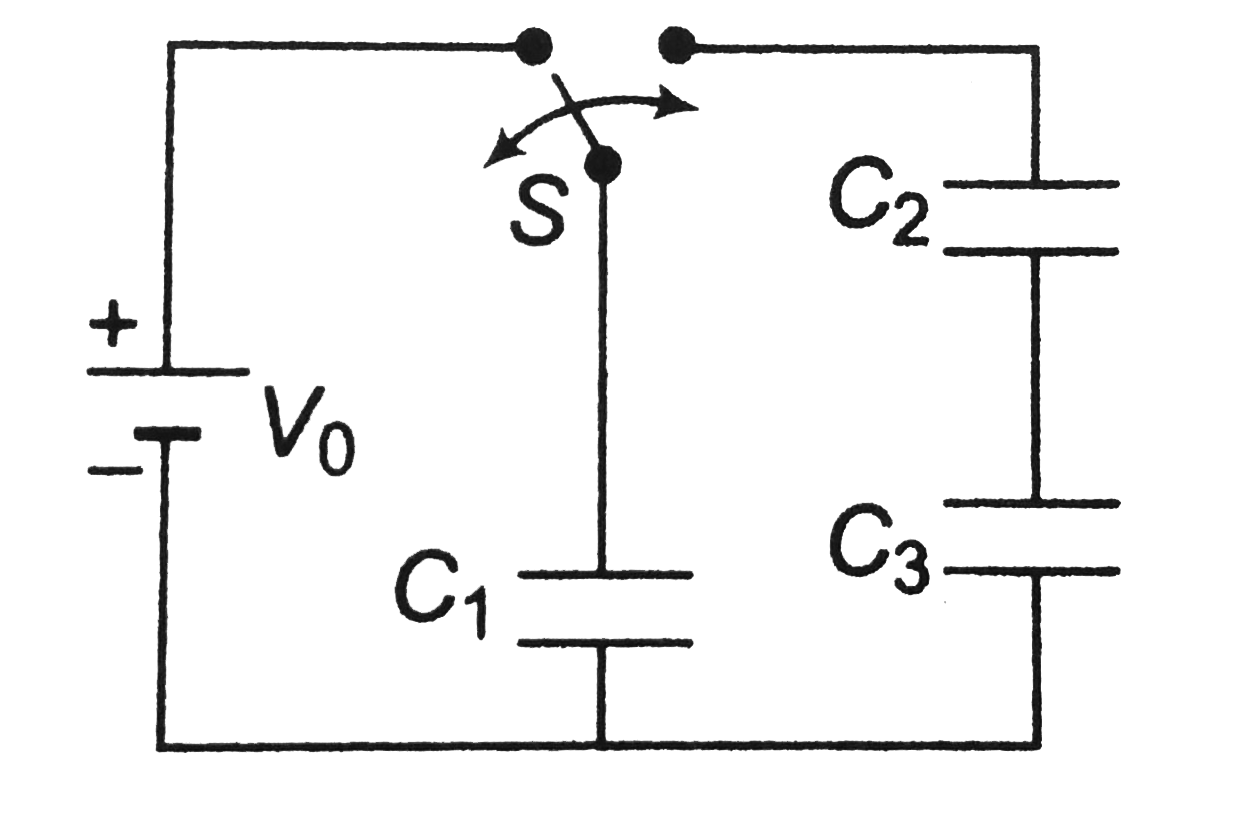
When switch `S` is thrown to the left in figure, the plates of capacitor 1 acquire a potential difference `V_0`. Capacitors 2 and 3 are initially uncharged. The switch is now thrown to the right. What are the final charges `q_1, q_2` and `q_3` on the capacitors?

Text Solution

Verified by Experts

The correct Answer is:
`q_(1)=(C_(1)^(2)V(C_(2)+C_(3)))/(C_(1)C_(2)+C_(2)C_(3)+C_(1)C_(3),)q_(2)=q_(3)=(C_(2)C_(3)C_(1)CV)/(C_(1)C_(2)+C_(1)C_(2)+C_(2)C_(3))`.

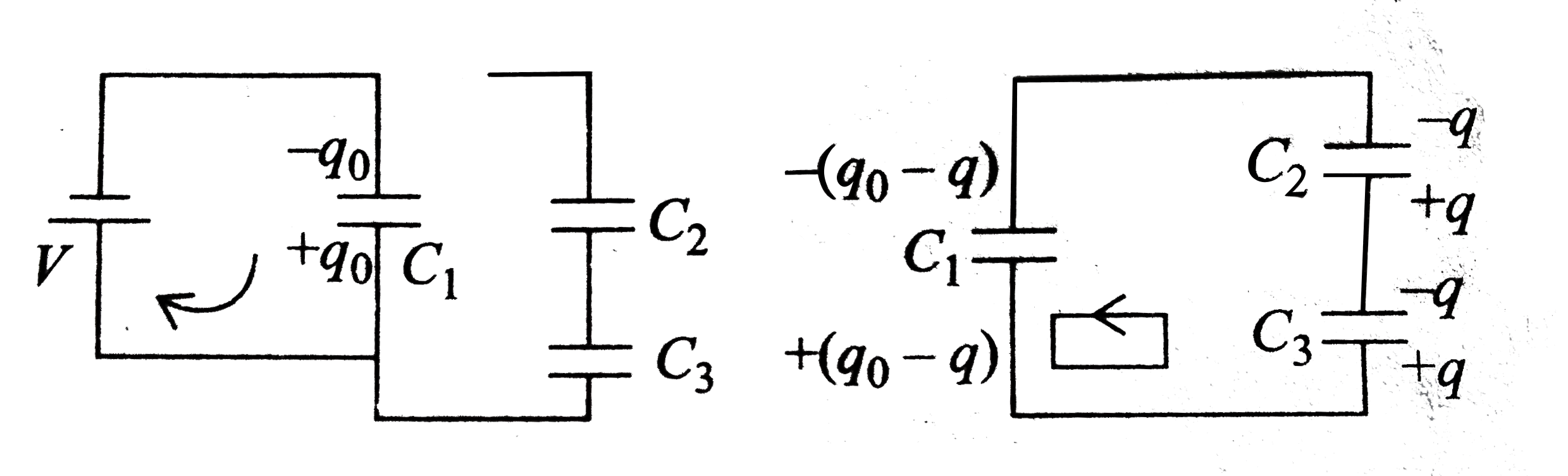
When switch is left
.
Appling loop rule:
`(q_(0) - q)/(C_(1)) - (q)/(C_(3)) - (q)/(C_(2)) = 0`
or `(q_(0))/(C_(1)) -
When switch is thrown right According to loop rule,
`(q_(0)-q)/C_(1)=q(1/C_(2)+1/C_(3))=2((C_(2)+C_(3))/(C_(2)C_(3)))`
`:. q=((C_(2)C_(3)q_(0))/(C_(1)C_(2)+C_(1)C_(3)+C_(2)C_(3)))`
`:. `q_(1)=q_(0)-q=C_(1)V-((C_(2)C_(3)q_(0))/(C_(1)C_(2)+C_(1)C_(3)+C_(2)C_(3)))`
`=(C_(1)^(2)V(C_(2)+C_(3)))/(C_(1)C_(2)+C_(2)C_(3)+C_(1)C_(3))`
Also, `q_(2)=q_(3)=q=(C_(2)C_(3)q_(0))/(C_(1)C_(2)+C_(2)C_(3)+C_(1)V_(3))`
`=(C_(2)C_(3)C_(1)V)/(C_(1)C_(2)+C_(1)C_(3)+C_(2)C_(3))`.
Promotional Banner

Topper's Solved these Questions

  • CAPACITOR AND CAPACITANCE

    CENGAGE PHYSICS|Exercise Single Correct|49 Videos
  • CAPACITOR AND CAPACITANCE

    CENGAGE PHYSICS|Exercise Multile Correct|11 Videos
  • CAPACITOR AND CAPACITANCE

    CENGAGE PHYSICS|Exercise Exercise 4.2|32 Videos
  • ATOMS

    CENGAGE PHYSICS|Exercise QUESTION BANK|40 Videos
  • CENGAGE PHYSICS DPP

    CENGAGE PHYSICS|Exercise subjective type|51 Videos

Similar Questions

Explore conceptually related problems

Initially capacitor 'A' is charged to a potential drop epsilon and capacitor B is uncharged At t=0, switch S is closed, then the maximum current through the inductor is

Charges q_(1) , q_(2) and q_(3) are placed on capacitors of capacitance C_(1) , C_(2) and C_(3) , respectively, arranged in series as shown. Switch S is there closed. What are the final charges q'_(1) , q'_(2) and q'_(3) on the capacitors? Given q_(1)=30muC , q_(2)=muC , q_(3)=10muC , C_(1)=10muF , C_(2)=20muF , C_(3)=30muF and epsilon=12"volt"

A capacitor of capacitance C is charged to a potential difference V from a cell and then disconnected from it. A charge +Q is now given to its positive plate. The potential difference across the capacitor is now.

A capacitor of capacitance C is charged to a potential difference V from a cell and then disconnected from it. A charge +Q is now given to its positive plate. The potential difference across the capacitor is now

The plates of a capacitor of capacitance C are given the charges Q_1 and Q_2 as shwon in figure. Now the switch is closed at t =0. Find the charges on plates after time t.

If A is the area of each plate, charge on it is q and potential difference is V then the distance between the parallel plate capacitor is

A battery is used to charge a parallel plate combination of two identical capacitors. If the potential difference across the battery is V and the total charge Q flows through the battery during the charging process then 1) The charge on each capacitor is Q/2 and the potential of each capacitor is V/2 2) The charge on each capacitor is Q and the potential of each capacitor is V 3) The charge on each capacitor is Q/2 and the potential of each capacitor is V 4) The charge on each capacitor is Q and the potential of each capacitor is V/2

The left plate of the capacitor shown in the figure above carries a charge +Q while the right plate is uncharged at t=0 . The total charge on the right plate after closing the switch will be:

CENGAGE PHYSICS-CAPACITOR AND CAPACITANCE-Subjective
  1. In when the switch is swapped from 1 to 2, find the heat produced in t...

    Text Solution

    |

  2. A capacitor of capacitance C(1)=1 muF withstand a maximum voltage of V...

    Text Solution

    |

  3. In the circuit shown , the emf of each battery is 60 V and C(1)=2 muF ...

    Text Solution

    |

  4. A parallel plate capacitor contanins a mica sheet (thickness 0. 5+xx1...

    Text Solution

    |

  5. Find the potential difference between points M and N of the system sho...

    Text Solution

    |

  6. Several capacitors are connected as shown in. If the charge on the 5 m...

    Text Solution

    |

  7. Find the potential differece between the poinst A and B and that betwe...

    Text Solution

    |

  8. Some capacitors each of capacitance 30 muF are connected as shown in. ...

    Text Solution

    |

  9. Two capacitors C(1) and C(2) are connected with two batteries of emf e...

    Text Solution

    |

  10. Find the potential difference between the points A and B in the circui...

    Text Solution

    |

  11. Shows a capacitive circuit, with a switch S(W). . a. What is the p...

    Text Solution

    |

  12. Shows an arrangement of identical metal plates paraed parallel to each...

    Text Solution

    |

  13. Two identical capacitors haveng plate separation d(0) are connected pa...

    Text Solution

    |

  14. Three capacitors each having capacitance C=2 muF are connected with a ...

    Text Solution

    |

  15. Five identical capacitors each of magnityde 5 muF are arranged with a ...

    Text Solution

    |

  16. When switch S is thrown to the left in figure, the plates of capacitor...

    Text Solution

    |

  17. A capacitor of capacitance C(0) is charged to a patential V(0) and the...

    Text Solution

    |

  18. Two dielectric slabs of relative oremittivities epsilon(r(1))=2 and ...

    Text Solution

    |

  19. Suppose n conducting face to face, and the distance between two succes...

    Text Solution

    |

  20. The arrangement of parallel conducting plates shown in are of the sam...

    Text Solution

    |

