Home
Class 12
PHYSICS
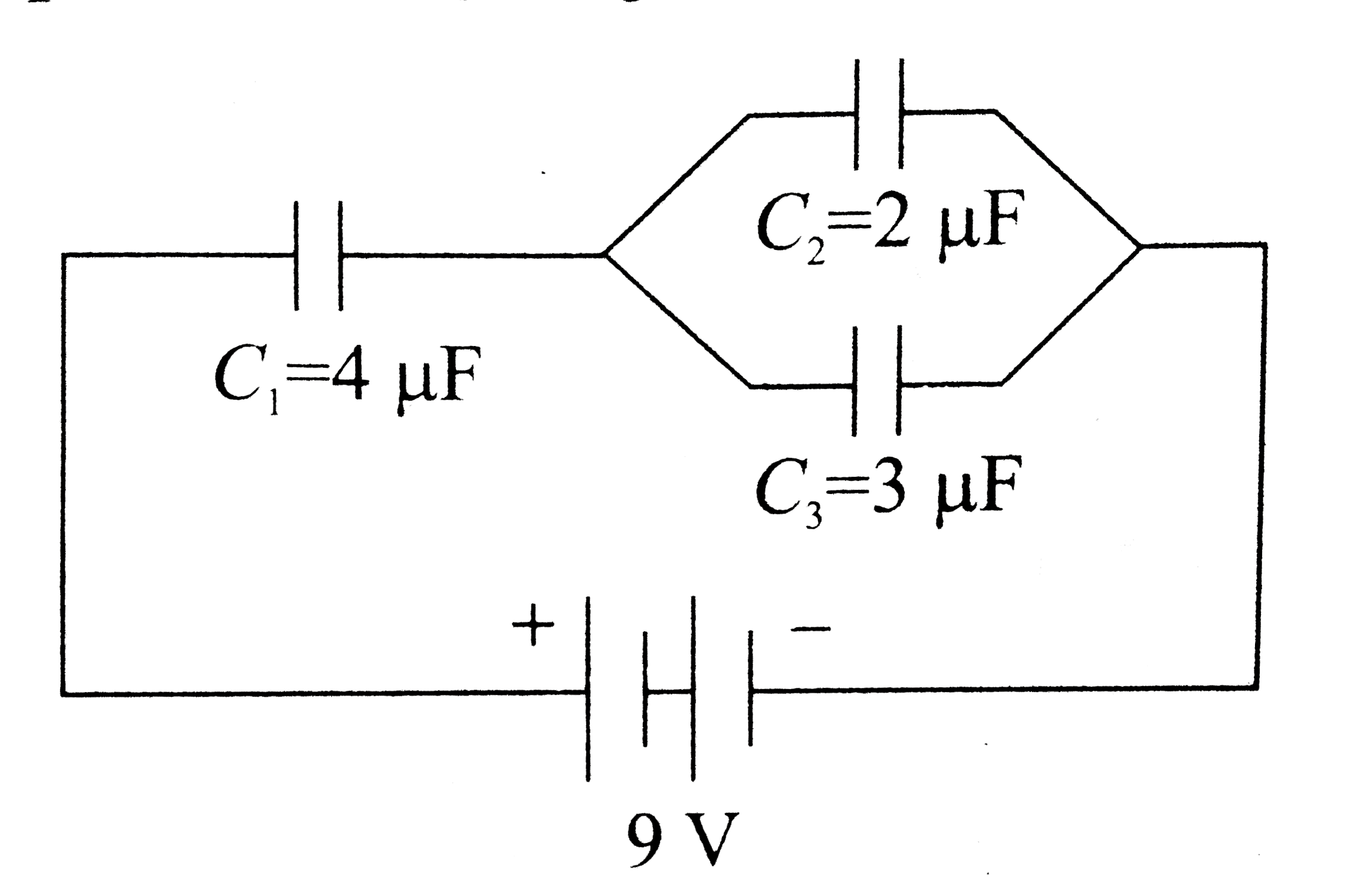
In, the charges on C(1),C(2), and C(3), ...

In, the charges on `C_(1),C_(2)`, and `C_(3)`, are `Q_(1), Q_(2)`, and `Q_(3)`, respectively.
.

A

`Q_(2)=8 muC`

B

`Q_(3)=12 muC`

C

`Q_(1)=20 muC`

D

`Q_(2)=12 muC`

Text Solution

Verified by Experts

The correct Answer is:

A, B, C

Effective capacitance is `C=(4xx5)/5=(20)/9 muF`
Charge on `C_(1)` is `Q_(1)=CV=(20)/(9)xx20 muC`
Charge on `C_(2)` is `Q_(2)((C_(2))/(C_(2)+C_(3)))Q_(1)=2/(3)xx20=8 muC`
Charge on `C_(3)` is `Q_(3) ((C_(3))/(C_(2)+C_(3)))Q_(1)=3/3xx20=12 muC`
Since, `Q_(2)/C_(2)=Q_(3)/C_(3)`
and `Q_(1)-Q_(2)+Q_(3)=Q_(2)+C_(3)/C_(2)Q_(2)=Q_(2)((C_(2)+C_(3))/C_(2))`
Therfore,
`Q_(2)=(C_(2)/(C_(2)+C_(3)))Q_(1)`
`Q_(3)=(C_(3)/(C_(2)+C_(3)))Q_(1)`
Thus, option `(a), (b)`, and `(c)` are correct.
Promotional Banner

Topper's Solved these Questions

  • CAPACITOR AND CAPACITANCE

    CENGAGE PHYSICS|Exercise Comprhension|35 Videos
  • CAPACITOR AND CAPACITANCE

    CENGAGE PHYSICS|Exercise Integer|5 Videos
  • CAPACITOR AND CAPACITANCE

    CENGAGE PHYSICS|Exercise Single Correct|49 Videos
  • ATOMS

    CENGAGE PHYSICS|Exercise QUESTION BANK|40 Videos
  • CENGAGE PHYSICS DPP

    CENGAGE PHYSICS|Exercise subjective type|51 Videos

Similar Questions

Explore conceptually related problems

Three capacitors are connected to D.C source of 100 volts shown in the adjoining figure. If the charge accumulated on plates of C_(1), C_(2) and C_(3) are q_(a), q_(b), q_(c ), q_(d), q_(e) and q_(f) respectively, then

In the circuit shown in figure , initially key K_(1) is closed and key K_(2) is open. Then K_(1) is opened and K_(2) is closed (order is important). [Take Q_(1)^(') and Q_(2)^(') as charges on C_(1) and C_(2) and V_(1) and V_(2) as voltage respectively]. Then

The circle C_(1) : x^(2)+y^(2)=3 , with cenre at O, intersects the parabola x^(2)=2y at the point P in the first quadrant. Let the tangent to the circle C_(1) at P touches other two circles C_(2) and C_(3) at R_(2) and R_(3) respectively. Suppose C_(2) and C_(3) have equal radii 2sqrt(3) and centres Q_(2) and Q_(3) respectively. If Q_(2) and Q_(3) lie on the y-axis, then Q_(2)Q_(3)=

A charge Q located at a point vec r is in equilibrium under the combined field of three charges q_(1), q_(2) and q_(3) . If the charges q_(1) and q_(2) are located at point vec r_(1) and vec r_(2) respectively, find the direction of the force on Q due to q_(3) in terms of q_(1),(q_2), vec r_(1) vec r_(2) , and vec(r) .

(Figure 3.78) shows three thin concentric spherical shells A, B and C with initial charges on A , B, and C as 3 Q, 2Q, and -Q, respectively. The shells A amd C are connected by a wire such that it does not touch B. Shell B is earthed. Determine the final charges q_A, q_B, "and" q_C . .

Three concentric metallic spherical shells of radii R, 2R, 3R are given charges Q_(1) Q_(2) Q_(3) , respectively. It is found that the surface charge densities on the outer surface of the shells are equal. Then, the ratio of the charges given to the shells Q_(1) : Q_(2) : Q_(3) is

Two point charges q_(1) and q_(2) , of magnitude +10^(–8) C and –10^(–8)C , respectively, are placed 0.1 m apart. Calculate the electric fields at points A, B and C shown in Fig. 1.14.
