Home
Class 12
PHYSICS
In each capacitance C(1) is 6.0 muF, and...

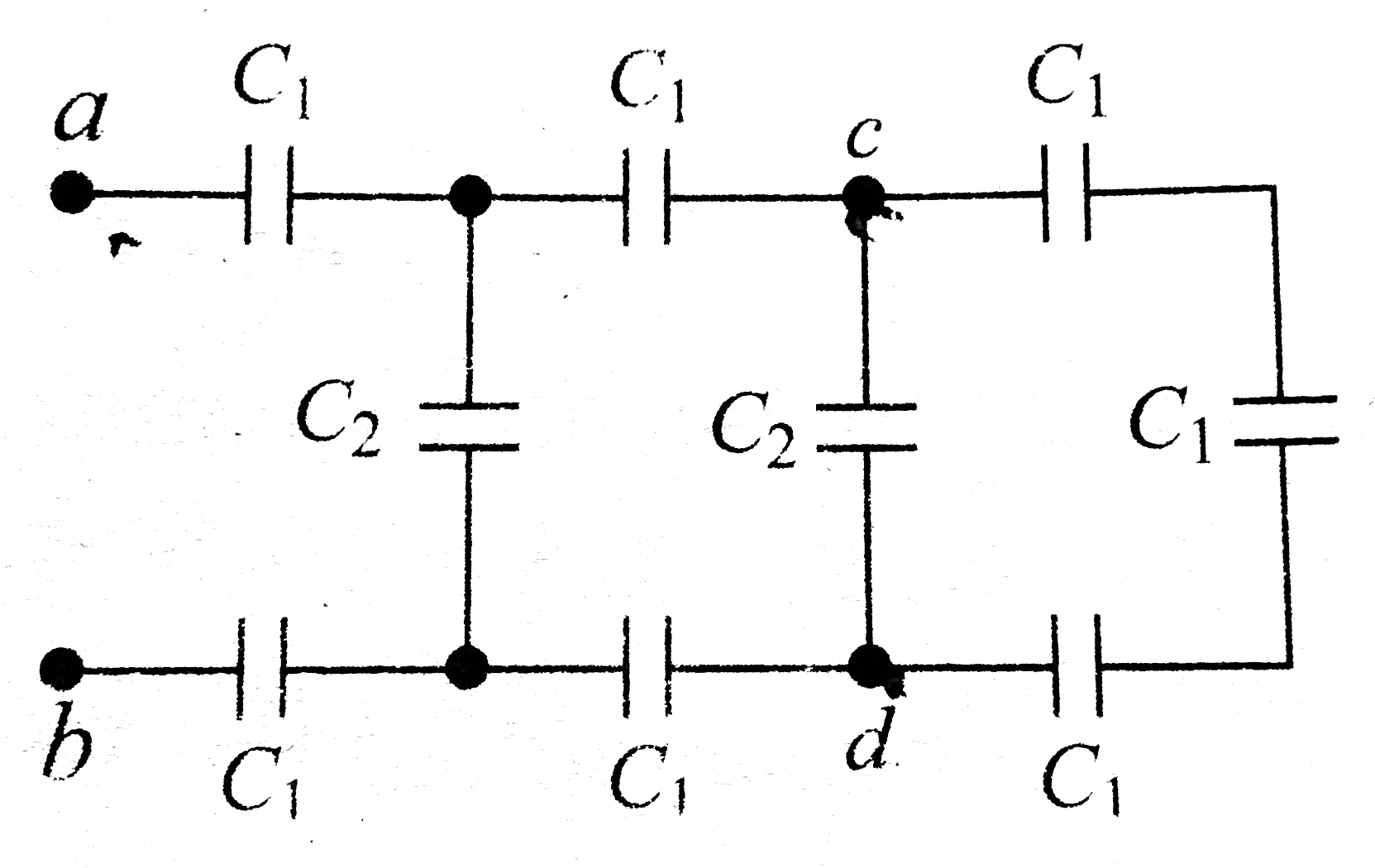
In each capacitance `C_(1) is 6.0 muF`, and each capacitance `C_(2)` is `4.0 muF`.
.
With `420 V` across a and b the value of `V_(c)-V_(d)` is.

A

`24.6 V`

B

`46.7 V`

C

`18 V`

D

`72 V`

Text Solution

Verified by Experts

The correct Answer is:

B

Reduction of the farthest right leg yields
`C=(1/(6.0 muF)+1/(6.0 muF)+1/(6.0 muF))^(-1)=20.0 muF=C_(1)/3`
It combines in parallel with `C_(2)`,i.e.,
`C=4.0 muF+2.0 muF=6.0muF=C_(1)`
So the next reduction is the same as the second, leaving `3C_(1)'s`, in series.
So `C_(eq)=2.0 muF=C_(1)//3`. For the three capacitors nearest to points `a` and `b`:
`Q_(C1)=C_(eq)V=(2.0xx10^(-6)F)(420 V)=8.4xx10^(-4)C`
`V_(cd)=1/3((420)/(3)V)=46.7 V`.
By symmetry, the total voltage drop over the equivalent capacitance of the part of the circuit from the junctions between`c` and `d` is `(420//3) V` and the equivalent capacitance is that of one of those capacitors, i.e., `1//3` of `420//3 V`.
Promotional Banner

Topper's Solved these Questions

  • CAPACITOR AND CAPACITANCE

    CENGAGE PHYSICS|Exercise Integer|5 Videos
  • CAPACITOR AND CAPACITANCE

    CENGAGE PHYSICS|Exercise Multile Correct|11 Videos
  • ATOMS

    CENGAGE PHYSICS|Exercise QUESTION BANK|40 Videos
  • CENGAGE PHYSICS DPP

    CENGAGE PHYSICS|Exercise subjective type|51 Videos

Similar Questions

Explore conceptually related problems

In each capacitance C_(1) is 6.0 muF , and each capacitance C_(2) is 4.0 muF . . The charge on C_(1) nearest to a when V_(ab)=420 V is.

In each capacitance C_(1) is 6.0 muF , and each capacitance C_(2) is 4.0 muF . . The equivalent capacitance of the netwok between ponts a and b is.

A capacitor of capacitance C_(1)=1 muF withstand a maximum voltage of V_(1)=6 KV , and another capacitor of capacitance C_(2)=2 muF , can with stand a maximum voltage of V_(2)=4KV . If they are connected in series, what maximum voltage will the system withstand?

A capaitor of capacitance C_(1) = 1.0 muF withstands teh maximum voltage V_(1) = 6.0 kV while a capacitor of capacitance C_(s) = 2.0 muF , the maximum voltage V_(s) = 4.0 kV . What voltage will the system of these two capacitors withsatand if they are connected in sereis ?

A circuit shown in the figure consists of a battery of emf 10V and two capacitance C_(1) and C_(2) of capacitances 1.0muF and 2.0muF respectively. The potential difference V_(A) - V_(B) is 5V

In the given network capacitance, C_(1) = 10muF, C_(2) = 5 muF and C_(3) = 4muF . What is the resultant capacitance between A and B ?

A circuit has a section Ab shown in fig. The emf of the source equals E = 10V , the capacitances are equal to C_(1) = 1.0 muF and C_(2) = 2.0 muF , and the potential difference varphi_(A) - varphi_(B) = 5.0 V . Find the voltage across each capacitor.

A capacitor of capacitance C_(1)=1 muF can withstand maximum voltage V_(1)=6 kV and another capacitor of capacitance C_(2)=3 muF can withstand maximum voltage V_(2) 4 kV . When the two capacitors are connected in series, the combined system can withstand a maximum voltage of

Condensers of capacity 4muF , 5muF and 6muF are connected first in series . The effective capacitance is C_(1) . When they are connected in parallel, the effective capacitance is C_(2) . Then the ratio C_(2)//C_(1) will be

A capacitor of capacitance C is charged to a potential difference V_(0) . The charged battery is disconnected and the capacitor is connected to a capacitor of unknown capacitance C_(x) . The potential difference across the combination is V. The value of C_(x) should be

CENGAGE PHYSICS-CAPACITOR AND CAPACITANCE-Comprhension
  1. In each capacitance C(1) is 6.0 muF, and each capacitance C(2) is 4.0 ...

    Text Solution

    |

  2. In each capacitance C(1) is 6.0 muF, and each capacitance C(2) is 4.0 ...

    Text Solution

    |

  3. In each capacitance C(1) is 6.0 muF, and each capacitance C(2) is 4.0 ...

    Text Solution

    |

  4. Condsider . In the circuit shown is the switch can be shifted to p...

    Text Solution

    |

  5. Condsider . Now the switch is shifted to position 2. The charge ap...

    Text Solution

    |

  6. Condsider . The charge on capacitor C(1) is.

    Text Solution

    |

  7. For the system shown in capacitance is C The left plate is given a cha...

    Text Solution

    |

  8. For the system shown in capacitance is C The left plate is given a ch...

    Text Solution

    |

  9. Consider the circuit shown is after switch S is closed. What amou...

    Text Solution

    |

  10. Consider the circuit shown is after switch S is closed. What amou...

    Text Solution

    |

  11. Two capacitors of capacity 6 muF and 3 muF are charge 100 V and 50 V s...

    Text Solution

    |

  12. Two capacitors of capacity 6 muF and 3 muF are charge 100 V and 50 V s...

    Text Solution

    |

  13. Two capacitors of capacity 6 muF and 3 muF are charge 100 V and 50 V s...

    Text Solution

    |

  14. Two capacitors of capacity 6 muF and 3 muF are charge 100 V and 50 V s...

    Text Solution

    |

  15. The given circuit shows an arrangement of four capacitors. A potential...

    Text Solution

    |

  16. The given circuit shows an arrangement of four capacitors. A potential...

    Text Solution

    |

  17. The given circuit shows an arrangement of four capacitors. A potential...

    Text Solution

    |

  18. . Let us now connect two more capacitors in the circuit. One of them...

    Text Solution

    |

  19. . Let us now connect two more capacitors in the circuit. One of them...

    Text Solution

    |

  20. Shows a diagonal symmetric arrangement of capacitors and a battery. Id...

    Text Solution

    |
