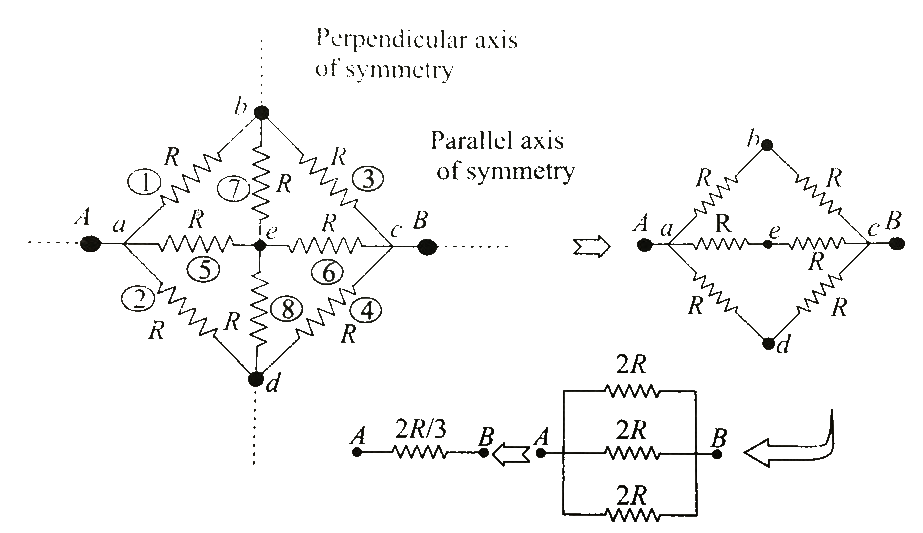
The circuit has both parallel axis and perpendicular
axis of symmetry (by symmetry we mean that the two parts
are mirror images of each other).
Method 1 : Let us solve this problem first usintg the perpendicular
axis of symmetry. We observe the following:
* The current in resistance (1) is equal to the current in resistance(3).
* The current in resistance (5) is equal to the current in resistance (6).
* The current in resistance (2) is equal to the current in
resistance(4).
From these observations it is clear that there is no mingling of
current form upper and lower branches into the middle branch.
Hence, resistor (7) and (8) are ineffective.
we also observe that all the points on the symmetry line are
equipotential. Hence, points b,e and d are equipotential points,
and so resistor (7) and (8) can be removed. The calculation of
effective resistance is shown if Fig. 5.28

The current flow is not a mirror image in branches ab
and bc because the flow is in the same direction. This is called
asymmetric condition. The special thing about this asymmetry
is that current incoming at b is equal to the outgoing current.
A similar situation exists at b and d also. Thus, resistors in
branched be and de are ineffective.
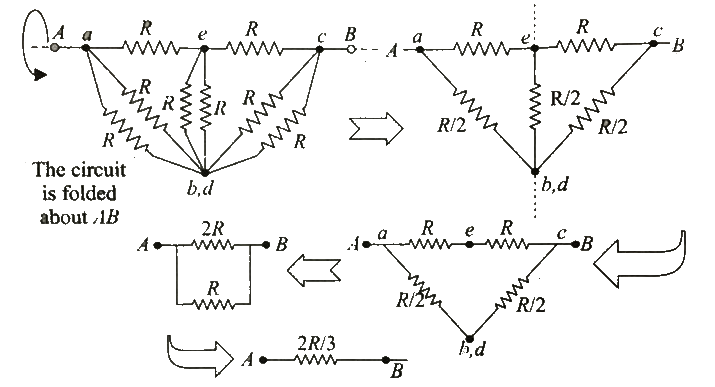
Method 2: The circutit has parallel axis symmetry about the line ac, so the potential and current must also be symmetrical. Therefore. current in ab and ad are saem. Current in dc and bc are also same. Potentials of the points b,e, and d are same. The circuit can be folded about the parallel axis of symmetry. The calculation of equivalent resistance are shown in Fig.

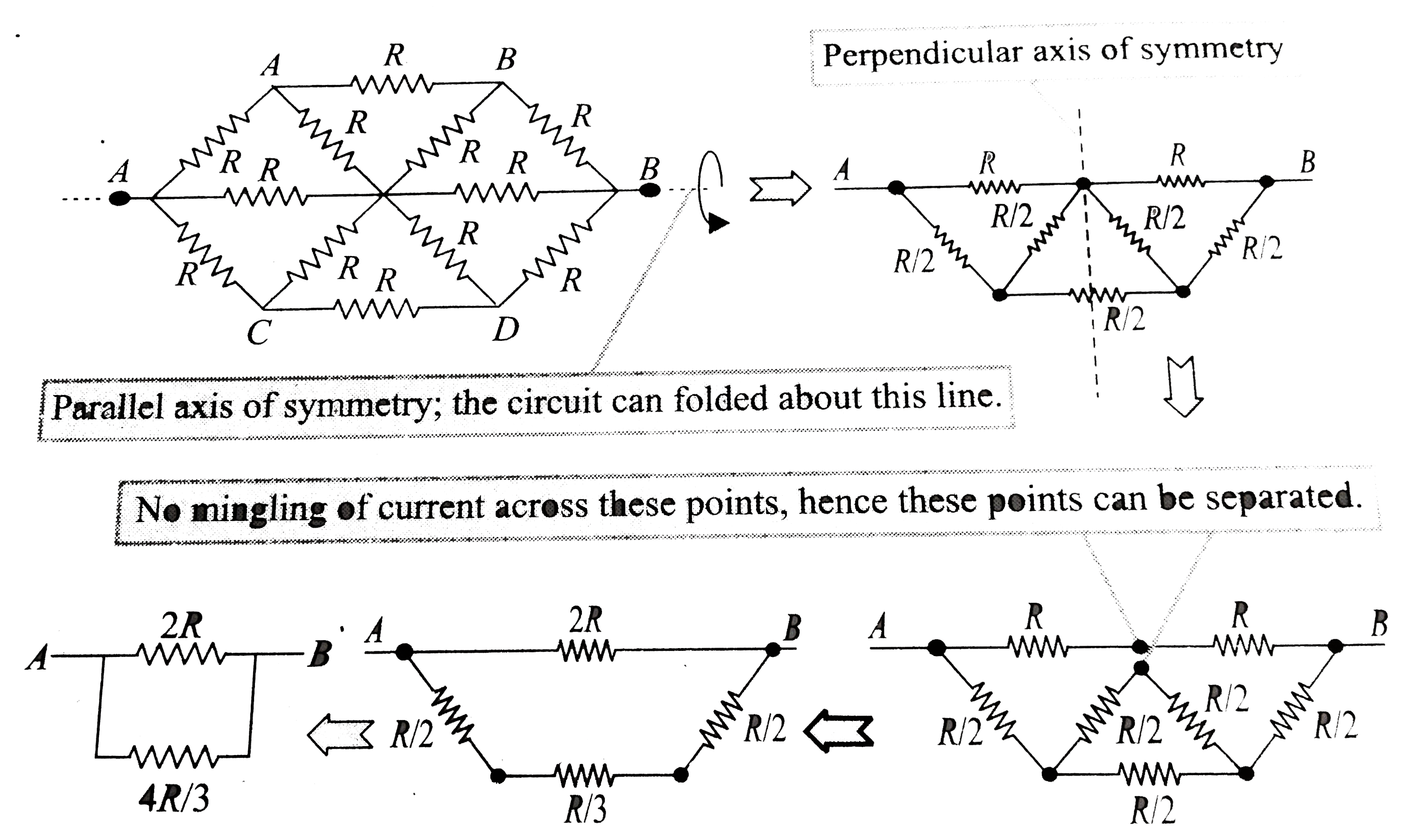
(b) The current has parallel axis of symmetry about the line passing through a and b and perpendicular axis of symmetry about the line x-y.
Method 1 : From perpnedicular axis of symmetry, it is clear that
*The current in resistane (7) is equal to the crrent in resistance (8).
*The current in resistane (9) is equal to the crrent in resistance (10).
*The current in resistane (11) is equal to the crrent in resistance (12).
From these observations, it is clear that there is no mingling of current from upper and lower branch into the middle branch. The upper and lower branches can be separted from the middle bracnh. The calculations of equivalent resistance are shown in fig. 5.60
Method 2 : we can observe the parallel axis symmetry. The potentials of c and e and that of d and f shoudl be equal. Hence, the circuit can be folded about the line passing through A and B. The calculations of equivalent resistance are shown in Fig. 5.61. As shown in the figure, finally 2R and 4R/3 are in parallel. Hence, the equivalent resistance will be
`R_(eq) = (2Rxx(4R)/(3))/((10R)/(3))=(4R)/(5) = (4R)/(5)`