Home
Class 12
PHYSICS
The particle P shown in the figure has a...

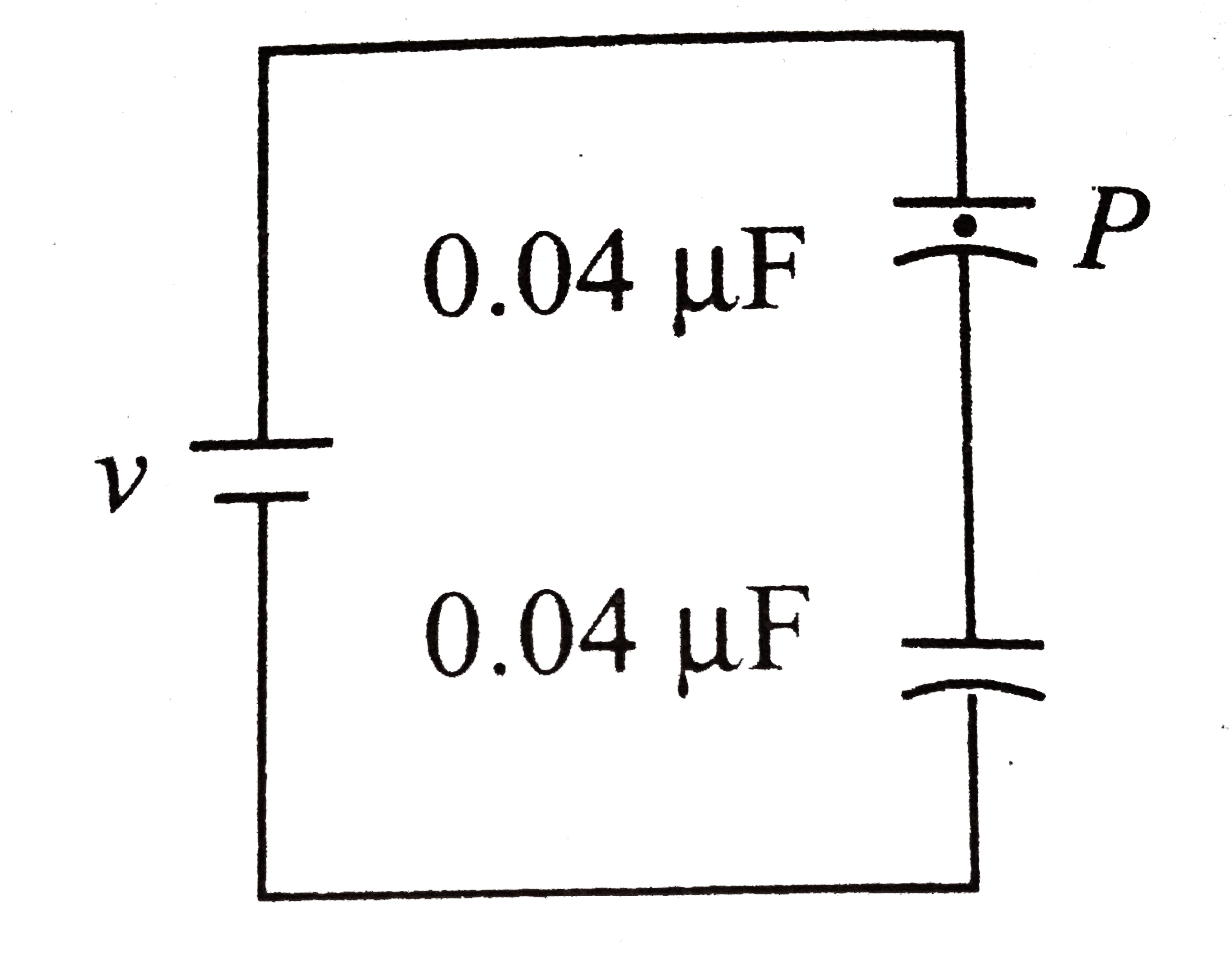
The particle P shown in the figure has a mass of 10 mg and a charge of `-0.01 muC`. Each plate has a surface area `10^(-2) m^2` on one side. What potential difference V should be applied to the combination to hold the particle P in equilibrium?

A

`43 mV`

B

`35 mV`

C

` 50 mV`

D

`55 mV`

Text Solution

Verified by Experts

The correct Answer is:

A

`mg=qE,` where `E=` electric field
or `mg=q(V)/(d)` (where `d=` separation at the plates)
`=q(V)/(2) (therefore (epsilon_(0)A)/(d)=C(1)/(d)=(C)/(epsilon_(0)A))`
or `V=(2"mg"epsilon)A)/(qC)`
`=(10^(-4)xx10xx2.2xx10^(-12)xx10^(-2))/(10^(-8)xx0.04xx10^(-6))`
`=(10^(-4)xx9.8xx8.88xx10^(-12))/(10^(-4)xx0.04xx10^(-6))`
`=43mV`
Promotional Banner

Topper's Solved these Questions

  • MISCELLANEOUS VOLUME 3

    CENGAGE PHYSICS|Exercise Multiple Correct Answer type|109 Videos
  • MISCELLANEOUS VOLUME 3

    CENGAGE PHYSICS|Exercise Assertion and Reason Type|8 Videos
  • MECHANICAL PROPERTIES OF SOLIDS

    CENGAGE PHYSICS|Exercise Question Bank|4 Videos
  • MISCELLANEOUS VOLUME 5

    CENGAGE PHYSICS|Exercise Integer|12 Videos

Similar Questions

Explore conceptually related problems

The particle P shown in the figure has a mass m and a charge -q. Each horizontal plate has a surface area A potential difference V=n((mg epsilon_(0)A)/(2qc)) should be applied to the combination to hold the particle p in equilibrium then find the value of n.

Lower plate of a parallel plate capacitor is fixed on a horizontal insulating surface. The upper plate is suspended above it using on elastic cord of force constant K. The upper plate has negligible mass and area of each plate is A. When there is no charge on the plates the equilibrium separation between them is d. When a potential difference = V is applied between the plates the equilibrium separation changes to x. (a) Calculate V as a function of x. (b) Find the value of x for which V is maximum. Calculate the maximum value of V (= V_(max)) (c) What will happen if V gt V_(max) ? (d) Plot a rough graph showing variation of equilibrium separation (x) with V

One plate of a capacitor of capacitance 2muF has total charge +10muC and its other plate has total charge +40mUC . The potential difference between the plates is (in Volt).

A parallel plate capacitor has rectangular plates of 400 cm^2 and are separated by a distance of 2 mm with air as medium. What charge will appear on the plates. If a 200 volt potential difference is applied across the condenser

A parallel air capacitance 245muF has a charge of magnitude 0.48muC on each plate. The plates are 0.328 mm apart. (a) What is the potential difference between the plates? (b) What is the area of each plate? (c) What is the surface charge density on each plate?

Particle P shown in figure is moving in a circle of radius R=10 cm with linear speed v=2m//s Find the angular speed of particle about point O.

An infinite sheet of charge has a surfaces charge density of 10^-7C/m^2 . The separation between two equipotential surfce whose potentials differ by 5 V is
