Home
Class 12
PHYSICS
Five Styrofoam balls are suspended from ...

Five Styrofoam balls are suspended from insulating threads. Several experiments are performed on the balls and the following observations are made:
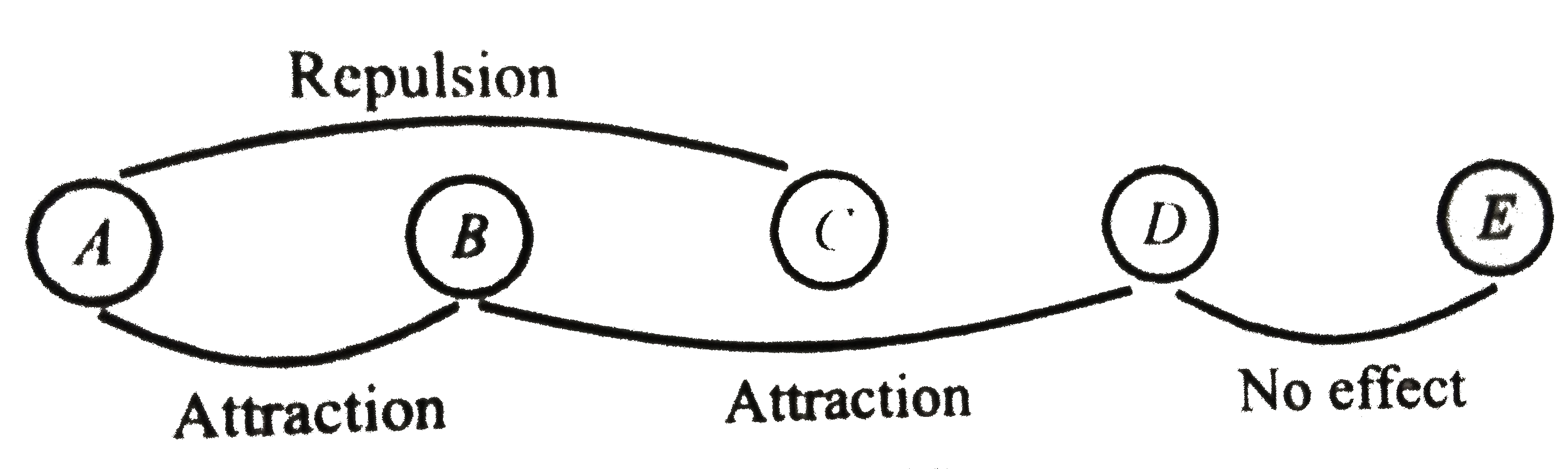
(i) Ball A repels C and attracts B.
(ii) Ball D attracts B and has no effect on E.
(iii) A negatively charged rod attracts both A and E.
An electrically neutral Styrofoam ball gets attracted if placed nearby a charged body due to induced charge. What are the charges, if any, on each ball A,B,C,D, and E?

A

`+, -, + , 0, + `

B

`+, -, +, +, 0`

C

`-, +, - , 0, 0`

D

`+, - , +, 0, 0`

Text Solution

Verified by Experts

The correct Answer is:
D

Ball `D` has no effect on `E`, it means both `D` and `E` should be neutral.

`A` repels `C`, so both should have similar type of charge. Negatively charged rod attracts `A`, so `A` should have positive charge. So `C` should also have positive charge.
`A` attracts `B`, is either negatively charged or has no charge. But `B` attracts `D` which is uncharged, so `B` should have negative charge.
Promotional Banner

Topper's Solved these Questions

  • MISCELLANEOUS VOLUME 3

    CENGAGE PHYSICS|Exercise Multiple Correct Answer type|109 Videos
  • MISCELLANEOUS VOLUME 3

    CENGAGE PHYSICS|Exercise Assertion and Reason Type|8 Videos
  • MECHANICAL PROPERTIES OF SOLIDS

    CENGAGE PHYSICS|Exercise Question Bank|4 Videos
  • MISCELLANEOUS VOLUME 5

    CENGAGE PHYSICS|Exercise Integer|12 Videos

Similar Questions

Explore conceptually related problems

The negatively charged dust particles are attracted by

A positively charged body 'A' attracts a body 'B' then charge on body 'B' may be :

If a charged body attracts another body, the charge on the other body

A negatively charged ebonite rod attracts a suspended ball of straw. Can we infer that the ball is positively charged ?

If a charged body is placed near a neutral conductor, will it attract the conductor or repel it ?

A body A repels another body B, A attracts body C, C repels body D. It is given that body D is positively charged. What is the charge on body B.

Explain why a neutral object can be attracted to a charged objec. Why can this neutal object not be repelled by a charged object ?

There are four light-weight-rod sample A, B, C, D separately suspended by threads. A bar magnet is slowly brought near each sample and the following observations are noted (i) A is feebly repelled (ii) B is feebly attracted (iii) C is strongly attracted (iv) D remains unaffected Which one of the following is true?

