Home
Class 12
PHYSICS
A wheel having mass m has charges +q an...

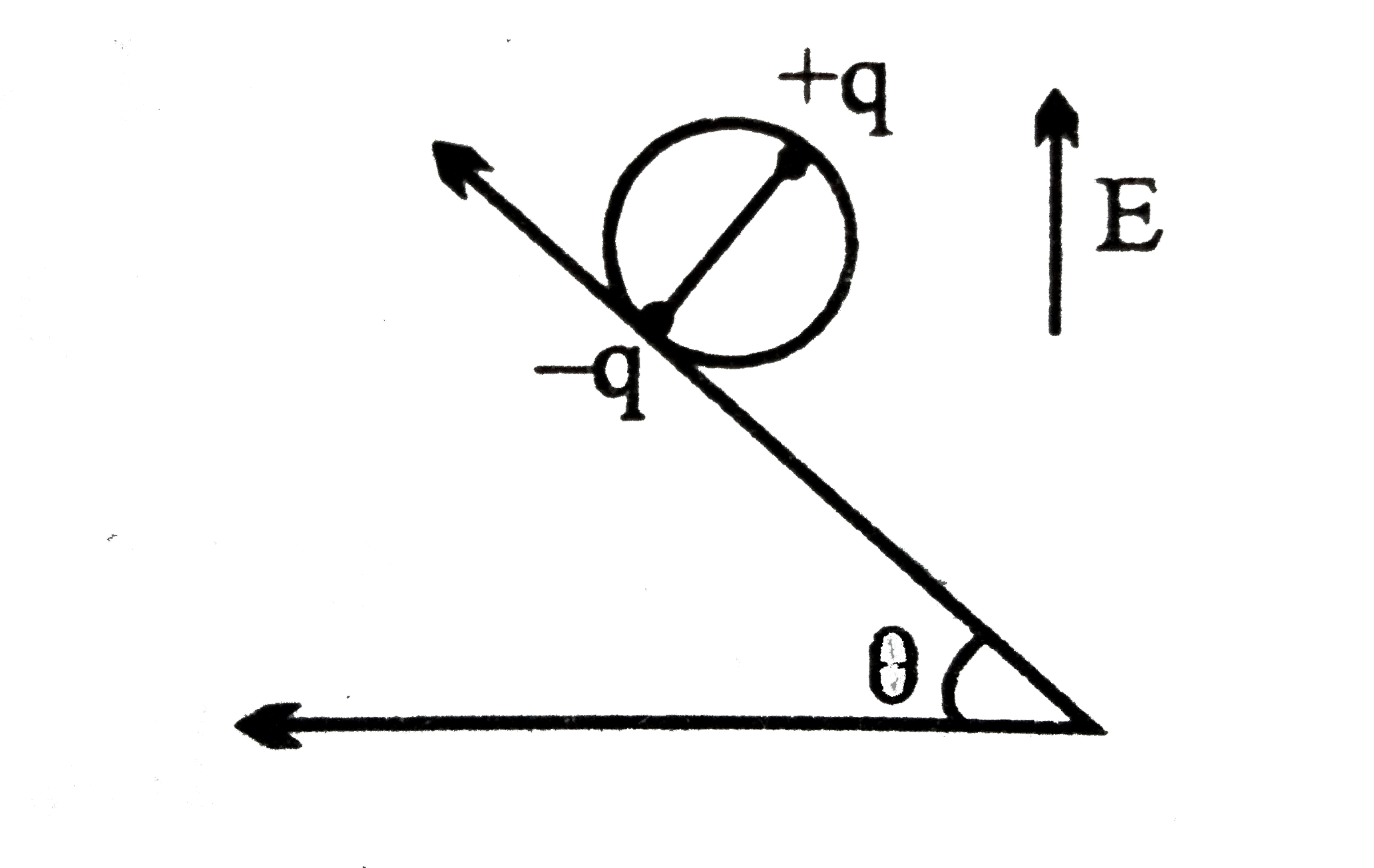
A wheel having mass `m` has charges ` +q` and `-q` on diametrically opposite points . It remains in equilibrium on a rough inclined plane in the presence of uniform vertical electric field ` vec E=`
` .

A

`mug//q`

B

`mug//2q`

C

`mug tantheta//2q`

D

none of these

Text Solution

Verified by Experts

The correct Answer is:
B


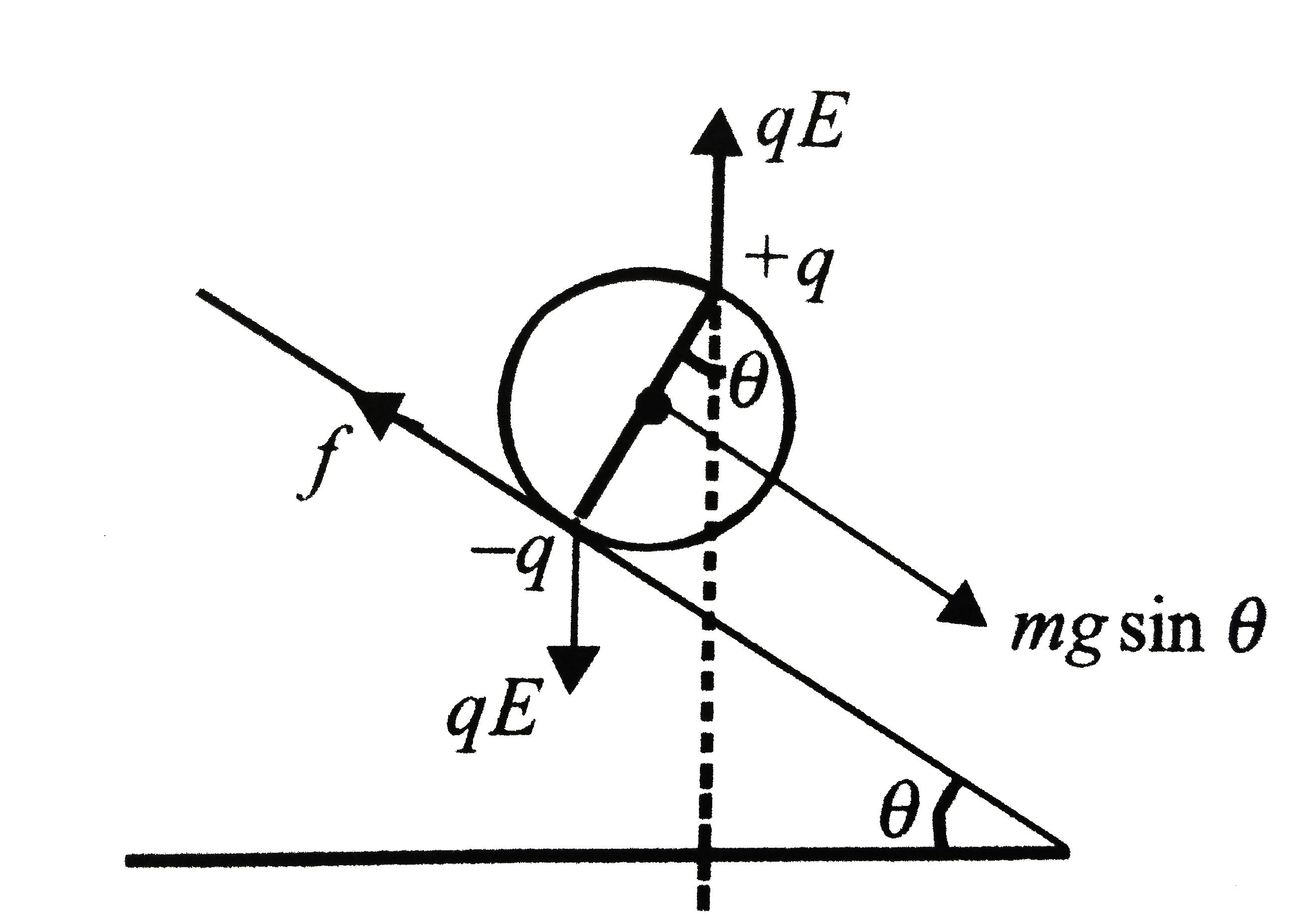
Balancing torque abot `-q` is
`qE2Rsintheta=mg sintheta R` or `E=(mg)/(2q)`
Promotional Banner

Topper's Solved these Questions

  • MISCELLANEOUS VOLUME 3

    CENGAGE PHYSICS|Exercise Multiple Correct Answer type|109 Videos
  • MISCELLANEOUS VOLUME 3

    CENGAGE PHYSICS|Exercise Assertion and Reason Type|8 Videos
  • MECHANICAL PROPERTIES OF SOLIDS

    CENGAGE PHYSICS|Exercise Question Bank|4 Videos
  • MISCELLANEOUS VOLUME 5

    CENGAGE PHYSICS|Exercise Integer|12 Videos

Similar Questions

Explore conceptually related problems

A wheel having mass m has charges +q and –q on diametrically opposite points. It remains in equilibrium on a rough inclined plane in the presence of uniform vertical electric field E =

A wheel having mass m has charges +q and -q on diametrically opposite points. It remains in equilibrium on a rough inclined plane in the presence of a uniform vertical electric field E. The value of E is

Two point charge +q and -q are fixed on diameterically opposite point on the unirom ring, such that -q is at bottom and is contact will a perfect insulator incline plane. Total mass is equal to m remains in equilibrium on the rough inclined plane in the presence of uniform vertical electric field. Then

Force vec(F) acting on a test charge q_(0) in a uniform electric field vec(E) is

find out mass of the charge Q, so that it remains in equilibrium for the given configuration.

A particle is having mass m & charge +q is projected horizontally from point O . Electric field is present and is directed vertically downward .

What is the direction of the force acting on a charged particle q, moving with a velocity vec(v) a uniform magnetic field vec(B) ?

