Home
Class 12
PHYSICS
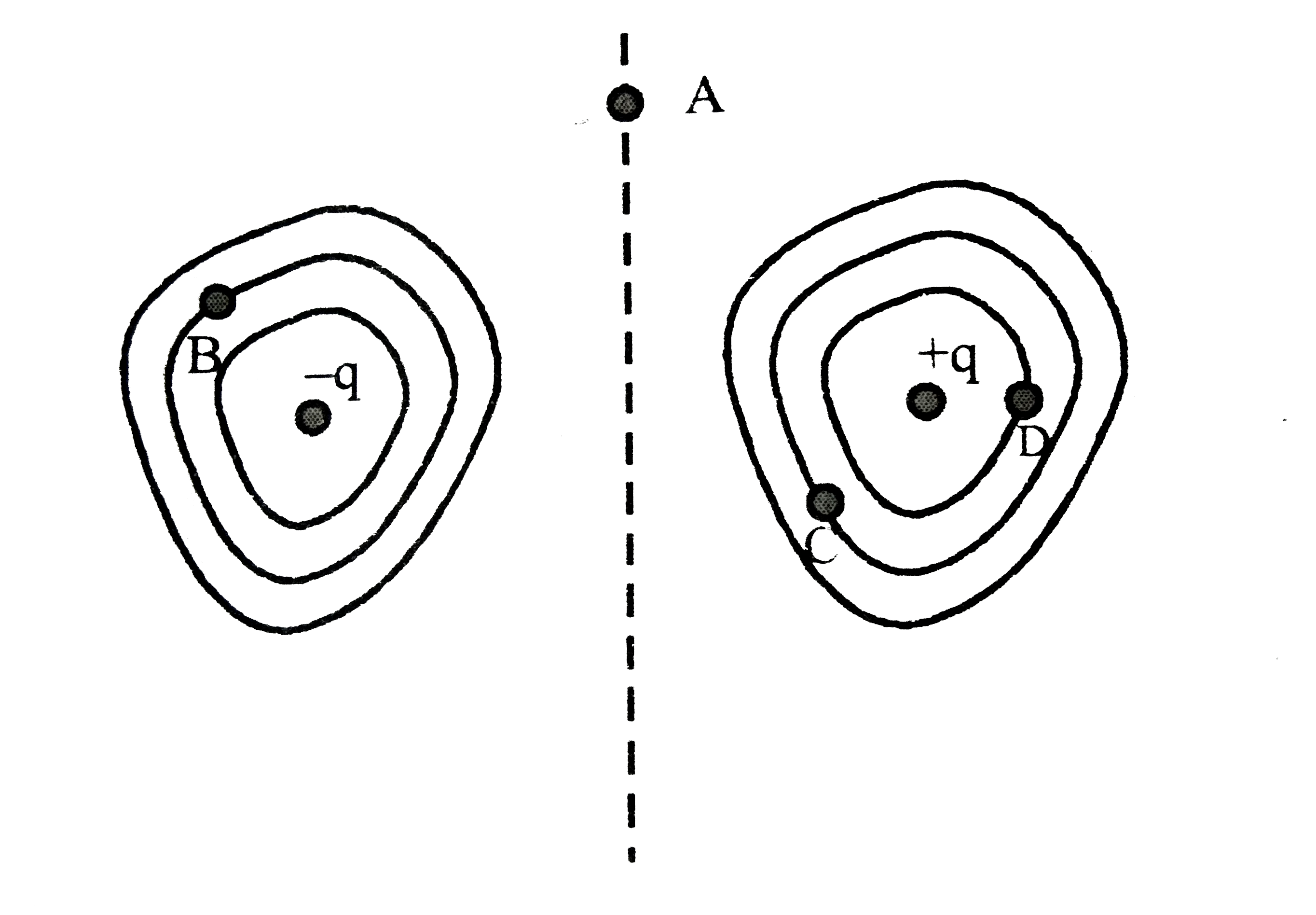
Figure shows equi-potential surfaces, at...

Figure shows equi-potential surfaces, at which point on labeled surfaces will an electron have the highest potential energy ?
.

A

point A

B

point B

C

point C

D

point D

Text Solution

Verified by Experts

The correct Answer is:

B

b. Potential energy of an electron at any point is `U=-eV`, where `V` is the potential at that point. `V` is negative maximum at point `B`, hence `U` is maximum for this point.
Promotional Banner

Topper's Solved these Questions

  • MISCELLANEOUS VOLUME 3

    CENGAGE PHYSICS|Exercise Multiple Correct Answer type|109 Videos
  • MISCELLANEOUS VOLUME 3

    CENGAGE PHYSICS|Exercise Assertion and Reason Type|8 Videos
  • MECHANICAL PROPERTIES OF SOLIDS

    CENGAGE PHYSICS|Exercise Question Bank|4 Videos
  • MISCELLANEOUS VOLUME 5

    CENGAGE PHYSICS|Exercise Integer|12 Videos

Similar Questions

Explore conceptually related problems

Figure shows equi-potential surfa es of the balbeled points point will an electron have the highest potential energy ? .

Figure shows equi-potential surfaces for a two charges system. At which of the labelled points will an electron have the highest potential energy ?

Find out equipotential surface where potential is zero ?

Assertion: Electric field is aways directed perpendicular to an equipotential surface. Reason: Equipotential surface is a surface on which at each point potential is same.

Figure shows a set of equipotential surfaces. There are a few points marked on them. An electron is being moved from one point to other. Which of the following statements is/are correct?

The figure shows equipotential surfaces due to two poit charges +3Q and -Q placed at a separation d. (a) Will the shape of epuipotential surface be spherical very close to both the point charges? What shape of equipotentials will be seen at very far away points from the pair of charges. (b) Find the distance of point P from the negative charge. (c) Find the potential of the surface marked as S_1 is the figure. (d) Consider the surface having zero potential. Write the flux of electric field through this surface

In an equipotential surface, the value of potential at all points on the
