Home
Class 12
PHYSICS
A plane sheet has a uniformly distribute...

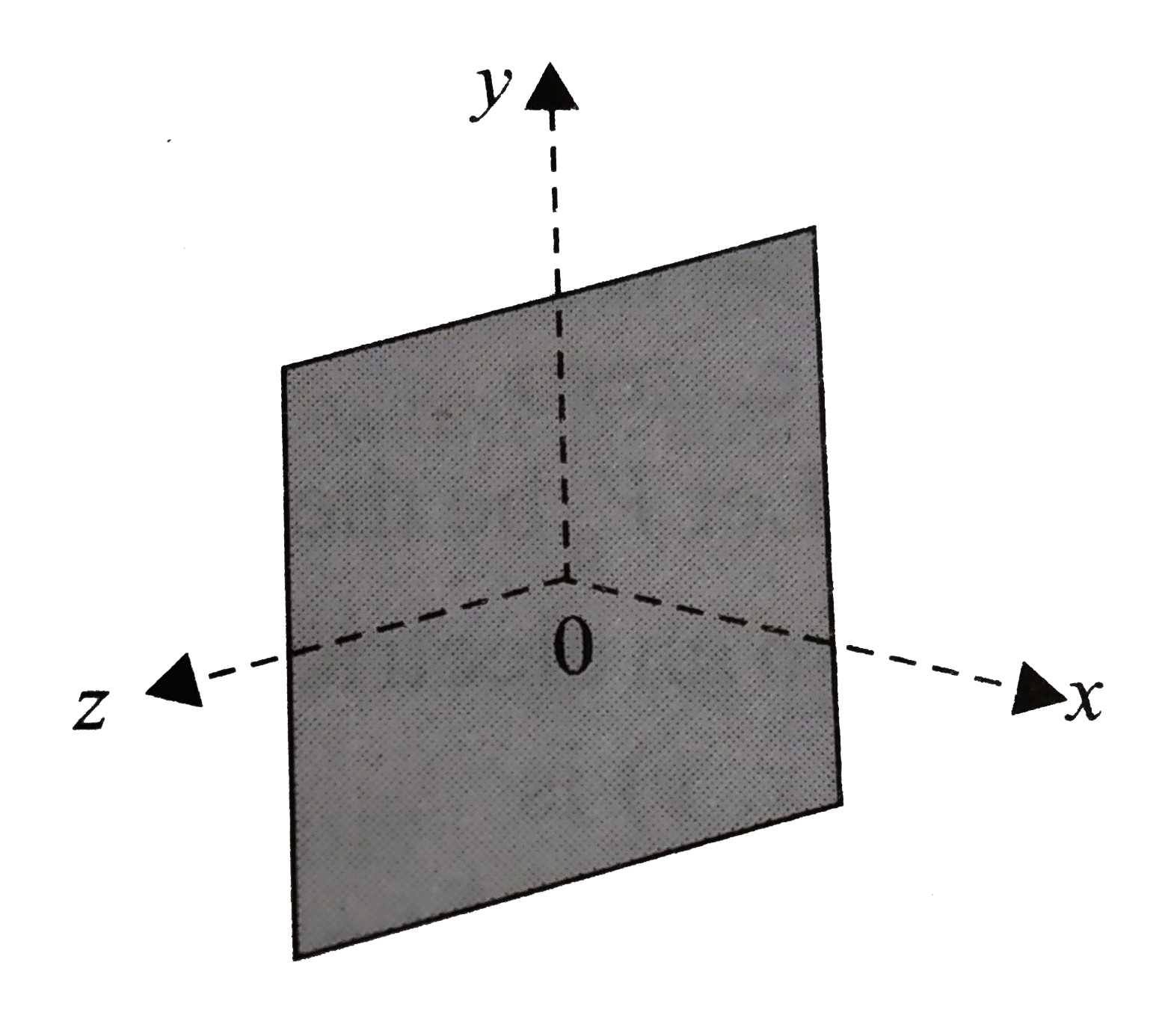
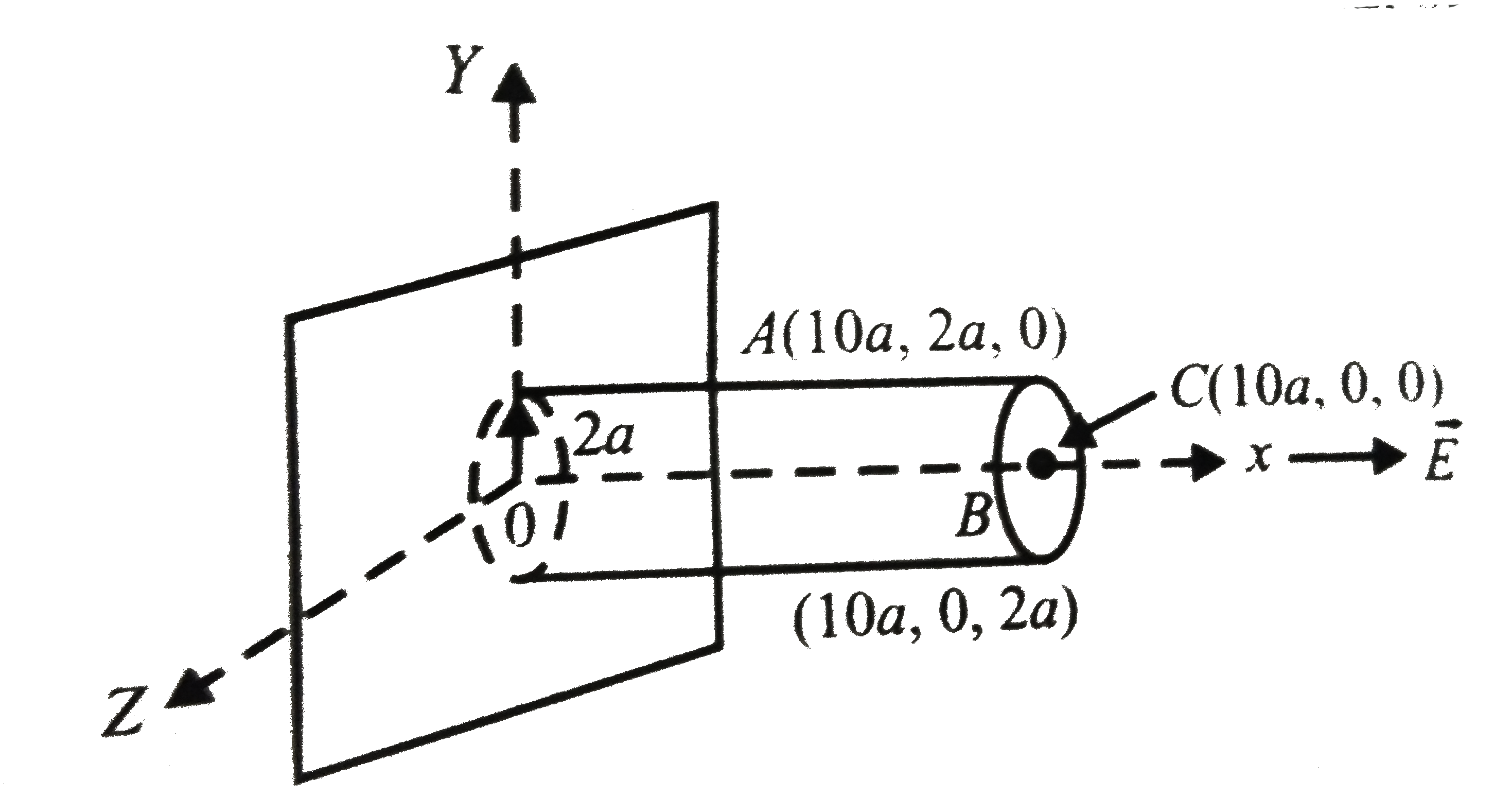
A plane sheet has a uniformly distributed charge. Origin is selected at the middle of the sheet (in yz plane). A charge `+Q` is moved from point A (10a, 2a,0) to point B (10a,0,2a) along a circle and then to point C(10a, 0, 0). If the initial electrostatic potential energy is `U_0`, what will be final electrostatic potential energy?

A

zero

B

`U_0`

C

`U_0(sqrt2)`

D

`U_0/2`

Text Solution

Verified by Experts

The correct Answer is:
B

b. The electric field will be as shown. `A` flat surface of cylinder of radius `2a` and length `10a` will be an equipotential surface.

Points `A` and `B` are located on a circle forming flat surface of the cylinder. The electric field is perpendicular at all the points of this plane surface. Thus, there will be no-change in electrostic `PE` in moving the charge `+Q` on this plane surface.
Promotional Banner

Topper's Solved these Questions

  • MISCELLANEOUS VOLUME 3

    CENGAGE PHYSICS|Exercise Multiple Correct Answer type|109 Videos
  • MISCELLANEOUS VOLUME 3

    CENGAGE PHYSICS|Exercise Assertion and Reason Type|8 Videos
  • MECHANICAL PROPERTIES OF SOLIDS

    CENGAGE PHYSICS|Exercise Question Bank|4 Videos
  • MISCELLANEOUS VOLUME 5

    CENGAGE PHYSICS|Exercise Integer|12 Videos

Similar Questions

Explore conceptually related problems

What do you understand by electrostatic potential energy ? Find an expression for electrostatic potential energy of a system of two point charges.

As per this diagram a point charge +q is placed at the origin O . Work done in taking another point charge -Q from the point A(0, a) to another point B(a, 0) along the staight path AB is:

Determine the point in yz plane which is equidistant from three points A(2, 0, 3), B(0, 3, 2) and C(0, 0, 1).

A charge of 8 mC is located at the origin. Calculate the work done in taking a small charge of -2xx10^(-9)C from a point P (0,0,3 cm) to a point Q (0,4 cm, 0) via a point R (0,6 cm, 9cm).

Two point charges 0.1 mC and 0.05 mC are kept at points (2m, 0, 0) and (-2m, 0, 0) respectively. Calculate the electrostatic potential energy of the system in absence of any external electric field.

A charge of 8 mC is located at the origin. Calculate the work done in taking a small charge of -2xx10^(-9) from a point P(0,0,3cm) to a point Q (0,4cm,0) via a point R(0,6cm,9cm).

Two identical charges of -0.1 muC are palced at point A (0, 0) and B (8cm, 0) respectively. Calculate the value of charge Q to be placed at a point M (4 cm, 0) such that the electrostatic potential energy of the system is zero.

Two point charges 20xx10^(-6)C and -4xx10^(-6)C are separated by a distance of 50cm in air, Find (i) the point on line joining the charges, where the electrostatic potential is zero (ii) Also, Calculate the electrostatic potential energy of the system.

