Home
Class 12
PHYSICS
Charges Q0 and 2Q0 are given to parallel...

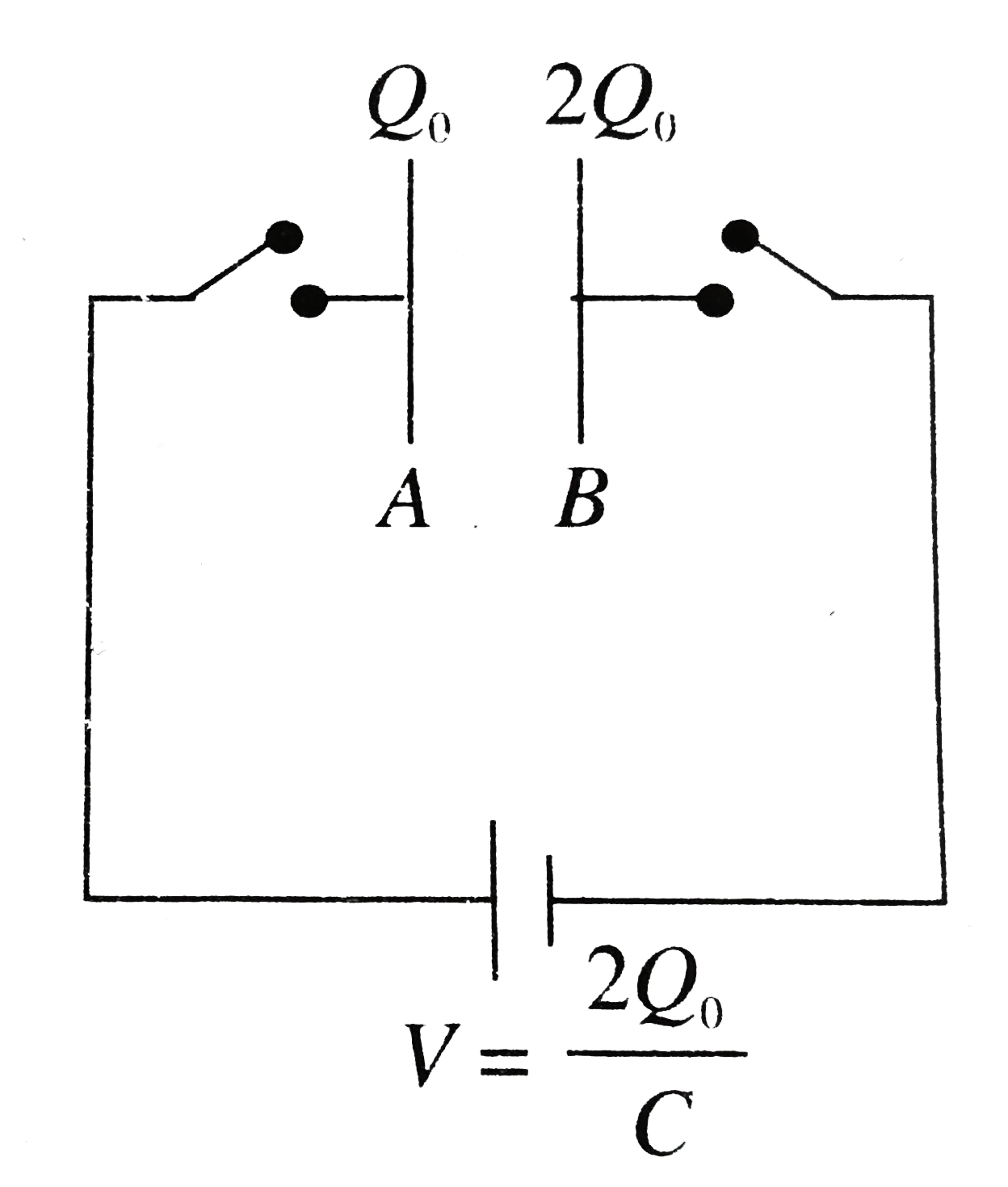
Charges `Q_0` and `2Q_0` are given to parallel plates A and B, respectively, and they are separated by a small distance. The capacitance of the given arrangement is C. Now, plates A and B are connected to positive and negative terminals of battery of potential difference `V = 2Q_0//C` respectively, as shown, then the work done by the battery is

A

`(2Q_(0)^(2))/C`

B

`(4Q_(0)^(2))/C`

C

`(5Q_(0)^(2))/C`

D

`(6Q_(0)^(2))/C`

Text Solution

Verified by Experts

The correct Answer is:

C

c. After connection the charge of capacitor `Q'=CV=C(2Q_(0))/(C)=2Q_(0)`
The final charge in inner plate of `A` will be `2Q_(0)`. Hence charge supplied by battery
`DeltaQ=(2Q-((-Q_(0))/(2)))=(5Q_(0))/(2)`
Hence work done by battery
`W=(DeltaQ)V=(5Q_(0))/(2)xx(2Q_(0))/(C)=(5Q_(0)^(2))/(C)`
Promotional Banner

Topper's Solved these Questions

  • MISCELLANEOUS VOLUME 3

    CENGAGE PHYSICS|Exercise Multiple Correct Answer type|109 Videos
  • MISCELLANEOUS VOLUME 3

    CENGAGE PHYSICS|Exercise Assertion and Reason Type|8 Videos
  • MECHANICAL PROPERTIES OF SOLIDS

    CENGAGE PHYSICS|Exercise Question Bank|4 Videos
  • MISCELLANEOUS VOLUME 5

    CENGAGE PHYSICS|Exercise Integer|12 Videos

Similar Questions

Explore conceptually related problems

Two identical pates P_(1) and P_(2) of cross sectional area A are separated at a very small disance, d , where (epsilon_(0)A)/d=2-SI unit. Initially charge on the plate P_(1) is -10C and charge on the plate P_(2) is +30C . Now plate P_(1) and P_(2) are connected to positive and negative terminals of battery of potential difference 10 Volts with the help of switches S_(1) and S_(2) respectively. Choose the correct option (s)

Charges 2q and -3q are given to two identical metal plates of area of cross section A . the distance between the plates is d . Find the capacitance and potential difference between the plates.

Passage II We have two parallel plate capacitors P and Q having same capacitance C_(0) . P is connected to a battery of potential difference V and it remains connected to the battery even after the charging is over. Q is also connected to a battery of the same potential difference V but after the charging gets over, it is disconnected from the battery. Answer the following questions: Potential difference between the plates of P, when a dielectric slab is inserted in between the plates

Two capacitors of capacitance 2muF and 4muF respectively are charged to a potential of 12 V. they are now connected to each other, with the positive plate of each joined to the negative plate of the other. The potential difference across each capacitor will be

T Two capacitors of capacitances 1 muF and 2 muF are charged to potential differnces 20 V and 15 V as shown in. If terminals B and C connected together and terminals A and D are connected with the positive and negative ends of the battery, respectively, then find the final charges on both the capacitors. .

In a circuit, 10 C of charge is passed through a battery . in a given time. The plates of the battery are maintained . at a potential difference of 12 V. How much work is done . by the battery?.

M and N are the plates of unequal areas of a parallel plate capacitor. Let A_(1) and A_(2) be the areas of M and N. let A_(1) gt A_(2) , M and N are connected to the +ve and -ve terminals of a battery. If Q^(+) and Q^(-) are the charges on the plates M and N respectively, then
