Home
Class 12
PHYSICS
Find the ratio of electric work done in ...

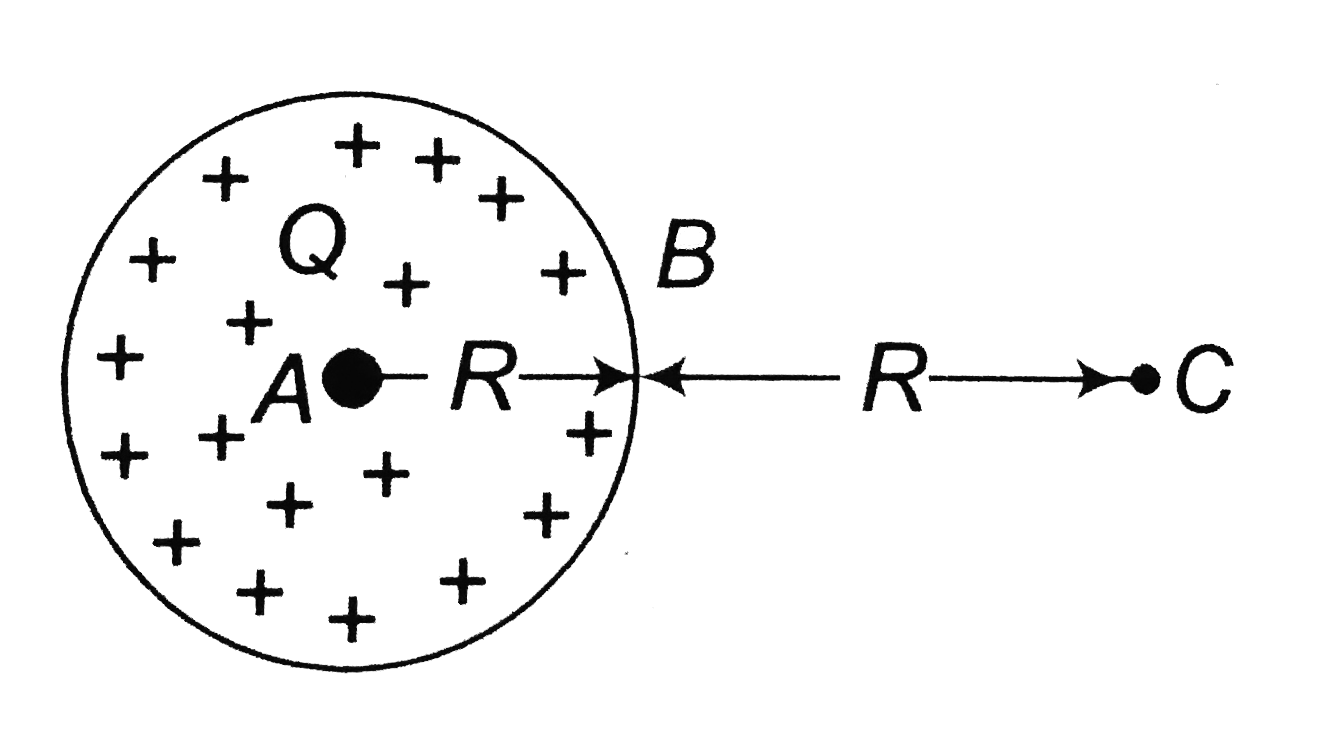
Find the ratio of electric work done in bringing a charge `q` from `A` to `B(W_(AB))` and that from `B` to `C(W_(BC))` in a sphere of charge `Q` distributed uniformly throughout its volume.

A

1

B

1.5

C

0.75

D

none of these

Text Solution

Verified by Experts

The correct Answer is:

A

`W_(AB)=q(V_(A)-V_(B))=q[(3Q)/(8piepsilon_(0)R)-(Q)/(4piepsilon_(0)R)]=(Qq)/(8pi_(0)R)`
`W_(BC)=q(V_(B)-V_(C))=q[(Q)/(4piepsilon_(0)R)-(Q)/(8piepsilon_(0)R)]=(Qq)/(8pi_(0)R)`
`therefore (W_(AB))/(W_(BC))=1`
Promotional Banner

Topper's Solved these Questions

  • MISCELLANEOUS VOLUME 3

    CENGAGE PHYSICS|Exercise Multiple Correct Answer type|109 Videos
  • MISCELLANEOUS VOLUME 3

    CENGAGE PHYSICS|Exercise Assertion and Reason Type|8 Videos
  • MECHANICAL PROPERTIES OF SOLIDS

    CENGAGE PHYSICS|Exercise Question Bank|4 Videos
  • MISCELLANEOUS VOLUME 5

    CENGAGE PHYSICS|Exercise Integer|12 Videos

Similar Questions

Explore conceptually related problems

Find the electric work done in bringing a charge q from A to B in a sphere of charge Q distributed uniformly throughout its volume. .

A rubber balloon is given a charge Q distributed uniformly over its surface. Then

The work done in taking a unit positive charge from P to A is W_A and P to B is W_B . Then .

Consider the situation of figure . The work done in taking a point charge form P to A is W_A from P to B is W_B from P to C is W_C.

A charge +Q is lying at the center of a circle. What is work done in carrying charge q from A to B, where A and B, both lie on the circle.

a. A circle is drawn with center as a charge +q. What is the work done in moving a charge +q from B to C along the circumferebce of the circle ? B In the above question, if the charge +q is first taken from B to A and then from A to C, on which path is the magnitude of work greater ? .

The work done in bringing a unit positive charge from infinite distance to a point at distance x from a positive charge Q is W. Then the potential phi at that point is

A nonconducting sphere with radius a is concentric with and surrounded by a conducting spherical shell with inner radius b and outer radius c. The inner sphere has a negative charge uniformly distributed throughout its volume, while the spherical shell has no net charge. The potential V (r) as a function of distance from the center is given by
