Home
Class 12
PHYSICS
Consider a system of two equal points ch...

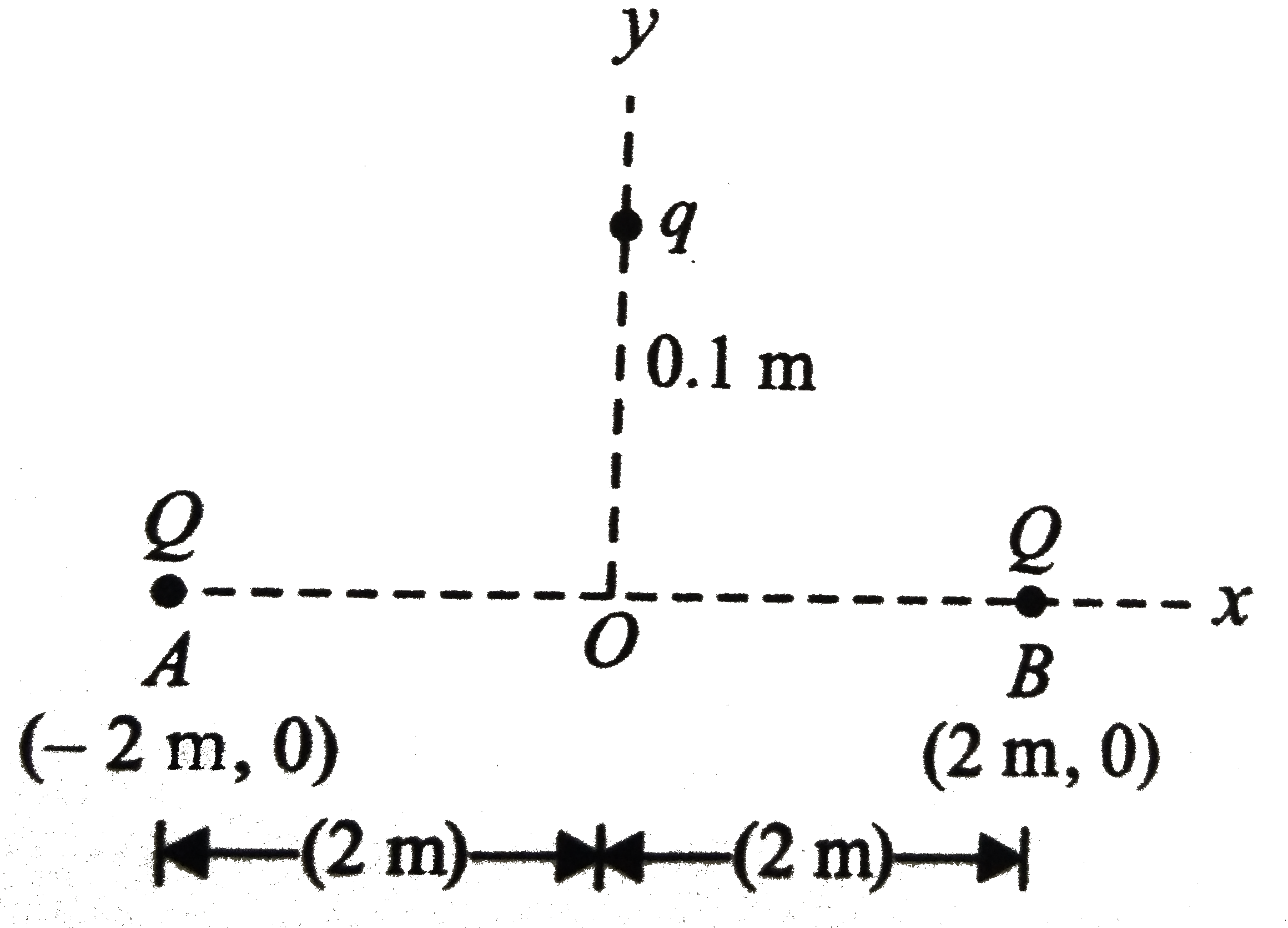
Consider a system of two equal points charges, each `Q = 8 muC`, which are fixed at points (2m, 0 ) and (-2m, 0). Another charge `mu` is held at a point (0,0.1m) on the y-axis. Mass of the charge `mu` is 91 mg . At t= 0 , `mu` is released from rest and it is observed to oscillate along y-axis in a simple harmonic manner. It is also observed that at t = 0 , the force experienced by it is ` 9 xx 10^(-3)N`.
Equation of SHM (displacement from mean position) can be expressed as

A

`y = 0.1 sin (10pit)`

B

`y = 0.1sin(10pit + pi//2)`

C

`y = 0.1 sin (5pit+ pi//2)`

D

`y = 0.2 sin (5pit)`

Text Solution

Verified by Experts

The correct Answer is:
B

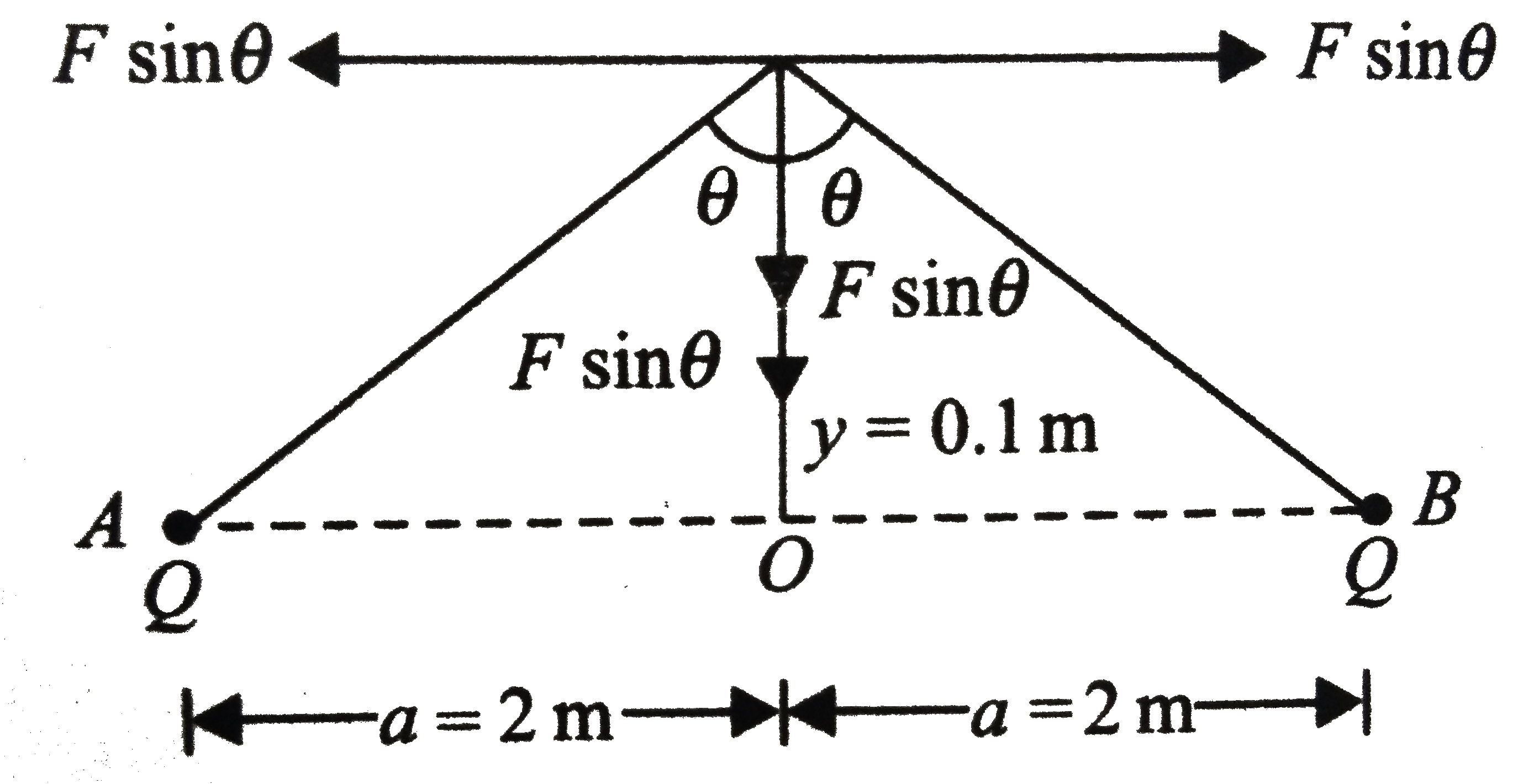
Since `Q8muC` , if `q` is a positive charge, resultant force on it due to `Q` at `A` and `Q` at `B` will be along positive `y-`axis and it would move away along `y-`axix. But the charge `q` here is observed to oscillate. This is possible only if `q` is a negative charge so that resultant force on it is possible only if `q` is a negative charge so that resultant force on it is possible only if `q` is a negative charge so that resultant force on it due to `Q` at `A` and `Q` at `B` is towar `O`. Under the action of this force, `q` moves toward `O`, crsosses `O` and as it is moving along negative `Y` direction, resultant force on it will again be toward `O`. This force retards the motion of `q` along negative `y-`axos. It comes to rest at some point and then moves back toward `O` and so on `(Fig. SA1.77)`. Force applied by `Q` on `q` has a magnitude
`F=(1)/(4piepsilon_(0))(Qq)/(Y^(2)+a^(2))`

Force applied by `Q` at `A` on `q` can be resolved into rectangular components: `F omegas theta` and `F sin theta`. Similarly, force applied by `Q` at `B` on `q` can be resolved into components: `F cos theta` and `F sin theta. F sin theta` components of the two forces balance each other so that the net force on `q` is `2F cos theta` toward `O`. Therefore, net force on q.
`F_(n)=2(1)/(4piepsilon_(0))(Qq)/(y^(2)+a^(2))costheta`
`F_(n)=(1)/(4piepsilon_(0))(2Qq)/(y^(2)+a^(2))(y)/((y^(2)+a^(2))^(1//2))=(1)/(4piepsilon_(0))(2Qqy)/((y^(2)+a^(2))^(3//2))` ..(i)
for `y lt lt a` net force on q,
`F_(n)=(1)/(4piepsilon_(0))(2Qqy)/(a^(3))` ..(ii)
Here `Q=8muC=8xx10^(-6)C`
At `t=0`, q is at `y=0.1` m obviously `ylta(=2m)` since the motion is simple harmonic we can use the approximation `ylt le a` so initially i.e, at `y=0` m force on q is `9xx10^(-3)` N
Units Eq. (i) we get
or `9xx10^(-3)=(9xx10^(9))(2(8xx10^(-6))q(0.1))/((2)^(3))`
or `q=5xx10^(-6)C=5muC`
this, in fact, is the magnitude of q. We know that q, as explained earlier is a negative charge hence `q=-5muC` So correct option is (c).
At `t=0` q is released at a piont 0.1 m from O on y-axis as it oscillates its other extreme position will be 0.1 m from O on the netative y-axis assuming undamped simple harmonic motion.
Hence amplitude of oscillation is 0.1 m or 10 cm so correct option is (a). from fig we get
`F_(n)=(1)/(4piepsilon_(0))(2Qqy)/(a^(3))=ky` ltbr where `k=(1)/(4piepsilon_(0))(2Qq)/(a^(3))`
Thus, `F_(n)propy` we also know that `F_(n)` always acts towards O (mean position) time period of resulting SHM will be `T=2pisqrt(m//k)` of frequency is `(1)/(2pi)sqrt(k//m)`
`f=(1)/(2pi)sqrt((1)/(4piepsilon_(0))(2Qq)/(ma^(3)))`
`=(1)/((2xx3.14))sqrt((9xx10^(9))((2)(8xx10^(-6))(5xx10^(-6)))/((91xx10^(-6))(2)^(3)))=5`
`[m=91mg=91xx10^(-6)kg]`
thus the correct option is (c).
In SHM, equation of displacement from mean position can be expressed as `y=asin(omegat+phi)` here `a=0.1mu,omega=2pif=2pixx5=10pi`,
`y=0.1sin(10pit+phi)`
but at `t=0,y=0.1` Hence `0.1=0.1sinphi` or `sinphi=1`
or `phi=(pi)/(2),y=0.1sin(10pit+pi//2)`
thus the correct option is (b).
Promotional Banner

Topper's Solved these Questions

  • MISCELLANEOUS VOLUME 3

    CENGAGE PHYSICS|Exercise Interger Answer type|20 Videos
  • MISCELLANEOUS VOLUME 3

    CENGAGE PHYSICS|Exercise Fill in the blanks|10 Videos
  • MISCELLANEOUS VOLUME 3

    CENGAGE PHYSICS|Exercise Assertion and Reason Type|8 Videos
  • MECHANICAL PROPERTIES OF SOLIDS

    CENGAGE PHYSICS|Exercise Question Bank|4 Videos
  • MISCELLANEOUS VOLUME 5

    CENGAGE PHYSICS|Exercise Integer|12 Videos

Similar Questions

Explore conceptually related problems

Two equal positive charges Q are fixed at points (a, 0) and (-a,0) on the x-axis. An opposite charge -q at rest is relased from point (0, a) on the y-axis. The charge -q will

Two equal negative charges -q are fixed at points (0, -a) and (0,a) on y-axis. A poistive charge Q is released from rest at point (2a, 0) on the x-axis. The charge Q will

Two equal negative charges are fixed at points and on y-axis. A positive charge Q is released from rest at the point on the x-axis. The charge Q will:

Two point charges q each are fixed at (a,0) and (-a,0). A third charge Q is placed at origin. Electrons potential energy of the system will

Two point charges of, 1 mu C and -1 mu C are kept at (-2 m, 0) and (2 m, 0) respectively. Calculate the electric field at point (0, 5 m).

two point charges 2 muC and -4 muC are situated at points (-2m, 0m) and (2m, 0m) respectively. Find out potential at point C( 4m, 0m) and D (0 m, sqrt(5) m) .

Two small particles P and Q each of mass m are fixed along x-axis at points (a,0) and (-a,0). A third particle R is kept at origin. Then

CENGAGE PHYSICS-MISCELLANEOUS VOLUME 3-Comprehension Type
  1. Consider a system of two equal points charges, each Q = 8 muC, which a...

    Text Solution

    |

  2. Consider a system of two equal points charges, each Q = 8 muC, which a...

    Text Solution

    |

  3. Consider a system of two equal points charges, each Q = 8 muC, which a...

    Text Solution

    |

  4. In a certain experiments to measure the ratio of charge to mass of ele...

    Text Solution

    |

  5. In a certain experiments to measure the ratio of charge to mass of ele...

    Text Solution

    |

  6. In a certain experiments to measure the ratio of charge to mass of ele...

    Text Solution

    |

  7. In a certain experiments to measure the ratio of charge to mass of ele...

    Text Solution

    |

  8. In the circuit shown in figure initially the switch is opened. The swi...

    Text Solution

    |

  9. In the circuit shown in figure initially the switch is opened. The swi...

    Text Solution

    |

  10. Capacitor C1 = 2 muF and C2 = 3muF are connected in series to a batter...

    Text Solution

    |

  11. Capacitor C1 = 2 muF and C2 = 3muF are connected in series to a batter...

    Text Solution

    |

  12. Capacitor C1 = 2 muF and C2 = 3muF are connected in series to a batter...

    Text Solution

    |

  13. A researcher studying the properties of ions in the upper atmosphere w...

    Text Solution

    |

  14. A researcher studying the properties of ions in the upper atmosphere w...

    Text Solution

    |

  15. A point charge q1 is placed inside cavity 1 and another point charge q...

    Text Solution

    |

  16. A point charge q1 is placed inside cavity 1 and another point charge q...

    Text Solution

    |

  17. A point charge q1 is placed inside cavity 1 and another point charge q...

    Text Solution

    |

  18. A point charge q1 is placed inside cavity 1 and another point charge q...

    Text Solution

    |

  19. A point charge q1 is placed inside cavity 1 and another point charge q...

    Text Solution

    |

  20. Four concentric hollow spheres of radii R, 2R, 3R, and 4R are given th...

    Text Solution

    |