Home
Class 12
PHYSICS
An electron (mass m(e ))falls through a ...

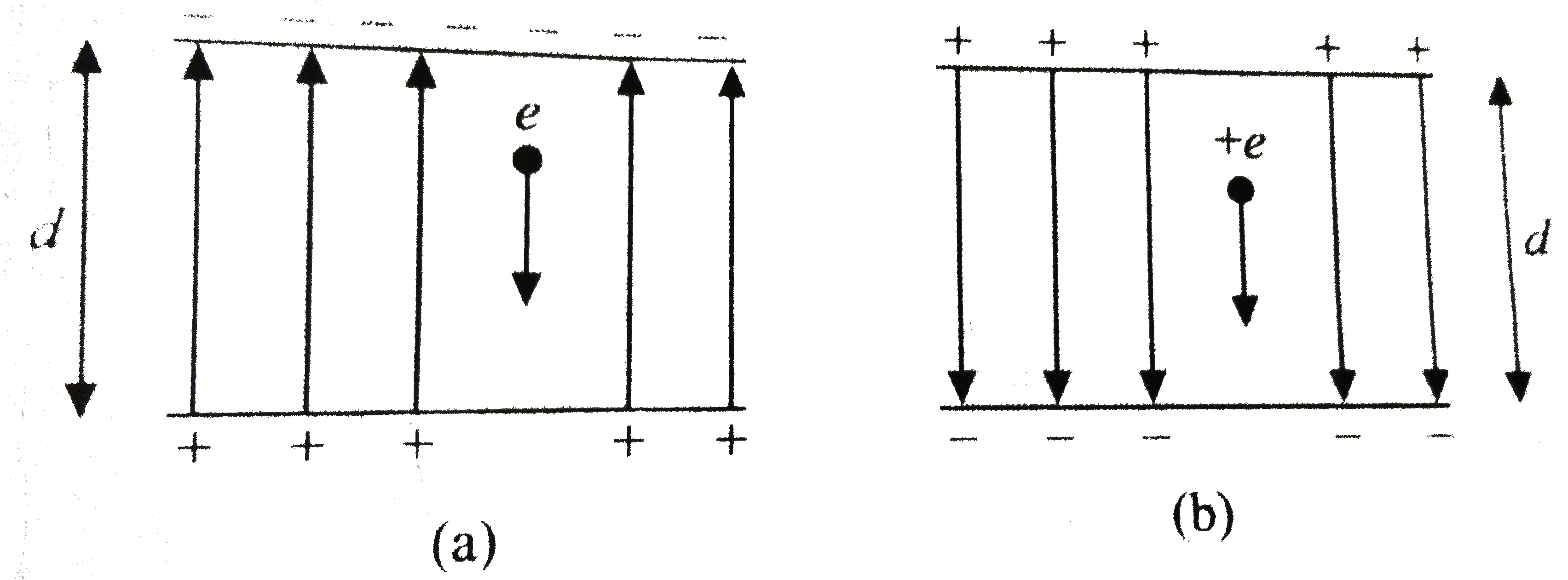
An electron (mass `m_(e )`)falls through a distance d in a uniform electric field of magnitude E.
,
The direction of the field is reversed keeping its magnitudes unchanged, and a proton(mass `m_(p)`) falls through the same distance. If the times taken by the electrons and the protons to fall the distance d is `t_("electron")` and `t_("proton")` respectively, then the ratio `t_("electron")//t_("proton")`.

A

1

B

`(m_p//m_e)^(1//2)`

C

`(m_e//m_p)^(1//2)`

D

1836

Text Solution

Verified by Experts

Let the distance to be traveled be `x`. Let the strength of uniform electric field be `E`. For the electron.
`u=0,S=x,a=(eF)/(m_(e)),t=t_(1)`
`S=ut+(1)/(2)at^(2)` or `x=(1)/(2)(eF)/(m_(e))xxt_(1)^(2)` (i)
For the proton,
`u=-0,s=x,a=(eF)/(mp),t=t_(1)`
`S=ut+(1)/(2)at^(2)` or `x=(1)/(2)(eF)/(m_(p))xxt_(2)^(2)` (ii)
From Eqs. (i) and (ii),
`(t_(2)^(2))/(t_(1)^(2))=(m_(p))/(m_(e))` or `(t_(2))/(t_(1))=[(m_(p))/(m_(e))]^(1//2)`
Promotional Banner

Topper's Solved these Questions

  • MISCELLANEOUS VOLUME 3

    CENGAGE PHYSICS|Exercise Multiple Correct Answer type|109 Videos
  • MISCELLANEOUS VOLUME 3

    CENGAGE PHYSICS|Exercise Assertion and Reason Type|8 Videos
  • MECHANICAL PROPERTIES OF SOLIDS

    CENGAGE PHYSICS|Exercise Question Bank|4 Videos
  • MISCELLANEOUS VOLUME 5

    CENGAGE PHYSICS|Exercise Integer|12 Videos

Similar Questions

Explore conceptually related problems

An electron falls through a small distance in a uniform electric field of magnitude 2xx10^(4)NC^(-1) . The direction of the field reversed keeping the magnitude unchanged and a proton falls through the same distance. The time of fall will be

An electron falls through a distance of 1.5 cm in a uniform electric field of magnitude 2.4xx10^(4) NC^(-1) [Fig.1.12 (a)] . The direction of the field is reversed keeping its magnitude unchagned and a proton falls through the same distance [Fig. 1.12 (b) ]. Complute the time of fall in each case. Contrast the situation (a) with that of free fall under gravity.

An electron falls from rest through a vertical distance h in a uniform and vertically upwards directed electric field E. The direction of electric field is now reversed , keeping its magnitude the same. A proton is allowed to fall from rest in it through the same vertical distance h. The time of fall of the electron, in comparison to the time of fall proton is

An electron initially at rest falls a distance of 1.5 cm in a uniform electric field of magnitude 2 xx10^(4) N//C . The time taken by the electron to fall this distance is

A proton falls dwon through a distance of 2 cm in a uniform electric field of magnitude 3.34xx10^(3) NC^(-1) . Determine (i) the acceleration of the electron (ii) the time taken by the proton to fall through the distance of 2 cm, and (iii) the direction of the electric field.

An electron and a proton travel through equal distances in the same uniform electric field E. Compare their time of travel. (Neglect gravity)

