Home
Class 12
PHYSICS
A spherical symmetric charge system is c...

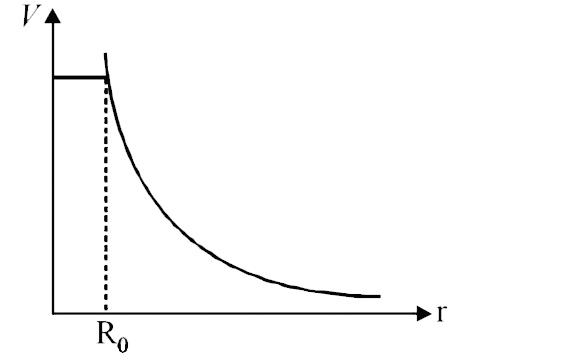
A spherical symmetric charge system is centered at origin. Given, Electric potential
`V=(Q)/(4piepsilon_0R_0)(rleR_0)`, `V=(Q)/(4piepsilon_0r)(rgtR_0)`

A

For spherical region `rleR_0`. Total electrostatic energy stored is zero.

B

Within `r = 2R_0`, total charge is Q.

C

There will be no charge anywhere except at ` r = R_0` .

D

Electric field is discontinuous at `r = R_0` .

Text Solution

Verified by Experts

For `rgtR_(0),E=(dphi)/(dr)=(Q)/(4piepsi_(0)r^(2))`
therefore, charge enclosed by concentric spherical surface at
r is
`2R_(0)=epsi_(0)phi_(E)4pir^(2)=epsi_(0)(Q)/(4piepsi_(0)r^(2))=Q`
For `rltR_(0),E=-(dV)/(dr)=0`
and for `rgtR_(0)E=-(dV)/(dr)=4piepsi_(0)r^(2)` (here `V=phi`)
Promotional Banner

Similar Questions

Explore conceptually related problems

For spherical symmetrical charge distribution, variation of electric potential with distance from centre is given in diagram Given that : V=(q)/(4pi epsilon_(0)R_(0)) for r le R_(0) and V=(q)/(4 piepsilon_(0)r) for r ge R_(0) Then which option (s) are correct : (1) Total charge within 2R_(0) is q (2) Total electrosstatic energy for r le R_(0) is non-zero (3) At r = R_(0) electric field is discontinuous (4) There will be no charge anywhere except at r lt R_(0)

The electrostatic potential (phi _r) of a spherical symmetric system , kept at origin is shown in the adhacent figure, and given as phi _e = q/( 4 pi varepsilon_0 r) (r le R_o) phi _e = q/( 4 pi varepsilon_0 R_o) (r le R_0) Which of the following option s in //are correct ?

A charge q = -2.0 muC is placed at origin. Find the electric field at (3 m, 4 m, 0) .

the following diagram represents a semi circular wire of linear charge density lambda=lambda_(0)sin theta where lambda_(0) is a positive constant.The electric potential at o is (take k=(1)/(4piepsilon_(0))

Find the dimensional formulae of the following quantities: (a) the charge Q (b) the permittivity of free space epsilon_(0) (c) the electric field E (d) the electric potential V (e) the capacitance C Q =It, F=(l)/(4piepsilon^(0)).(q_(1)q_(2))/(r^(2)),E=(F)/(q),V=(W)/(q)=CV where I : current, F: force, q : charge, r : distance and W : work.

The Bohr model for the H-atom relies on the Coulomb's law of electrostatics . Coulomb's law has not directly been varified for very short distances of the order of angstroms. Suppos-ing Coulomb's law between two oppsite charge +q_(1),-q_(2) is modified to |vec(F)|=(q_(1)q_(2))/((4piepsilon_(0))r^(2))1/r^(2),rgeR_(0) =(q_(1)q_(2))/((4piepsilon_(0))r^(2))1/R_(0)^(2)(R_(0)/r)^(epsilon), rleR_(0) Calculate in such a case , the ground state enenergy of H-atom , if epsilon 0.1,R_(0)=1Å

The electric field at point P due to a charged ball is given by E_(p)=(1)/( 4pi epsilon_(0))(q)/(r^(2)) To measure 'E' at point P, A test charge q_(0) is placed at point P and measure electric force F upon the test charge. Check whether (F)/(q_(0)) is equal to (1)/(4pi epsilon_(0))(q)/(r^(2)) or not .

A regular hexagon of side a has a charge Q at each vertex. Potential at the centres of hexagon is (k= (1/4piepsilon_0) )

